
Chickens
'Broiler' chickens (chickens raised for meat) are placed in
windowless sheds, on the floor or in cages.
In the shed, hundreds to tens of thousands of
chickens live amid toxic dust, feces, and fumes.
Inside the shed, all aspects of the chicken's environment
is controlled, from the lighting to the amount of food
and water
available, in order to make them grow faster on less feed.
These conditions cause outbreaks
of fighting, with birds pecking at each other's feathers and sometimes killing and eating each other.
In order to prevent such situations,
the farmer subjects the chickens to a painful process called
'debeaking,' in which a part of a chick's beak is cut off.

Laying hens are cramped into stacked cages about the size of a record album, with three to nine birds fighting for space.
A shed of laying hens may contain as many as a
quarter million birds or more.
The cages have a sloping wire floor, which makes
it uncomfortable for the hens to stand.
The wire floor often cuts the hens' deformed feet
and the skin frequently grows back around the metal wiring. Their wings are rubbed raw by the wire walls of the cage.
These beaten little birds lay almost an egg a day for
a year.
Then they are either killed and fed back to the flock,
sold as food, or are placed in a forced molt, which denies them all light, food, and water for one to two weeks, to get them to start laying again.
A third of the birds will not survive a forced molt.
Male chicks born to egg laying hens are of no use and
are discarded.
It is estimated that 380 million are thrown in
garbage bags to die, gassed, or worse, crushed or ground alive. 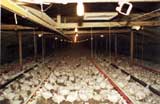
The natural lifespan of a chicken ranges from 7-20 years.
Laying hens survive for approximately 18 months and slaughtered
or shipped to rendering plants and trashed, and a broiler has but
seven weeks.
Onto Pig Treatment
Back
.