Official Thesis Abstract
and Acknowledgements Page
(plus List of Contents of my Thesis)
CLICK
HERE
………….To my mother and father
……………………To my wife Licia and children Brian and Scott
…………………………….. and the loveliest family in the world
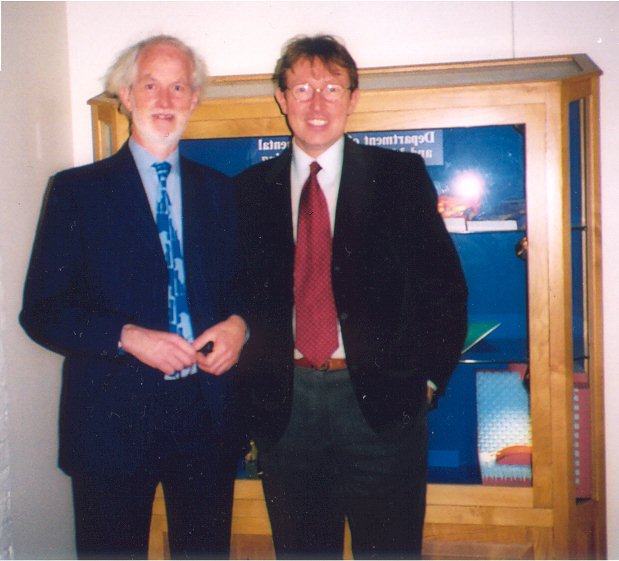
Many Thanks to Bill from the Department of Environmental and Mechanical
Engineering, The Open University, Miltom Keynes, UK

Acknowledgements
There is no doubt in my mind that my acknowledgements should start with
Fred Stave, a very rare species of man, who not only master minded the
Mass Transfer project at Whirlpool but inspired and indirectly coached
me towards my PhD. He has left a tough role model that I will endeavour
to emulate to the best of my ability. I will be indebted to Fred for the
rest of my life.
Claudio Danelli facilitated matters by joining forces with Fred and
allowing me to start my research while under his charge at Whirlpool. This
noble act was carried on by Marco Poma, whom I am not only grateful for
sharing a common vision in personal development but who has revealed numerous
other features that who knows how long it will take me to truly understand
and apply. Of equal standing is my present boss, Adriano Scaburri, who
understood that I was walking a tight rope by combining academic expectations
and job milestones, especially in my final year, and let me get on with
the job.
A big thank you to Alex, a long standing friend and he who refereed
my original application to the OU at the beginning of 1997, an academic
I will strive to match and exceed.
And how could I repay the work of Daniele, Marco and Elio?, three undergraduate
students who will no doubt make their mark as time goes by. Daniele laid
the foundation stone for the early part of the research and has been justly
rewarded with the opportunity to do research himself. Good luck.
Marco, continued this excellent early work, not an easy task by all
means, and provided me not only with the fuel to persist and attempt the
unfeasible but co-generated the sphere idea. I still remember the day this
idea was born, a wonderful sensation, full of risk but so rich in potential
that we just couldn't resist the temptation. Marco was also my first stager
and provided me with a unique mix of tutorship and friendship, may this
last forever.
And what may I say about Elio? not only was he propelled into the most
difficult of tasks, the testing of the sphere, but was a true example of
patience. He followed my guidelines and advice through thick and thin,
and transformed the sphere idea into reality.
Dan, the "big" man, must figure along side Mark as being the drill
behind the M.T. project and to whom my most sincere "all the best" is consigned
for the future. Maybe we haven't re-invented the wheel but our work will
make things easier for future researchers.
Marco, Giovanni, Samuele and Domenico, all dear colleagues from the
model shop along with Sig. Milani and Sig. Colombo at the Politecnico,
were the men behind the scenes. These were the people that made the experimentation
particularly gratifying and fruitful. And what may I say about Ivano and
Patrizia?, two people grossly undervalued yet always willing to help me,
whatever the price. To all these associates may God help me to repay the
immense arrears I have with them.
So on to Bill. There have been a lot of 'first times', 'ifs', 'buts'
in my research so Bill must have been quite perplexed when I called him
to speak about my plans to do a PhD way back in 1997. From that simple
phone call all of what is in my thesis was born. Bill has always been there
to listen, providing me with simple but fundamental advice. The OU should
be proud of Bill, a shining example and typical of the OU.
So here I am with the most difficult of closures, thanking Giovanni
from start to finish for his backing and involvement in my research that
is not only mandatory but above all, a pleasure. Thank you also for believing
in me and making my path easier. Perhaps it is too unpretentious but my
immediate thoughts are to wish Giovanni the very best for the future and
hope that my academic contribution has given him the same satisfaction
and proudness that it has given me.
Hydrodynamic Effects on Soiled Surfaces
- An Experimental Study and Theoretical Analysis
-
This thesis presents the findings of an investigation aimed at understanding
the effects of hydrodynamic shear stress on soil removal from textile surfaces
both inside the washing machine and in closely controlled laboratory conditions.
The research has involved developing a technique for the indirect measurement
of shear stress based on pressure recordings and small block probes that
provide both an indication of shear stress magnitude and direction. The
probes have been investigated and calibrated in a purpose-built, rectangular-section,
water tunnel in which tests were also carried out on specially prepared
soiled cotton textile samples. This has allowed the correlation between
shear stress and soil removal efficiency for 15k<Re<155k. A more
general investigation involving the washing machine has also been carried
out so as to quantify and compare the effects of detergency, water temperature,
time, abrasion, warping and tangential shear force.
The hydrodynamic conditions inside the washing machine were investigated
providing insight into flow conditions both on the inside and outside of
the wash load. This was achieved through the use of a wireless device in
the form of a sphere with an on-board pressure-flow sensor and radio transmitter
for remote monitoring via radio. This remote data acquisition system was
designed, developed and patented by the author. A model of the wash load
motion has also been developed and high speed filming techniques employed
to qualify and quantify the wash load dynamics.
The main outcome of the research may be summarised as follows:
-
Hydrodynamic shear stress up to 7.7Pa circa (15k<Re<155k) is inadequate
to remove soil from the standard EMPA textile surfaces.
-
Only 10-15% of the soil removed in the washing machines can be attributed
to abrasion, warping (due to churning) and hydrodynamic shear stress, the
rest is attributed to detergency and heat transfer.
-
There are at least two different flow domains within a horizontal-axis
washing machine, one on the inside of the wash load and one on the outside.
-
Flow conditions on both the inside and outside are turbulent and velocities
up to several meters per second have been recorded.
Thesis List of Contents (Double line spacing version)
| Chapter 1 |
Introduction |
pages 2-13 |
| Chapter 2 |
Overview of Research |
pages 14-24 |
| Chapter 3 |
Development of Prototypes |
pages 25-79 |
| Chapter 4 |
Literature Reviews |
pages 80-100 |
| Chapter 5a |
The Measurement and Determination of Shear Stress Magnitude |
pages 101-149 |
| Chapter 5b |
The Measurement and Determination of Shear Stress Direction |
pages 150-178 |
| Chapter 5c |
Conditioning Effects of Hydrodynamic Shear Stress on Soil Removal |
pages 179-213 |
| Chapter 5d |
The Measurement of External Wash Load Hydrodynamic Conditions |
pages 214-230 |
| Chapter 5e |
The Measurement of Internal Wash Load Hydrodynamic Conditions |
pages 231-280 |
| Chapter 6 |
Research Steps and Additional Washing Machine Experimental Results |
pages 281-342 |
| Chapter 7 |
Round-up of Results, Findings and Next Steps |
pages 343-350 |
| Chapter 8 |
Appendices |
pages 351-369 |
CLICK
HERE