• Page 2 - More About My Research
  • @ More about the boundary layer
    @ Some of the benefits of my research


    If you are interested in more info.

    go to the next page.CLICK HERE
    What is a Boundary Layer?
    If you have ever been caught outdoors with the wind blowing in your face then you know that crouching down or better still, lying flat,  reduces the wind force imparted on your body. In other words as you get closer to the ground the (hydrodynamic) force decreases and the wind (air) flows more  smoothly over your body. You are essentially reducing the drag force on your body.
    Incidentally this is one reason why cars, aeroplanes etc. have a smooth rounded ("crouched") shape, it is not just a designers fling, it's based on science!
    If you get right next to the ground you will find that the wind speed is zero at the ground  surface  known as the wall surface. As the fluid (air) is at rest and 'sticking' to the wall  it is often known as the "no-slip condition". This is where and when the boundary layer starts. 
    Hence as you are come away from the ground level you will gradually see (or feel) an increase in wind speed, when this speed reaches 99% of the nominal wind speed the boundary layer ceases to exist and one speaks of the free stream condition.
    Summarising the boundary layer is that area of fluid (e.g. air, water etc.) where the speed of the fluid (e.g. the wind) is blow 99% of the nominal  (freestream) fluid speed.

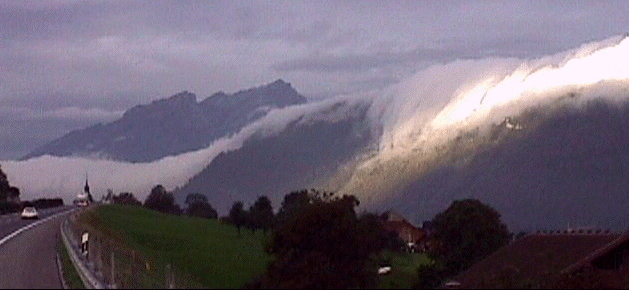
    Boundary layers occur whenever fluids flow across surfaces including the cloud clinging to mountain sides as shown in the picture below. In this case air is flowing against the mountain side and the clouds are clinging to the mountain face (wall).

    This picture was taken on the motorway going to Zurich in Nov.1999


    Is this Research useful for mankind and if so, why?
    Well, of course it is. As I mentioned on the first page it is worth a considerable among of money and don't forget that shear stress can save you from a heart attack!.
    I am particularly interested in understanding the effects of soil removal from textiles under hydrodynamic shear stress: especially what happens during garment cleaning in domestic washing machines. Today's worldwide washing machine market is worth billions of dollars, going from machines to soap powder. Remember the advert???? "My whites are whiter than your whites!". Ever wondered why washing machines haven't changed for the last century?? read-on.

    Buit the research is not just tied to soil removal from garments as it has several outcomes including;
     

    1. Shear stress measurement in air and water flows: Essential to understand flows in river beds, design of aeroplane wings, bridge pillars etc.
    1. Soil removal from rigid, semi-rigid and flexible surfaces under pure shear: - Essential to quantify the role of hydrodynamic forces on soil detachment from surfaces (both solid and flexible surfaces). This is particular important for nano technology e.g. 3D microprocessors, micro-machines, and sensors.
    1. Measurement of flow domains inside mixing drums:  Essential for understanding how machine and mixing-cleaning processes are linked.
    1. Remote measurement of washing process parameters: Essential for the monitoring of washing processes via radio or wireless connections
    1. Coronary research: By-pass operations and other heart surgery will be revolutionised over the coming decade as new knowledge is added to understanding artery routing and section are understood.
    Clearly there are many more aspects that I won't go into right now but you will see as this website grows.
    If you are interested in more info.
    go to the next page.CLICK HERE


    Hosted by www.Geocities.ws

    1