I have recently become interested in geode collecting. I have
several interesting geodes shown here.
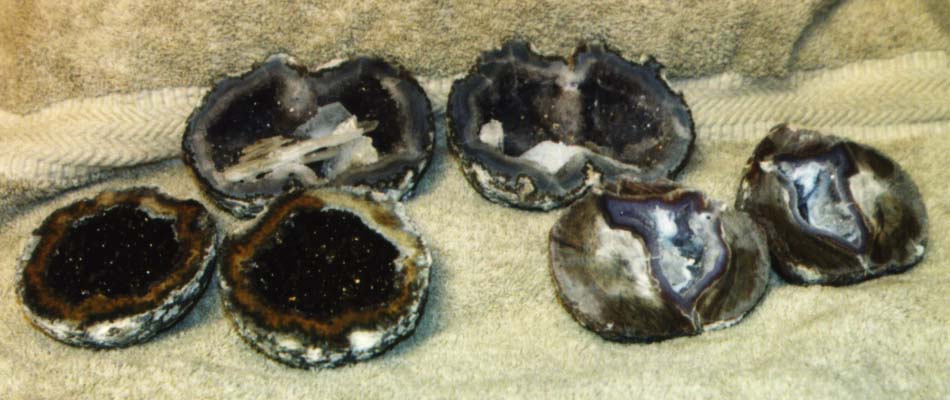
Single-node Mexican Coconut.
Mexican coconuts are from the state of Chihuahua in Mexico. Found
hundreds of feet deep in a valley buried under volcanic ash 65,000,000
years ago, gas bubbles trapped in the ash and washed by hot silica-rich
water became geodes over time. The acidic solution mixed with impurities
such as iron, manganese and other minerals. After millions of years
of heat and pressure, the bubbles took on a concentric blue-white banding
around the interior wall of stone. Inside would form clear, amethyst
or smoky quartz crystals, sometimes with formations of calcite crystals
or other minerals.
This geode has very dark smoky quartz crystals, with golden calcite
highlights and goethite needles. The needles are very fragile.
The perimeter is brown limonite.
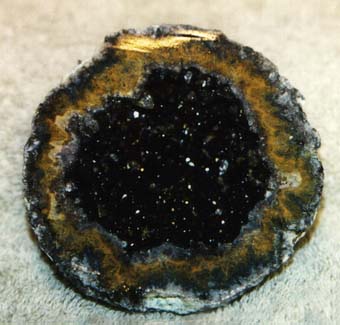
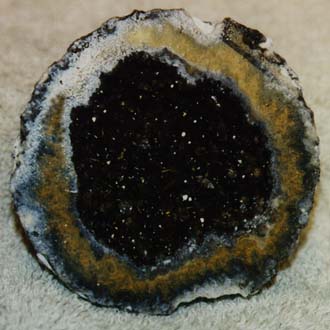
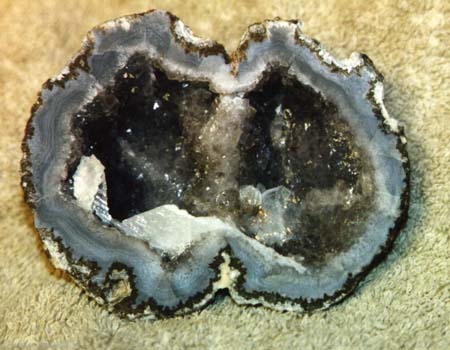
Double-node Mexican Coconut.
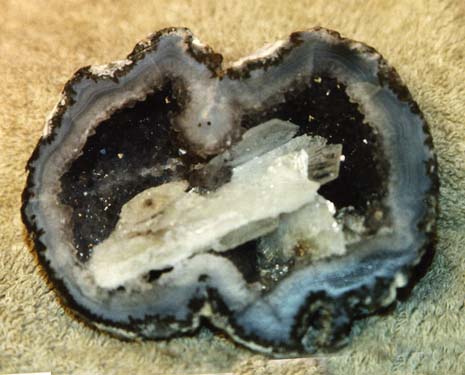
This two-scoop geode formed from two touching bubbles. The quartz
crystals are amethyst and light smoky. The perimeter is a beautiful
blue chatoyant. Inside are golden calcites, and the most obvious
feature, blade-angel wing. This blade-like white crystal structure
was cut when the geode was cut open, so part can be found in each half.
Dugway geode.
This geode is from the Dugway
geode beds near the Dugway Mountains in Utah, within sight of the Bonneville
salt flats. Dugway Geodes are the legacy of Tertiary vulcanism in
Western Utah. Gas bubbles in volcanic rhyolite silicified and filled with
agate and quartz crystals during the 40-50 million years since the volcanos.
The right half has a window in the back. Both halves have beautiful
fine-grained blue stone surrounding a small cavity with several types of
white calcites in crystalline formations. The surrounding stone looks
almost like wood-grain, with gorgeous brown coloration.
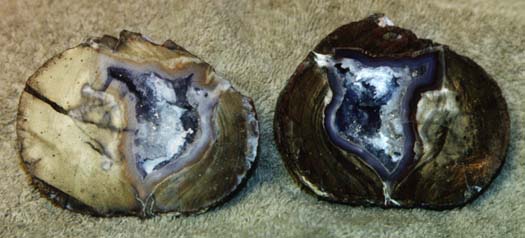
None of these geodes have polished cuts. The cut edges were wet
when photographed to better display their colors. If properly polished
these would all be much more spectacular.
All of these geodes are available for the right offer. Larger,
higher-resolution versions of these images are available upon request.
The high-res images better display the unusual features like goethite needles.
They also reveal how much I need to learn about macro-photography. :-)