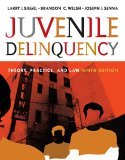
| University of La Verne Course Syllabus SOC 321: Juvenile Delinquency (4 SH) Prerequisite: SOC 250 Professor Sharon K. Davis, Ph.D. Office: Hoover Building 107 Phone: (909) 593-3511, x4171 Email: [email protected] or [email protected] FAX: (909) 392-2745 Course Description Welcome! This course is designed to increase your awareness and understanding of Juvenile Delinquency as it exists in our society today. Specifically the course will provide: an overview of the major social factors associated with delinquency including familial, peer, social class (SES), drug and educational influences. an exposure to various theoretical perspectives that have been used in explaining, understanding and predicting delinquent behavior. an historical grounding of present day societal definitions of, attitudes toward and reactions to juvenile delinquency as well as current trends in treatment. The focus of the course is on the theoretical, empirical, and applied aspects of juvenile delinquency primarily in the United States today. Course Requirements Weekly Assignments: There are ten weekly written assignments in this course in lieu of a term paper. They consist of five questions from each assigned chapter. Answers to these questions for each week should be turned in each Sunday by midnight. Beginning with the first week, you will receive constructive feedback on your answers periodically. Exams: There will be two exams, a midterm and a final, consisting of multiple choice questions, true false questions, definitions, and short answer essay questions from your text and from Monster. Each exam covers approximately one-half of the course material. The scheduled dates for each exam is listed in your schedule of readings. You must arrange to take your exams with a proctor. Exams are non-cumulative in their content. Make up exams are strongly discouraged. Similarly, incomplete grades at the end of the course are also strongly discouraged. Incomplete grades are an option only if you have satisfactorily completed one-half of all graded assignments. Practice Exams: To encourage your timely reading of the assigned chapters and successful performance on the midterm and final, an online practice exam will be posted a week prior to each exam. Final Grades: Final grades are determined on the basis of cumulative points. The percentage breakdown of your grade will be as follows: 33% Exam 1 (Midterm) 33% Exam 2 (Final Exam) 33% Weekly Assignments (10) 1% Timely submission of assignments and exams 100% Course Grade Academic Integrity It is expected that you will maintain a standard of academic integrity at all times. This means that you do your own work on exams and weekly assignments. You must give credit to persons whose ideas you present through proper citations and references. Failure to do so may result in no credit given you for the assignment or the class. The university catalog states, �each student is responsible for performing academic tasks in such a way that honesty is not in question. The use of wording, ideas, or findings of other persons, writers, or researchers requires the explicit citation of the source; use of the exact wording requires a quotation format.� Please paraphrase other people�s ideas using your own words whenever possible for best results and identify original authors when appropriate. Writing Standards The standards for writing in this course include: Content: Completed all parts of assignment Developed thoughtfully with appropriate support for ideas Synthesized/evaluated appropriate materials Original/appropriate approach�clear thesis Organization: Logical plan Appropriate order of ideas Appropriate beginning and conclusion Appropriate cohesion/progression of ideas/transitions Form/Mechanics/Surface Correct language control No grammatical or sentence errors No spelling/punctuation/capitalization errors Correct idiom/word usage Followed assignment format standards (APA) You are encouraged to think; examine your prejudices, process new information, integrate it with your own experiences and prior knowledge, and arrive at a new awareness of and well reasoned opinions about juvenile delinquency. Required Readings Siegel, Larry J., Welsh, Brandon C., & Senna, Joseph J. (2006). Juvenile Delinquency: Theory, Practice and Law. Ninth Edition. St. Paul, MN: West Publishing Co. Shakur, Sanyika. (1993). Monster: The Autobiography of an L.A. Gang Member. New York: Penguin Books. Recommended Readings (if you find you enjoy reading and learning about Juvenile Delinquency, try some of these books later, in your spare time) Bing, Leon. (1991). Do or Die. New York: Harper Perennial. Flowers, R. Barri. (2003). Kids Who Commit Adult Crimes: Serious Criminality by Juvenile Offenders. New York: The Haworth Press. Fremon, Celeste. (1995). Father Greg & the Homeboys: The Extraordinary Journey of Father Greg Boyle and His Work with the Latino Gangs of East L.A. New York: Hyperion. Huff, C. Ronald. (Ed.). (2002). Gangs in America. Thousand Oaks, CA: Sage Publications. Humes, Edward. (1997). No Matter How Loud I Shout: A Year In the Life of Juvenile Court. New York: Touchstone. Kotlowitz, Alex. (1991). There Are No Children Here. New York: Anchor Books. O�Donnell, Clifford R. & Ferrari, Joseph R. (Eds.) (2003). Culture, Peers, and Delinquency. New York: The Haworth Press. Sanders, William B. (1994). Gangbangs and Drive-Bys: Grounded Culture and Juvenile Gang Violence. New York: Aldine DeGruyter. Sipchen, Bob. (1993). Baby Insane and the Buddah: How a Crip & a Cop Joined Forces to Shut Down a Street Gang. New York: Doubleday. Course Outline and Assignments The schedule of readings follows. The assignments are a general guide to topics that will be covered in course. Stay with the schedule; please keep your reading current. The course syllabus may be adjusted or modified, as needed, by the professor. Welcome to SOC 321: Juvenile Delinquency!! |
 |
 |