| Notes on Costa Rica continued... Traffic and addresses |
| Traffic as the soul of a country Let�s play contrast and compare. Bermuda: Pedestrians rule. Cars seem to compete on who can come to the most complete stop in front of a crosswalk with a pedestrian in it. This in a country with a national speed limit of 20 mph. Where grownups grumble when hell-raising teenagers blow by on their motorbikes at all of 30 mph. Costa Rica: ALTO does not mean STOP when written on a street sign. Instead it translates roughly to: Velocidad Minimo = 30 mph. And in really small letters it must say: �Please accelerate in the presence of pedestrians�. Bermuda: I have never once heard anyone blow their car horn at someone else in anger. Ever. But maybe when you snap, you snap. Front page news in the Bermuda Gazette recently when an American tourist kid on a rental moped gave the finger to a Bermudian woman driving a car whom he thought cut him off. Seems she was so infuriated that she didn�t know what to do, so she ran him down. He�s ok, but a bit surprised that the public sentiment is against HIM. Costa Rica: I have never once been on the street where people are not honking their horn. Usually at pedestrians. True: the town of Heredia has three nicknames. �Ciudad de las Universidads� (3 schools in a fairly small neighborhood). �Ciudad de las flores.� (in praise of the beautiful women here). And �Ciudad de peatons en el medio.� No kidding. �City of the pedestrians in the middle of the street.� It�s because the drivers won�t let pedestrians get all the way to the other side. Crossing the street in Heredia becomes fun when you realize it is simply samba dancing without the music. �Left foot back, right foot back. Spin. Twist. Three steps forward.� The only sane way to cross the street is to use cars going in your direction as interference. But it means you have to run across the street at the same speed as your blocking car. So people wait on the curb, bunching up, til a slow car comes along, and then they all sprint across the street alongside it, hoping to make the opposite sidewalk before cross traffic catches them exposed. I saw a grandmother with a cane crossing in front of a bus. It became obvious she was not going to make it. So like that poor guy in Tieneman Square, she turned face on to the bus, raised her cane and dared the guy to hit her. He didn�t stop, but squeezed to the side of the street and passed her. Everyone saved face. The yin to this yang is that Costa Ricans are just as relaxed as Bermudians, but in their own way. They wouldn�t run down the American kid for giving them the finger, they would hit him because he was in their way. Nothing personal. |
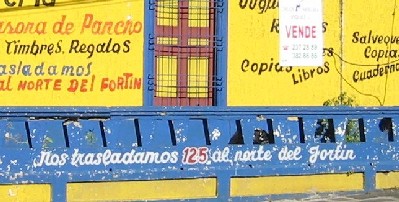
| Addresses in Costa Rica: an introduction Two million or more people in Costa Rica. Perhaps a half million households. And none of them have addresses. Instead of street addresses, like �23 Harbour Road�, they give directions from a landmark. Using points of the compass and meters. Dona Elba�s house address is �la casa amarilla, 375 metros al Norte de los Bomberos� or �375 meters north of the Fire Station�. The confusion starts when there are two fire stations. In really congested areas they don�t bother you with meters. My Spanish lessons are at �C Ctl y 1 a 6� or: �Sixth Avenue between Central and First Streets�. You can try this at home: go to Yahoo and get the address of the Gran Hotel Costa Rica. It is a landmark, on the central square about 20 meters northeast of the Teatro Nacional. How do I know? Because its address in the phonebook is: �20 m NE Teatro Nacional, San Jose, CR. Dropping off my laundry this morning, I was given a choice between two lavandarias. One�s address is �350 metros west of the government building�. The other, �75 metros este del Banco San Jose�. Which one is closer? I did the simple and asked a guy on the street where government house was and where the bank was, and started pacing off metros. As I was walking along counting, I realized it was really no different than the description that is on the deed to my house in Rowayton. �Starting at the northeast corner of the property once owned by Samuel Bryan extending 52 feet Northeast to Meadowood Road, then�� Samuel Bryan has been dead for decades and Meadowood Road never actually became a paved road, but I know where my house is. I met an expat househusband here. He spoke no Spanish for the first couple of months as he watched his kids during the workday. He said it was creepy how every day various people would knock on his door, ask him some kind of question in Spanish and when it became obvious he couldn�t understand, they would leave in a huff. After taking lessons for a little while, he finally figured out that they were looking for various houses, and wanted to know how many meters they had walked from the public park. He�s thinking of painting his meters count on his house for these people. I�m not sure, though. There has to be some reason, cultural, political, practical, aesthetic, that has kept his neighbors and his neighbors� neighbors from putting their street number up. I�ve seen only one building with its numbers on it. And it was out of business. |
 |
| But after all that, Costa Ricans finish with a nice touch. After telling you that the best way to mail them a letter is, in effect, to tell the mailman to take a left at the bank and go a hundred yards to their house, and including the town, for example Heredia, and of course, their country, Costa Rica, they put it all in context. They finish with �Centroamerica�. It�s like one of those letters little kids write to Santa Claus with the return address of �136 Harbor Street, Branford, Connecticut, USA, North America, Earth, Solar System, Milky Way Galaxy�. Costaricenses are saying, hey, we may have a crazy address system, but if you get the letter to the right subcontinent, we�ll take it from there. |