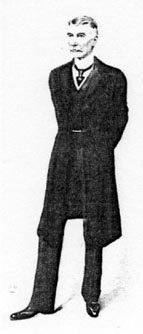
General Fredrick Forestier-Walker, c.1902
Vanity Fair Magazine
Portrait painted by "Spy"
The General wears a double breasted dark frock coat with wide lapels faced with silk; his waistcoat is single breasted and has a white slip visible at the top edge; the trousers are grey striped. His shirt has a high stiff collar and he wears a long knotted tie.
In the later Victorian period the forck coat was the usual formal day wear for gentlemen but by the early 20th c. it was becoming less common but still correct.
The General wears a jeweled pin just below the knot of his tie and a watch chain across the front of his waist coat.
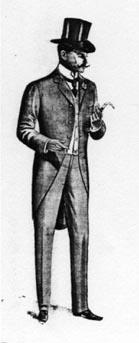
Morning Suit Mens Day Suit,c.1900
from The Tailor and the Cutter
The gentleman wears a single breasted morning coat that slopes at the sides to form tails in the back. The waist coat is single breasted and the narrow trousers are cut long (to break over the shoe). The shirt has a high starched ,"wing" or "butterfly" collar and the neccktie is long and knotted.
The hair is cut short and close to the head. Facial hair is going out of fashion but some men still wear mustaches. Side burns are no longer seen.His shoes are narrow , laced and have pointed toes. He wears a boutineir in his lapel and carries a walking cane or folded umbrella and gloves.
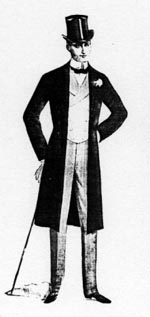
Frock Coat, Mens Formal Day Suit, c.1900
from The Tailor and Cutter
The dark double-breasted frock coat is knee lenth, with staight front edges, and long lapels. It is worn with a double breasted waist coat with a deep shawl collar, and light colored trousers. The shirt has a high , stiff, "double or turned over collar and a narrow bow tie.
The gentleman wears a formal top hat and a boutineir in his lapel. He is clean shaven as was then high fashion.He carries a walking cane. He carried gloves in his right hand.He wears laced shoes with pointed toes.
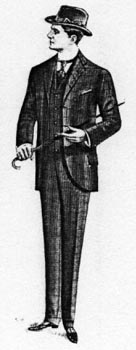
Lounge Suit, Informal Day Suit, c.1900 from The Tailor and The Cutter
The lounge suit has a short single-breasted jacket, single-breasted waist coat and trousers to match, with starched wing collar and long knotted tie. After the 1890's the center crease in the trouser leg became usual.
The gentleman wears a Homburg(a soft felt hat with ribbon-bound brim) He wears gloves and carries a walking cane. In his front jacket breast pocket is a folded handkerchief. His laced shoes are narrow and have pointed toes.
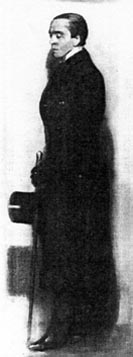
Sir Max Beerbohm,1905
Max Beerbohm (1872-1956), the auther and cartoonist was a notes dandy and one of the few men to praise the costume of his day. He commended " Its sombre delicacy, it's congruities of black, white and grey and the way it produced a supreme effect through means the least extravagant."
He wears a long, fitted, Chesterfield overcoat in dark cloth. His shirt collar is high and stiff.
His hair is short and very neat, being smoothed flat over the crown.
He carried a hop and walking stick and is wears gloves.
This picture is elegant in the shading and simplicity even though it is too dark to tell much about the clothing itself. It is an excellant example for mens hair style of 1905.
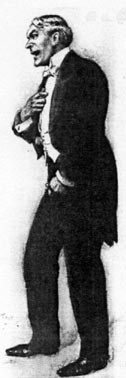
Sir George Alexander,c 1909
The famous actor/manager is portrayed in formal evening dress. He wears an evening suit with a cut in tail coat or dress coat with matching trousers of fine, black wool cloth, with a white waist coat. The dress coat is cut away in a horizontal line across the waist ( as opposed to sloping back at the sides as in the swallow tailed morning coat). A white waist coat was now customary with the dress suit rather than the black one perfered in the victorian period. A white shirt with starched front, stiff wing collar and white bow tie were correct accessories to formal dress. Links fastiening his shirt cuffs are also visible at his wrists.
His hair is a little longer than was conventional at this date but would have been acceptable in view of the artistic nature of his profession.
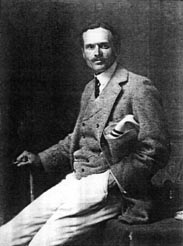
Horace Annesley Vachell, c.1910
Horace Annesley Vachel l(1861-1955) was the author of over 50 novels and 14 plays. He is dressed here in informal summer clothes.
Vachell's suit consists of a matching lounge jacket and double-breasted waistcoat in a light, textured tweed, worn with white trousers. His shirt has a starched turned down collar and he wears a dark narrow, knotted tie.
Under one arm he holds a soft, light Panama hat with striped silk hat band( a style wich was replacing the boater for summer wear); the other hand, holding a cigarette, rests on a walking stick. A watch chain is worn across his waistcoat.
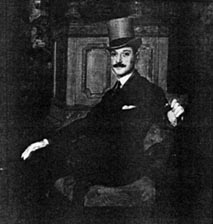
The Jester(William Somerset Maugham), c. 1911
painted by G.Kelly
One of the many portraits Kelly painted of the writer William Somerset Maugham(1874-1965).He is portrayed here as an elegant figure, formally dressed, in an opulant setting.
Maugham is dressed in a dark morning suit with a white stiffened, turned down collar and dark tie.
His hair is bery neatly trimmed and hardly visible beneath his grey top hat. He wears a thick moustache.
There is a white handkerchief in the breast pocket of his coat and he wears light colored gloves. His laced shoes are of plain black leather. He holds a wlaking stick with crook handle.
Return Home.
Updated March 21, 2001
� Copyright by Davide LeMoyne 1998,1999,2000,2001

