II. Plot
Submission:
Assignments must be done in Microsoft Word. Combine the writing assignments for this
section in single document titled “Plot.”
Include your name, class, and Course ID in the paper heading. Save the document
as Plot + Your Last Name. Then e-mail the assignments as an attachment to [email protected]
.
Plot Structure
Assignment 1:
Read “Plot” in The Bedford Introduction to Literature, pages
64-65.
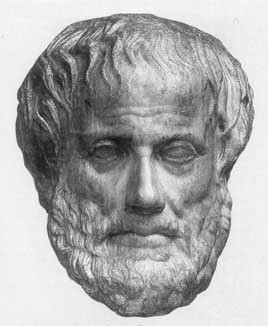
Meyer defines plot as not just the “arrangement of incidents,” in a work of fiction, but “the organizing principle that controls the order of events” (Meyer 64). Meyer agrees with Aristotle who discusses the nature of plot in The Poetics. (See http://classics.mit.edu/Aristotle/poetics.1.1.html for the complete text.) In the following passage, Aristotle tells us that the plot must have a beginning, middle, and end that are logically connected.
 Now, according to our definition Tragedy is an imitation of an action that is complete, and whole, and of a certain magnitude; for there may be a whole that is wanting in magnitude. A whole is that which has a beginning, a middle, and an end. A beginning is that which does not itself follow anything by causal necessity, but after which something
naturally is or comes to be. An end, on the contrary, is that
which itself naturally follows some other thing, either by
necessity, or as a rule, but has nothing following it. A middle
is that which follows something as some other thing follows it.
A well constructed plot, therefore, must neither begin nor end
at haphazard, but conform to these principles. (Aristotle Part VII)
Now, according to our definition Tragedy is an imitation of an action that is complete, and whole, and of a certain magnitude; for there may be a whole that is wanting in magnitude. A whole is that which has a beginning, a middle, and an end. A beginning is that which does not itself follow anything by causal necessity, but after which something
naturally is or comes to be. An end, on the contrary, is that
which itself naturally follows some other thing, either by
necessity, or as a rule, but has nothing following it. A middle
is that which follows something as some other thing follows it.
A well constructed plot, therefore, must neither begin nor end
at haphazard, but conform to these principles. (Aristotle Part VII)
Aristotle also says that the unity of the plot is based on action not character. He cites Homer’s Odyssey as an example of a work that has a unified plot.
Unity of plot does not, as some persons think, consist in the unity of the hero. For infinitely various are the incidents in one man's life which cannot be reduced to unity; and so, too, there are many actions of one man out of which we cannot make one action. Hence the error, as it appears, of all poets who have composed a Heracleid, a Theseid, or other poems of the kind. They imagine that as Heracles was one man, the story of Heracles must also be a unity. But Homer, as in all else he is of surpassing merit, here too- whether from art or natural genius- seems to have happily discerned the truth. In composing the Odyssey he did not include all the adventures of Odysseus- such as his wound on Parnassus, or his feigned madness at the mustering of the host- incidents between which there was no necessary or probable connection: but he made the Odyssey, and likewise the Iliad, to center round an action that in our sense of the word is one. As therefore, in the other imitative arts, the imitation is one when the object imitated is one, so the plot, being an imitation of an action, must imitate one action and that a whole, the structural union of the parts being such that, if any one of them is displaced or removed, the whole will be disjointed and disturbed. For a thing whose presence or absence makes no visible difference, is not an organic part of the whole. (Aristotle Part VIII).
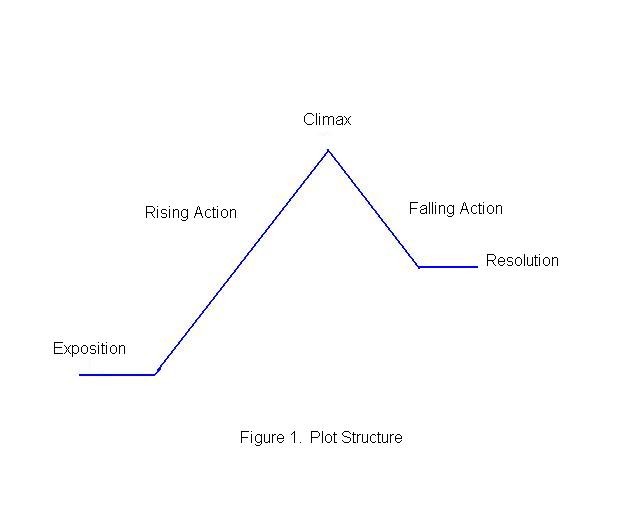
Plot can be broken down into smaller elements that describe the action in a specific part of the plot. (See Figure 1. Plot Structure)
- Exposition – the introductory material that creates the tone, gives the setting, introduces the characters, and supplies other facts necessary to understanding.
- Complication or Conflict – the struggle that grows out of the interplay of opposing forces. It provides interest, suspense, and tension. At least one of the opposing forces is customarily a person. This person, usually the protagonist, may be involved in conflicts in a number of different kinds:
- a struggle against nature
- a struggle against another person, usually the antagonist
- a struggle against society
- a struggle for mastery by two elements within the person
- the struggle against Fate or Destiny
- Rising Action – that part of the plot in which the entanglement caused by the conflict of opposing forces is developed. It is the tying of the knot to be untied in the resolution.
- Climax – the highest point of dramatic action where the reader makes the greatest emotional response. It is the turning point in the action, the crisis at which the rising action reverses and becomes the falling action.
- Denouement or Resolution – literally, “unknotting”. The final unraveling of a plot; the solution or outcome. It is usually an ingenious untying of the knot of an intrigue, involving not only a satisfactory outcome of the main situation but an explanation of all the secrets and misunderstandings connected with the plot’s complication.
In the exposition of “The Story of an Hour,” we are introduced to Mrs. Mallard, who is a woman “Afflicted with a heart trouble” (Chopin 13). The conflict arises out of the news of her husband’s death in a train wreck. Her immediate reaction is unusual. Instead of being paralyzed by the “inability to accept its significance,” (13), Mrs. Mallard “wept at once, with sudden wild abandonment” (13). The conflict begins to develop when she goes to her room alone but instead of continuing to cry, she stares out her window at the beautiful spring day with a glance that “indicated a suspension of intelligent thought” (13). Here the conflict intensifies. “There was something coming to her and she was waiting for it, fearfully” (13). As she begins to recognize what it is, “Her bosom rose and fell tumultuously,” (13) and she tries to “beat it back with her will” (13). She is unable to stop it from coming, and when she “abandoned herself a little whispered word escaped from her slightly parted lips. She said it over and over again under her breath: ‘free, free, free!’” (13) It is at this point that the plot reaches its greatest intensity – Mrs. Mallard’s awakening to her own freedom. She sees beyond her grief to “a long procession of years to come that would belong to her absolutely” (13). She would be able to “live for herself” (13) without “a powerful will bending hers in that blind persistence with which men and women believe they have a right to impose a private will upon a fellow-creature” (13). For Mrs. Mallard, love was not as important as “self-assertion” (14). The climax of the story, however, occurs when Mr. Mallard returns unexpectedly, and Mrs. Mallard dies instantly. Here we realize not only the intensity but the depth of her feeling. The resolution has a twist of bitter irony. The doctors attribute her death to “the joy that kills” (14). Brently Mallard, her sister Josephine, nor Mr. Richards will ever know the truth.
Aristotle saw plot as the central unifying element in fiction. However, modern critics and writers might disagree. Ask yourself whether events cause people to behave in certain ways or whether people cause events to happen? What causes Louise Mallard’s death - Brently Mallard’s return or Louise’s vision of freedom? Further, ask yourself whether events would occur or people would behave in certain ways at different periods in history or in different social settings. Would Louise Mallard have died if divorce was socially acceptable in the late 1800’s? In reality plot, character, and setting are closely related and interdependent. Nathaniel Hawthorne might have said that they are “inextricably intertwined.” We examine elements of fiction separately for the purposes of analysis, but we should understand that they are not separate in reality.
The plot structure described above may be used as a model that we can use for purposes of comparison. The plot structures of “The Story of an Hour,” The Secret Sorrow, and “The Sorrowful Woman” might fall neatly into this pattern, but the plots of “A Rose for Emily” and “The Lady with the Pet Dog” by Joyce Carol Oates do not. However, examining these stories to determine how and why they differ may help us to develop a deeper understanding of them.
Chronological Order
Another approach to analyzing plot is to examine the way the events take place in time. Many stories, novels, and plays are organized in chronological order. They begin at some point in the past and move forward to the present. “The Story of an Hour” takes place over the period of an hour. Mrs. Mallard learns of her husband’s death, goes to her room where she grieves, her grief leads to an awakening, her husband returns, and she dies of “heart problems.” There are no breaks in time in the story, a fact that intensifies the action and helps to create the feeling of shock we experience. The Chapter Eleven from The Secret Sorrow focuses on the events of one evening, and Chapter Twelve compresses a number of years into a few paragraphs. Karen van der Zee uses time to show us the lasting happiness that resulted from the events that almost lead to the break down of Faye and Kai’s relationship. In the “The Sorrowful Woman,” Goodwin selects several key events that take place over a period of year to show us the slow decline of the Woman in her role as wife and mother. While each of these stories uses time differently, the basic time order is from past to present.
Some plots may cover long periods of time or contain breaks in time. Some plots may begin in the present and move back through the past, or begin in the middle and move forward and backward in time. Sometimes the use of time is structured according to the perception of the narrator of the story or a character in the story. Some stories do not have a traditional plot structure. While authors may use time differently, understanding the way they use time is an important element to consider in analysis
Oedipus the King
Assignment 2: Read "A Study of Sophocles" on pages 1292-1299 and Oedipus the King by
Sophocles on pages 1299-1341 in The Bedford Introduction to Literature. Write a brief summary of the
key events in the play. You need not
include what the chorus says unless it is related to the plot. Your summary should be approximately 1-1 ½
pages. Resources for Writing: (1) Annotating a text. (2) Writing a summary, (3) The Story of the House of Cadmus, and (4) Oedipus the King.
Oedipus the King is the play that Aristotle used as
the model for plot and character in The Poetics. The play has almost perfect unity of time,
place, and action. The action in the
play takes nearly the same amount of time as the play takes to perform. The action occurs in one place, the area in
front of the royal residence at
A Rose for Emily
Assignment 3: Read “A Rose for Emily” by William
Faulkner, (pp.90-97). Write: As you read the story, make a list of the main
events in the order they are presented by the narrator. Then, make a list of the events as they occur
in chronological order. Your assignment
should be comprised of two lists of not more than 12 events. To read more on the chronology, click on "A Rose for Emily".
 Whether
you were able to place all the events in the story in chronological order or
not, it should be clear that Faulkner does not make conventional use of time to
organize the events in “A Rose for Emily.”
The main organizing principle in the story has to do with the way the
narrator organizes the events. The story
begins and ends with Miss Emily’s funeral, but the events in between appear to
be organized randomly. One way of
looking at the plot is to imagine a Southern story teller sitting on the porch
telling the story after sipping a few mint juleps. The story teller does not follow a
conventional pattern but rather associates or links together ideas rather than
events. One idea triggers the memory of
another; the visit by the new alderman to collect taxes reminds the narrator of
the smell, when the men decide to dust the property with lime at night rather
than confront Miss Emily as they did about the taxes. The association has more to do with the way
the people of the town react to Miss Emily than it does with a sequence of
events.
Whether
you were able to place all the events in the story in chronological order or
not, it should be clear that Faulkner does not make conventional use of time to
organize the events in “A Rose for Emily.”
The main organizing principle in the story has to do with the way the
narrator organizes the events. The story
begins and ends with Miss Emily’s funeral, but the events in between appear to
be organized randomly. One way of
looking at the plot is to imagine a Southern story teller sitting on the porch
telling the story after sipping a few mint juleps. The story teller does not follow a
conventional pattern but rather associates or links together ideas rather than
events. One idea triggers the memory of
another; the visit by the new alderman to collect taxes reminds the narrator of
the smell, when the men decide to dust the property with lime at night rather
than confront Miss Emily as they did about the taxes. The association has more to do with the way
the people of the town react to Miss Emily than it does with a sequence of
events.
Another way to look at the organizational structure of the story is to
examine the narrator’s motives more closely.
The story is called “A Rose for Emily,” which at first appears to be an
unlikely title for a story about a bizarre woman who kills her lover and sleeps
with his dead body. The story is a rose
for Emily, a gesture of compassion for a woman who was forced to live without
love or compassion. Instead having us
prejudge Miss Emily by telling us about “the long strand of iron gray hair” on
the pillow at the beginning of the story, the narrator shows us how the
townspeople treated her. The events mentioned in the story are the only times
when the townspeople have contact with her.
No one in the town pieced together the story because they did not know
her as a person, only as “a tradition, a duty, and a care; a sort of hereditary
obligation” (75). She is “a fallen
monument” (Faulkner 75), a symbol of the old Southern aristocracy, and as such
she is required to adhere to a code of behavior. The town understands when she does not want
to let them bury her father:
We did not say she was crazy then. We believed she had to do that. We remembered all the young men her father had driven away, and we knew that with nothing left, she would have to cling to that which had robbed her, as people will. (77)
However, they will not let her marry a Yankee because “it was a disgrace
to the town and a bad example to young people” (79). It is only after the townspeople call in her
relatives from Alabama
Crash Dummies
Assignment 4:
Read the following contemporary story.
If you haven’t seen one of these before, that’s me sitting in the death seat. My mother is driving. The sun is shining in this one, but the street is wet like in a real movie. I am gagging on my mother’s perfume while she is talking about her friend, Mary Lou, whose husband worked for Ford and has excellent medical benefits. So what does she have to worry about? She is not to be confused with the Mary Lou who is hiding a slalom ski in my mother’s basement to punish her husband for giving his ex-wife money for his son Jason’s tuition at the New York School of Interior Design. Squinting, I pull down the visor and see that we are headed into a bridge abutment, one that has been hit before. In the nanoseconds before impact, I realize I could be trapped in the car with my mother forever.
When I regain consciousness, the first thing I hear is the telephone.
“It’s me. I didn’t wake you up, did I? You sound tired. I’ve got some things I want to give to
you. Is it all right if I come
over? I clipped a story out of the
newspaper about what’s his name. Where
is it? I put it right here by the phone
so I wouldn’t forget it. Honestly, I’d
forget my head if it wasn’t attached.
You know, the man who wrote that play about
While I am listening, men in white lab coats record the data.
I ask them if I am dead. One shakes his head yes, one no. One shrugs, writes something, and presses a red button. The test vehicle moves back to the starting position behind the black and yellow stripes.
“Then on Thursday I have gourmet club. It’s at Sharon Zoloft’s. They have such a nice house. Her husband works for at Pfizer’s. He does something with drugs. Maybe you know him. She is such a talker. I’ll tell you. You can’t get a word in edgewise. Talk, talk, talk, talk, talk. I have to make the dessert. Again! I don’t know why they always want me to make dessert. They all like that Better-Than-Sex cake I make with Bisquick, vanilla pudding, and crushed pineapple. I got the recipe from Olive before she had her gall bladder out. You remember Olive. She goes over to St. Christopher’s with Mary Lou. Anyway, it’s so easy. You just mix the pudding powder and the pineapple right in with the Bisquick. But, I’m out of pineapple, so I’m using some dried prunes I had left over from the fruit cake I made last Christmas. Did I tell you we’re reading The Sound and the Fury for book club? I don’t know where they get their books from. They’re always so depressing.”
This time my head flies off. It is still spinning when they put it back on.
This story is an example of flash fiction or very short fiction. The story does not have a traditional plot, but our understanding of the story depends on our knowledge of plot structure. The narrator does not tell a complete story, but we can complete the story in our own imaginations based on what is implied. One of the key features of the story is that there is no climax, no turning point where the conflict reaches maximum intensity. Instead, the narrator implies that the action in the story – the crash tests/conversations with the mother - will be repeated over and over again. The conflict will continue to intensify without resolution. The mother will continue her meaningless, self-absorbed blabber, and the son will continue to sustain injuries until the men in the white lab coats will no longer be able to put him back together.
Stopping by Woods on a Snowy Evening
Assignment 5:
Read “Stopping by Woods on a Snowy Evening,” in The Bedford
Introduction to Literature (p. 1043). Write an answer to the following
question: Does “Stopping by Woods on a
Snowy Evening” have a plot? Explain your
answer. Your assignment should be 1
paragraph.
Poetry like short fiction, the novel, and the drama can have a plot structure. Long narrative poems like The Iliad and The Odyssey composed by Homer have well-developed plots, but even short, lyric poetry like “Stopping by Woods on a Snowy Evening” tell stories. The plot may not be well developed, and elements of the plot may be implied rather than stated directly. The general sense many readers get from the poem is one of rest. The speaker has stopped to relax and watch the beauty of the falling snow. The feeling of rest is certainly part of the poem, but the first stanza of the poem introduces the speaker’s inner conflict.
Whose woods these are I think I know.
His house is in the village, though;
He will not see me stopping her
To watch his woods fill up with snow. (1015)
The speaker seems to be concerned about being seen trespassing even though it does not seem likely that anyone would be out on a dark winter night this far from town during a snow storm. Instead of providing any exposition, Frost immediately focuses our attention on the speaker’s internal conflict. It is up to us to infer the exposition from what is implied by the speaker; that is, we have to determine who the speaker is and what the speaker is doing by carefully examining the speaker’s thoughts and feelings. In other words, what type of person would be looking over his/her shoulder to see if anyone was watching under these circumstances? Or, why would anyone have such concerns in this situation?
In the second stanza, the speaker seems to project his/her feelings into the mind of the horse: “My little horse must think it queer/ To stop without a farm house near...” (1015). The speaker continues this line of thought in the third stanza: “He gives his harness bells a shake/ To ask if there is some mistake…” (1016). These lines not only serve to intensify the conflict – the speaker thinks that stopping is “queer” and may be a “mistake” – they also tell us that the speaker is driving a sleigh. The fact that the horse shakes the harness bells while stopped indicates that the horse is not used to stopping “without a farm house near” (1015). This coupled with the fact that the speaker still has “miles to go before I sleep,” (1016) indicates that the speaker is at work, perhaps making deliveries on an established route.
This expository information is implied rather than stated directly because the focus of the poem is the speaker’s inner experience of stopping. The idea that the speaker is taking time away from work to rest would explain the concern about being seen trespassing because taking a break while there is more to do is a trespass against the Protestant work ethic, values concerning the importance of hard work that the speaker has internalized.
The speaker’s conflict between work and reaches its climax in the final stanza: “The woods are lovely, dark, and deep,/ But I have promises to keep…” (1016). Here the speaker is caught between the need and desire to rest and the need and desire to work. The resolution of the plot is also implied. The conflict will end when the speaker returns to work and completes driving the miles so that he can rest for the evening. The repetition of “And miles to go before I sleep” (1016) in the last two lines of the final stanza implies that this story applies to this experience as well as to the speaker’s entire life.
Killings and In the Bedroom
Assignment 6:
Read “Killings” by Andre Dubus in The
Bedford Introduction to Literature, pages 100-112. Watch the film In the Bedroom directed
by Todd Field, starring Tom Wilkinson, Sissey Spacek, Nick Stahl, Marisa Tomei,
and William Mapother.
Write a comparison of the plot structure. How do the differences in plot affect the
meaning of the story? Your paper should be approximately 1 to 2 pages.
In the Bedroom is a film version of the short story “Killings.” Many students have found the short story difficult to follow because of the plot structure and prefer the film version. The assignment provides you an opportunity to examine the differences in the sequences of events and the logical connections between events. You will note that there are similarities in plot structure, but that the exposition and part of the rising action are significantly different. These differences affect the way we see and interpret the story. Rather than trying to determine which approach you like best, examine how the differences affect the way you view and interpret the story.
 You
will notice that the short story begins with Frank’s funeral and the film shows
Frank and Natalie (Mary Ann in the short story) running through a field by the
ocean. This affects our
expectations. One begins with death, the
other with the promise of romance. The events in the first part of short story
seem disconnected. For example, the
second paragraph of the story on page 84 begins with the fact that Matt’s son,
Steve, drove home the day after the funeral but switches abruptly to a month
later when Matt goes to play poker at Willis Trotter’s. A month is missing from the story, an
important month during which Matt and his wife, Ruth, would have mourned the
loss of their son. Instead the story
jumps from the funeral to the night of the poker game when Matt and Willis
discuss their feelings about Richard Strout, Frank’s
killer. The plot of the story includes
several abrupt breaks before the events are arranged in chronological
order. In contrast, the events in the
film are arranged in chronological order from the beginning. Todd Field leads
us through the events so that we can see exactly how they occurred. Andre Dubus,
however, presents many of the events in a different order. How are the events arranged and why are they
arranged that way? How are they
connected? Why are the events placed in
chronological order from the time when Matt kidnaps Strout
outside the bar?
You
will notice that the short story begins with Frank’s funeral and the film shows
Frank and Natalie (Mary Ann in the short story) running through a field by the
ocean. This affects our
expectations. One begins with death, the
other with the promise of romance. The events in the first part of short story
seem disconnected. For example, the
second paragraph of the story on page 84 begins with the fact that Matt’s son,
Steve, drove home the day after the funeral but switches abruptly to a month
later when Matt goes to play poker at Willis Trotter’s. A month is missing from the story, an
important month during which Matt and his wife, Ruth, would have mourned the
loss of their son. Instead the story
jumps from the funeral to the night of the poker game when Matt and Willis
discuss their feelings about Richard Strout, Frank’s
killer. The plot of the story includes
several abrupt breaks before the events are arranged in chronological
order. In contrast, the events in the
film are arranged in chronological order from the beginning. Todd Field leads
us through the events so that we can see exactly how they occurred. Andre Dubus,
however, presents many of the events in a different order. How are the events arranged and why are they
arranged that way? How are they
connected? Why are the events placed in
chronological order from the time when Matt kidnaps Strout
outside the bar?
In the Lake
of the Woods
Assignment 7a:
Read Chapter 1 of In the Lake
of the Woods by Tim O’Brien. Write down a list of the facts you are given
in the first chapter no matter how vague or general they seem to be. Based on the first chapter, what do you expect to happen in the novel? Your assignment should be 1 – 2 paragraphs. Post your ideas about what you think will happen in the novel on Discussion 2 on WebCT.
Assignment 7b: Read the discussions and revise your answer to 7a based on what your consider the most important ideas presented in the discussion.
 The beginning of a short story, novel, or play often contains the exposition. The information presented and the manner in
which it is organized introduces us to the work and helps to establish our
expectations. Part of our experience is
based on what we expect will happen contrasted with what actually happens. After reading the beginning of Killings
we might expect that Matt to get revenge for Frank’s murder since the story
quickly turns from Frank’s funeral to the thoughts Matt has been having in the
first month of his grief. We might share
his feelings about revenge but not anticipate the isolation from his family and
humanity he experiences at the end of the story. Certainly our Sylvester Stalone-Mel
Gibson-Bruce Willis-Westly Snipes-Arnold Swatrzenegger-Jackie Chan-Charlie’s Angels-Revenge films
lead us to believe that revenge is not only heroic, it is also emotionally
satisfying because it brings the “bad guys” to justice. However, after watching the exposition in In the Bedroom we expect more of a romance,
the kind where the lovers have to overcome numerous obstacles – interference by
the ex-husband, disapproval of parents and friends, difficult career choices,
etc. – to finally be together.
Initially, we do not expect Frank to be brutally murdered.
The beginning of a short story, novel, or play often contains the exposition. The information presented and the manner in
which it is organized introduces us to the work and helps to establish our
expectations. Part of our experience is
based on what we expect will happen contrasted with what actually happens. After reading the beginning of Killings
we might expect that Matt to get revenge for Frank’s murder since the story
quickly turns from Frank’s funeral to the thoughts Matt has been having in the
first month of his grief. We might share
his feelings about revenge but not anticipate the isolation from his family and
humanity he experiences at the end of the story. Certainly our Sylvester Stalone-Mel
Gibson-Bruce Willis-Westly Snipes-Arnold Swatrzenegger-Jackie Chan-Charlie’s Angels-Revenge films
lead us to believe that revenge is not only heroic, it is also emotionally
satisfying because it brings the “bad guys” to justice. However, after watching the exposition in In the Bedroom we expect more of a romance,
the kind where the lovers have to overcome numerous obstacles – interference by
the ex-husband, disapproval of parents and friends, difficult career choices,
etc. – to finally be together.
Initially, we do not expect Frank to be brutally murdered.
As you examine the exposition of In the Lake of the Woods, consider the facts. What has happened prior to the beginning of the story? How has that affected what is happening to John and Kathy now? How do they each react to the lost election? What do they think they need to do to recover from the election? Are Kathy and John’s perceptions the same or different? What do you think they need to do to recover from the election? Do their ideas and feeling indicate that they have a good chance to recover or not? Why do you think John lost the election after so many successful years in politics? What does the text say will happen next? What do you think will happen based on what you know?
Summary
Neither “A Rose for Emily,” “Crash Dummies,” “Stopping by Woods on a Snowy Evening,” “Killings,” or In the Lake of the Woods has a typical plot structure like the one shown in Figure 1. We can, however, develop a better understanding of the stories if we understand the elements of a typical plot and analyze the differences. Changes in plot structure are like variations on a theme in music or art. A musician plays a group of notes that comprise a theme or melody, and then changes the original pattern. One variation is to play the same notes in a different key as Beethoven does in the 5th symphony. If we are good listeners, we can hear traces of the original theme in the variations. Jazz musicians often begin with an “old standard” and then improvise variations on both the melody and harmony to express different shades of feeling. To understand the music of Kurt Cobain, we need to understand the basic three cord pattern of popular rock music and be familiar with the structure of rock lyrics. There is a sharp contrast between “I want to hold your hand,” by The Beatles, and “I want to eat your cancer,” by Cobain.
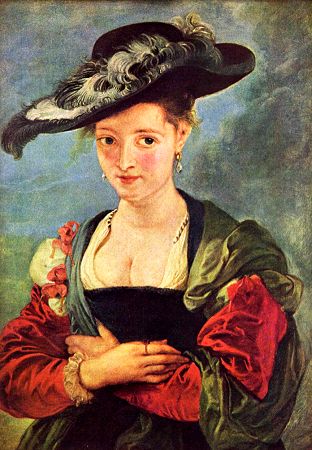
 Variations on a Theme in Art
Painters also do variations on a theme. The two paintings to the left are portraits of women that use a standard pose. The one on the left, “The Straw Hat” by Peter Paul Rubens, is a portrait of a European woman; the one on the right “Ancestors of Tehamana” is by Paul Gauguin. Gauguin purposefully places his Tahitian lover in a traditional pose to show the striking contrast between Tehamana and European women.
Both women are beautiful and mysterious, but in very different ways. There are simple contrasts in color, dress, posture, expression, and background. There are also more complex contrasts. The European woman, for example, is complex and sophisticated. Here she seems to be listening to someone intently, perhaps a gentleman or lover. She seems skeptical but attracted judging from her somewhat defensive pose, the tension in her neck, the blush on her cheek, and the brightness of her eyes. She seems almost on the verge of responding, but it is not clear whether her attraction and desire will overcome her skepticism?
Tehemana’s beauty is natural and primal rather than complex and sophisticated. She seems aware that she is posing for a painting. Gauguin has dressed her in a modest costume and given her a fan to hold. (Most of the portraits of Tehemana show her either dressed in her native clothing, or partially or completely naked.) Despite this “unnatural” situation, she seems comfortable, poised and dignified, as much at home in a European dress as she is among the strange symbols and images in the background. Gauguin depends on the viewer’s ability to make the connection between a “traditional European pose” and his portrait of Tehamana. Authors also depend on our ability to understand variations in traditional plot structure.
Works Cited
Aristotle. The Poetics. Internet Web Classics, Ed. Daniel
Stevenson. 2000.
Faulkner, William. “A Rose for Emily.” The
Frost, Robert. “Stopping by Woods on a Snowy Evening.” The