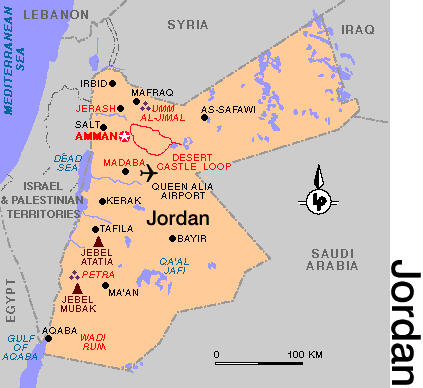
Find out about the country at the Lonely Planet Jordan info page.
|
Find out about the country at the Lonely Planet Jordan info page.
|
Jordanian Customs was a tedious process of collecting one piece of paper from one official, only to hand it to another sitting at the next desk. And then they charged us 8JD (1JD is worth about the same as one pound or US70c), presumably to cover the cost of all the paper. When we told the official that our Syrian insurance certificate was meant to cover us in Lebanon and Jordan too, he just laughed. So we had to cough up another 9JD each for seven days third party insurance. Until Syria no-one had mentioned insurance so neither had we. It's not really something we can object to paying for and we'll certainly need to organise some sort of insurance for Europe.
Immigration was the fastest yet and suddenly we were into Jordan, country number nine since Bangladesh. There is an enormous sign at the border: "Welcome to the Hashemite Kingdom of Jordan", next to an even bigger picture of the King and his beautiful wife. We were wondering whether the Jordanians belonged to some strange Islamic sect, neither of us having heard of the Hashemite religion, or even knowing how to pronounce it; same as Yosemite perhaps? We later discovered that it is just the Royal Family's name, the obvious equivalent being "Welcome to the United Windsor Kingdom".
We rode into Jordan in high spirits, on a beautiful cloudless day, in a surprisingly pleasant temperature. In Australia, when discussing Britain with Aussies, the topic of the weather would inevitably come up. It used to annoy us how everyone would focus on how dreadful the British weather is, and actually pitied the British because of it. We realised of course that it rained and was cloudy a lot of the time in Scotland, but thought surely everywhere else has bad weather too? Having bought an umbrella 11,000km, six countries and eight weeks ago, (albeit a sacred Buddhist umbrella), which has never been used, we have at last come to understand that the rest of the world is sunny almost all of the time and rarely even sees a cloud.
The ruins of the ancient Roman city of Jerash lay almost on our route to Amman and although we have seen a lot of ancient ruins in the last few weeks, and were on our way to Petra, we felt obliged to make at least a cursory visit. So it was with a certain resigned weariness that we headed off the highway towards the Israeli border. Having found the modern town of Jerash, the signposts of course stopped and we found ourselves in the local bus station. Asking a motorcycle policeman for directions got us a police escort the rest of the way to the visitors centre, and a few inquisitive stares met us in the carpark as people wondered what we might have done wrong.
The view of the ruins from the carpark was of an almost empty hillside with a few columns in the distance and we debated whether we really wanted to pay $8 each to see more derelict buildings. But of course we did and it was the right decision. The visitors centre had a comprehensive leaflet, the first at any of the sites we'd visited, which suggested an itinerary and explained what each of the major remains had been. Of course if we'd paid for a guide we could have found out this information at any of the other sites, but it's not really the way we do things.
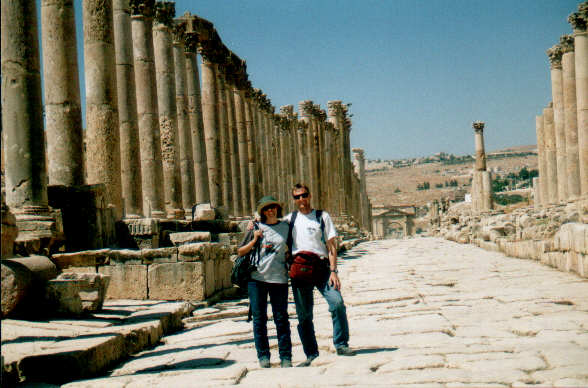
Jerash High Street
We religiously followed the suggested itinerary for almost three hours and were really impressed by how much has survived the earthquakes, floods and the local demands for building materials over the centuries. The main reason so much has survived is that the city was buried. It was 'lost' to history until the last century, and even now it is estimated that 95% of the ruins remain buried. What we found most striking and which brought the city to life for us was that much of the original paving is intact, and in places you can clearly see the ruts worn by chariots and carts over centuries of use. The main shopping street still has two-storey shops on one side and in the Roman baths you can still see parts of the hypercaust, the underground heating system.
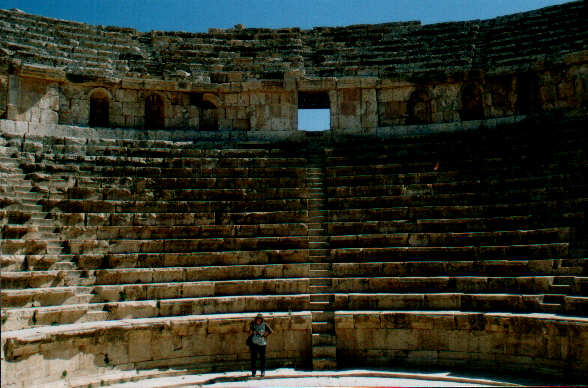
At the theatre at Jerash
When we first arrived, we'd had a look at the tourist shops and unusually had been quite taken with one of them where you could buy a little bottle filled with various colours of sand which had been used to create a desert scene, and in which you could have your name written. So we are now the proud owners of a bottle of sand showing camels walking through a desert sunset with the legend 'Two Flat Arses' emblazoned across the red sky. Very tasteful.
Amman was only 80km further south so we confidently set off expecting to be in our hotel room in an hour. Despite Amman being the the capital city, it is barely signposted and we had passed through it before we noticed. A u-turn got us into the city but completely confused our orientation. After asking various people, we resorted to the time tested method of following a kind local. Unfortunately he was only going half way so we ended up paying a taxi to take us the remaining way, a good decision as it turned out. Amman is not laid out on the standard grid system of most cities and it sprawls across a number of hills, making direction finding pretty tricky. Fortunately the taxi driver knew where he was going and he pulled up right outside the Farah Hotel 15 minutes later.
British election day today. It's strange to be a spectator, as we didn't even manage a proxy vote this time. There clearly wasn't the same excitement or sense of a possibility to change things this time. Apathy appears to have set in. We've been listening to the BBC World Service to try to get a bit of the pre-election excitement ourselves but the polls are so one sided that I don't think we'll be staying up to hear the results as they come in.
After our unsuccessful shopping attempt in Beirut, we thought we'd have another try in Amman. The taxi dropped us at a very swanky and very new shopping mall in one of the more upmarket areas of the city. Abdoun Mall had only opened the previous week and was full of very cosmopolitan or maybe just generic-American dressed Ammanis. We joined the crowds gazing at the unexpected shopping opportunities, and Mo spent a happy few hours trying on various clothes that might not be too useful on the bike, but which would certainly be more acceptable on the beaches of the Greek islands than her current option of travel-worn bra and knickers. Unfortunately Mo's shopping skills have lost some of their edge and she couldn't bring herself to pay Australian prices for something less than perfect, so the search for bikini perfection continues.
A young girl at the information desk asked how we liked the new mall, and we said it was very unexpected and could be anwhere in the west. When I asked her the same question she frowned and said "welcome to the United States of Jordan". Western retail culture isn't universally welcome then.
The city is closed today, it being Friday, so we spent all morning in a very nice internet cafe, which turned out to be one of the few gay hangouts in the city. We hadn't really expected Amman to be so modern and were surprised first of all by the totally up to date computer facilities and then by the steady trickle of well dressed young male couples.
The retail quest continues. Mo spotted someone yesterday wearing an Esprit t-shirt and had managed to get an approximation of the shop's address from the girl at the mall, with an assurance that it would be open on a Friday. So after another taxi ride to a another unknown part of the city, we wandered up and down empty streets for half an hour searching for the elusive shop. We found it eventually, between the Coronation Street Pub and the Subway sandwich shop. It's interesting which parts of western culture are exported. Of course Esprit was closed, so we had a Sub sandwich (very good actually) instead.
Our friend in Sydney, Wa'el, has a brother in Amman and one of our reasons for coming to Amman was to meet him. Despite having spent his one day-off entertaining other visitors, Khaled duly turned up at short notice and gave us a guided tour of the city. We had no idea what he looked like or even what age he was, so based on his brother Wa'el, we looked out for a shaven headed, impressively moustachioed forty year old. We were surprised then, when a man in his fifties with a full head of hair and a well trimmed moustache walked up and introduced himself as Khaled.
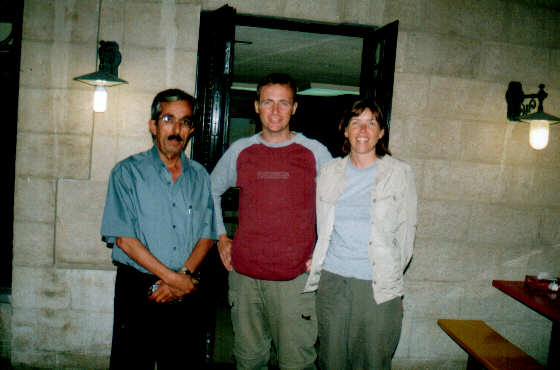
Khaled Sabri, our Amman tour guide
We told him we'd been surprised by how westernised Amman was, so he gave us a tour to show us the various malls and hotels which have sprung up over the last few years. There's no restriction on imports here so you can buy what you want and judging by the number of hotels, there are plenty of foreign visitors. Khaled is an architect and he showed us round the five star hotel he is working on, all lined with imported Italian marble and timber. Someone clearly expects some well heeled visitors. The city itself appears very new and uniformly white. Apparently the colour of buildings is dictated by local regulations to fit in with the colour of the local stone, so that in Amman everything is white whereas in the town near Petra it is pink.
We drove to the edge of the city and looked west over the hills where on a clear night you can see the distant lights of Jerusalem. Khaled's family had left Palestine in the sixties and was subsequently scattered across the world, the five brothers and two sisters settling in Jordan, Kuwait, Azerbaijan and Australia. His own family had been uprooted again in 1990 when they were living in Kuwait City and Iraq had invaded. Of course they had to start all over again once they had arrived in Jordan.
In the valley below, Khaled told us, was one of the massive Palestinian refugee camps where 250,000 people lived. It is apparently a real community where many people have chosen to stay, preferring to remain with their own people than to move to the Jordanian cities, where many of them commute to work. They still hope, thirty years later, that these homes are temporary. Khaled said that the massive influx of Palestinian refugees over the years had caused some tensions among Jordanians, the usual "they take all the jobs" reaction to immigrants everywhere, which we experienced in both Britain and Australia. However, over the years the immigrants had become the backbone of the economy and while local people worked in government, the Palestinians actually powered the economy. Again, another common story.
Having been given the option of western fast food or a local restaurant, we obviously chose the latter and were then treated to some of the best food we'd had for weeks, with not a kebab in sight. Middle Eastern cuisine at its best, with various dips and freshly baked bread. As Khaled lit a post dinner cigarette, we told him that his brother Wa'el had given up smoking. "Wa'el is not a good smoker, he smokes only one pack a day". So Wa'el, what were you complaining about, it must have been easy for you, not being a proper smoker.
When the time came to pay, Khaled was insistent, he would be insulted if we tried to pay and it was his duty to provide us with hospitality. So a big thank you to you Khaled for your generosity and as we find ourselves saying again and again to people who have been so kind to us throughout the trip, please visit us so that we can offer you the same hospitality.
After another drive through still unfamiliar streets, we said our farewells. Back at the hotel, we turned on the World Service, to hear that as expected, Labour had won convincingly again. It's very difficult to equate the current Conservative party with the government of only a few years ago and also difficult to imagine them becoming a credible opposition in time for the next election.
Half an hour after leaving the hotel, we were pleasantly surprised to find ourselves on the main road south. The city soon gave way to farmland and then to the more familiar desert. We had intended to stop to see some famous mosaics but we found ourselves back in the desert before we realised we'd even reached the town we were looking for.
About 60km down the road, there was suddenly a rift in the flat landscape and the road dropped steeply down the side of a vertiginous gorge, Wadi-Al-Mujab, a canyon almost 1km deep. We stopped for photos and to try to take in the scale of the landscape. Suddenly aware of the consequences of breaking down here, I took the opportunity to adjust the chains and check nothing was about to fall off the bikes. We weaved our way down the precariously looping road and past trucks crawling in first gear, engines screaming in protest as they tried to avoid melting their brakes. We stopped for lunch in Kerak and ate an omelette in the shade of a crusader castle, which we didn't even bother going into. Well, once you've seen the best...
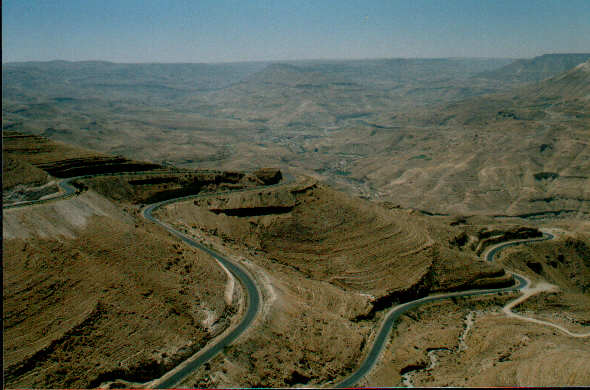
Another long and winding road
The road south to Petra is slowly being upgraded so we were forced to take various diversions, each one longer and more circuitous than the last. We were glad when a local suggested we just ignore the latest sign which indicated a 30km detour, and just drive around it. We followed an empty road for several kilometres which soon deteriorated into rock then hard dried ridges of mud. We were beginning to wonder where we'd end up when we crested a low wooded hill. Suddenly the road dropped away again and we were overlooking a vast desert plain, in places rumpled like an old carpet into folds of multicoloured sandstone. Tall ridges of rock were contorted into wonderful shapes, the layers of colour like some massive lozenge.
We soon arrived in Wadi Mousa, the town adjacent to the ruins of the ancient city of Petra. At the bottom of the dusty and unattractive mainstreet, and closest to the entrance to Petra, the Movenpick Hotel sits alone in splendour, pristine against the older hotels and shops which crowd one side of the steep main street and which get progressively tattier as you climb away from the entrance to Petra. We had been recommended the 'Orient Gate Hotel' and the hotel card promised everything we needed: clean rooms, comfortable beds, private parking, hot water, internet, reasonable prices, friendly staff, food and a nightly showing of Indiana Jones (the one filmed in Petra of course).
Within a few minutes of checking in, it became clear that the card was bending the truth slightly. Having parked the bikes in a narrow street opposite the hotel, we then had a cold shower before almost falling through the springs of the worn bed. We went downstairs to order food and collect our email only to be told by the grumpy manager that he had no food but there was a decent restaurant up the street and if we kept walking we'd find an internet place too as he wasn't connected, no they wouldn't be showing Indiana Jones because he was sick of it and no we couldn't have a discount on the room. Since we were so high up the main street, at least the room had a view across the minarets to the pink hued valleys of Petra in the distance.
Unfortunately our view across the minarets also meant that we were within earshot of every one of them. We were woken at 5am by the loudest cacophony of competing mosques so far. We have fallen for the romance of the call to prayer at sunset, when on a warm evening you are drawn by the eerily compelling cries from the minarets. However in the chill of early morning after a mosquito-broken sleep, the appeal is somewhat lacking. We managed a 7am breakfast of hard boiled egg, cucumber and tomato (not the omelette as promised - "oh that's the special breakfast") and were at the ticket office in time for it opening. You can buy a one, two or three day pass and everyone we had spoken to had said it would take two long days to really see the whole city, so we handed over our 25JD (US$35) somewhat reluctantly and headed down the hill toward the gorge which leads into the city.
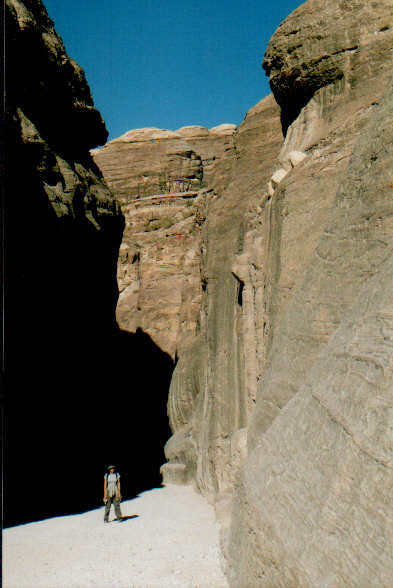
Mo in the Siq
The Siq is the narrow gap between two towering stone walls which bends gently downhill for over a kilometre and leads into Petra. As the path descends, the walls grow higher and the patch of blue sky overhead grows more distant. In past times, this was the only way that caravans could pass into Petra as they followed the ancient spice route to the east. The city grew rich on the monopoly of trade from the passing camel trains and remained rich after the city was taken by the Romans. It was only after the Romans changed the trade routes through the Middle East that Petra declined and was eventually abandoned, to lie unrecognised for almost two millenia.
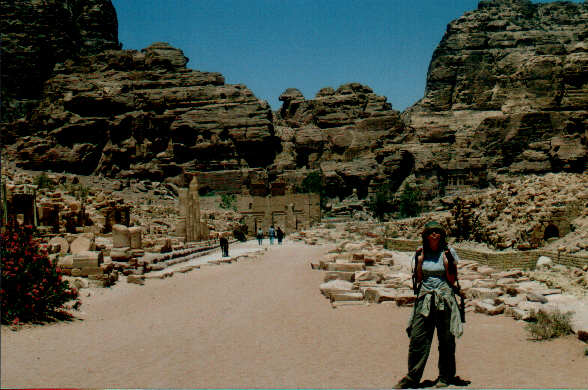
Petra High Street
The Nabateans who built Petra had a real grasp of many of the sciences. They mastered hydraulics and were therefore able to irrigate their desert city. You can still see the terracotta lined irrigation channels which carried water through the Siq down into the city. After walking for over one kilometre, suddenly you turn a corner and there towering above, and carved deeply into the soft rock, is the 'Treasury'. It is the single most impressive carving in the whole city and really takes your breath away. It is also the tomb that was used in Indiana Jones so is very familiar. Little huddles of tourists sat silently watching as the shadow moved across the carved rock, waiting for the ideal photo. Camels and donkeys stood patiently waiting for the slower tourists to come out of the Siq where they would have to leave their horse and trap. It's a fair walk, especially with the temperature in the 30s and by the end of the day we were quite tempted ourselves.
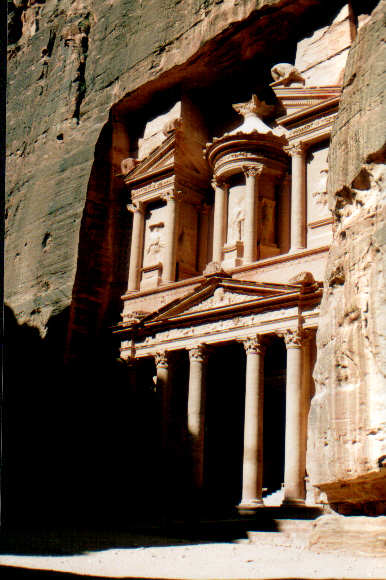
The Treasury
Petra was a thriving city which grew to occupy several valleys. What remains of the city, mainly the extravagant tombs, were laboriously carved in the cliffs which overlook the road and start from the valley floor and climb high into the rock face. We visited as many as we could but soon realised that the interiors usually consisted of one vast open space but sometimes they would have several interconecting roooms with trenches cut in the floor which presumably used to house the sarcophagi. Following a series of steps cut into the rock, we found ourselves high above the tombs and looking down the length of the main valley. Using my binoculars for the first time in three months, we could discern rock carvings in the far distance. We decided from this highpoint that we (or our legs) could appreciate the grandeur of the tombs from ground level.
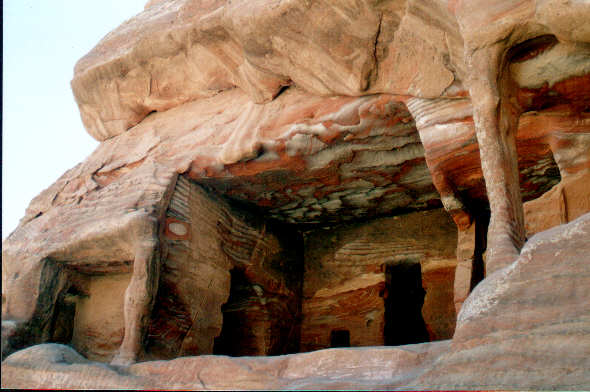
Stunning colours of Petra
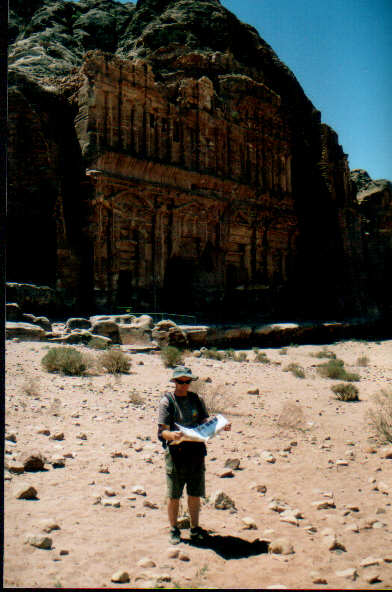
It's behind you...
Having declined an expensive but tasty looking buffet lunch at the new visitor centre, we steeled ourselves for the climb up through a rocky gorge to the Monastery, another of the highlights of the city. Having been built as a mausoleum, in later times it was apparently used by monks. Very fit monks too, if they went up and down that path very often. The path weaved its way through narrow gulleys below towering jagged fingers of rock, with a lattice surface like a melted candle. After almost an hour we puffed our way round a final boulder and rising vertically in front of us was a stunning facade of smoothly carved rock, framed by dramatic peaks.
In the distance on a particularly remote and inaccessible ridge, a tiny white church stood in contrast to the mottled rock around it. This was the shrine of Moses' brother, Aaron. This is supposedly an important place of Christian pilgrimage but with my lack of biblical knowledge, it wasn't important enough to me to walk another five hours to reach it. So we turned and made our way back down, passing groups of German tourists pulsing bright red and sweating copiously in the growing heat. Presumably the tour guide who was leading them had some sort of insurance as there was a good chance of at least one heart attack between them.
Once at ground level, we realised we had another hour to walk uphill to get back out of the city, and despite Mo's affection for camels, or possibly because of it, she refused to catch a camel taxi back and we trudged onward and upward. Fortunately the Movenpick ice cream shop was open and we had possibly the best, or at least the best deserved, ice cream of our lives.
I got up at 7am and made my way back down to Petra. Mo had decided she had seen enough tombs for one lifetime but there was a particular place that I still wanted to see. The 'High Place of Sacrifice' is well named and I climbed hundreds of narrow stone steps which crossed a steep gorge high above the rocky tombs. It wasn't difficult to imagine a solemn procession winding its way up here with the unfortunate subject of the sacrifice being prodded upwards. On a high and windy plateau from where I could look out across both valleys, I found a stone dish carved into the rock where the ritual killing must have taken place. There was a drainage channel leading from it into a large oblong tank also cut from the rock. I wondered how many animals or people they must have sacrificed at one time to fill this gory trough.
When I got back to the hotel, we quickly packed up and left before our friendly host could charge us for another day. We were heading south for the Gulf of Aqaba in the Red Sea, the most southerly point we would reach on the trip and from where our journey would take a final turn northwards. The weather, which until now had been hot but bearable, took a turn for the worst and it really felt like the dial on the oven had been turned up several notches. We followed signs for Wadi Rum, where Lawrence of Arabia had united the Arabs in revolt, and where we had intended to visit, but with the temperature somewhere in the 40s the idea of a few days in the desert was no longer appealing. So we just kept driving, visors down, sucking constantly on our Camelbaks, the water reservoir in our rucksacks, sweat drying before it had time to trickle out of our sleeves. The desert landscape was beautiful with massive sandstone cliffs rising from the sand but we were struggling to appreciate it, our eyes on the road and blinking sweat.
I pulled out to overtake a truck doing about 80kmh and I saw Mo pull out behind me. The road ahead was clear but with a sickening feeling of dread I realised that the road surface was shining in the sunlight, slick with diesel. Before I had time to consider how to avoid the diesel which covered two thirds of the road, I was in it and the bike was already beginning to weave beneath me. With a horrible dread of inevitability and a feeling of utter helplessness, I fought with the bars to keep the bike straight and glancing in my mirror saw that Mo was having similar problems as her light swerved from side to side. Everything was in slow motion as the bike wobbled and weaved, all control gone, and all I could think was, my poor panniers are going to get all dented.
And then somehow we were stationary, sitting on our bikes on the verge, hearts pumping and laughing hysterically. I don't know how we managed to stay upright but there must have been some instinctive self preservation at work. So with some relief we gingerly got back out onto the road and carefully made our way into Aqaba, the diesel slick in the other lane continuing for 5km, traffic speeding through it oblivious. We passed a northbound motorcycle policeman who I frantically waved at to slow down, but he just waved back and continued on his way.
The hotel in the Lonely Planet was a real dump but the hotel next door was one of the best we'd stayed in so we happily turned on the A/C and settled in. Aqaba is a real tourist resort, famed for its diving. Unfortunately with the unrest in the Middle East, the town was absolutely dead. We had a wander along the grey public beach and then to the resort hotels, again in search of a bikini for Mo. Amazingly we found one in the little shop in the Radisson, so we were all set for a snorkelling trip in the morning. We had dinner in Pizza Hut, which was far nicer than we'd remembered. I suppose anything that wasn't grilled meat would have tasted like heaven.
We had considered going diving but when we found that the reef we would be visiting was only a few metres deep, it hardly seemed worth the extra money, so we decided to go snorkelling instead. The dive guide drove us 12km south of Aqaba towards the Saudi border along with a Jordanian who was on holiday from his American university. He was a Russian Orthodox Christian and had a lot to say about the current troubles in the region, citing Israel's inability to share the Holy Land and pointing out that all religions had shared it for centuries before Israel had been created. He certainly voiced an opinion we've been hearing more and more, that Israel, with its extreme military reaction to a situation that can only ever be resolved politically, is losing the world's sympathy, the sympathy which allowed it to be created in the first place.
The snorkelling was pretty impressive and the reef was indeed very shallow, and full of life. The student complained that local people had no interest in ecology and certainly parts of the reef had died and there was some litter, but there were various types of coral, shoals of multicoloured fish and hundreds of incredibly long sea cucumbers, so the water must have been pretty clean. There was a narrow channel through the shallow reef where it then dropped off into deeper water, the point where you can only see vaguely into the murky distance and where the imagination becomes a little overactive. It was nice to know there weren't any sharks. It was warm enough to swim without a wetsuit but only for an hour at a time, so after an hour and a half we headed back to the town.
With the temperature again in the 40s, we decided to spend the afternoon in an airconditioned internet cafe. We've noticed in a number of countries, from the menu of the last few sites visited, that most of the customers spend their time looking at porn sites. In the Muslim world especially, this may be the only images of women and sex that young men get so they must have a pretty distorted view of what to expect when they do eventually get married. I sat down next to a man in his fifties and was amazed over the next three hours to find what his sexual preferences were. I wonder if his wife knows that he likes transsexuals? When he was replaced by a Saudi man resplendent in white robes, I thought he might just be collecting his email. But no, he'd brought a CD with him full of porno video files. It was all a bit distracting I have to admit!
After our dinner of 'boneless chicken' (a kebab by any other name is still a kebab), we sat and plotted how we were going to get to Haifa in Israel where we planned to catch the ferry to Greece. We didn't really want to go to Israel at all, but the alternative of driving an extra 2000km through Syria again was unthinkable so we plotted how we could spend as little time in Israel as possible. My Mum and Dad called and when I mentioned to my Dad we were heading into Israel tomorrow, I gathered from his surprise that we hadn't really made our plans clear. Anyway, it would be a flying visit, and we'd have to be pretty unlucky to get involved in any of the troubles.
(Writing this on a strange foreign keyboard so sorry if the spelling is a l�ttle olde Engl�she.)
For once we did manage to get up early - survival instinct kicking in at last - and we were packed and heading north before 7am. It was hot, but not unbearable. The road was quiet and we sped along, following signs for the Dead Sea, our next stop. This was going to be our last day in real desert and Jordan pulled out all the stops as a farewell. The landscape was amazing and changed every few miles - black craggy ridges on one side, rolling pink hills on the other, flat scrub and then proper golden yellow sandy dunes. And lots and lots of camels. We saw family groups strolling across the horizon with no sign of an owner, and working teams being led by the ubiquitous white robed Arab. We saw two young ones chasing each other round in circles like huge puppies. More facts for you camel fans out there: when camels run their lips bounce around madly - they have big lips. And when they sit down they bend their back legs backwards and kneel on them, like someone doing a jigsaw puzzle on the floor, and their knees are hairless and leathery.
It got hotter and hotter and we finally sighted water by mid-morning - turquoise blue with salt crusting around the edges. The air was salty - if you stuck your tongue out or licked your lips you could taste it. We passed a sign for the Tomb of the Prophet Lot and it suddenly made a lot more sense that his poor old wife had turned into a pillar of salt rather than pepper. Anyone who stood still long enough would be coated in the stuff at the very least. The water we had seen dried up gradually but a few miles on we came to the Dead Sea itself - bright deep blue, absolutely beautiful. We realised that the hills on the other side, the ones we had been riding alongside all morning, were actually in Israel. That might explain the loud booming sounds we could hear from over there every now and then, which had become a bit of a worry.
We rode on to the hotel area on the north edge of the sea. For a fee the three hotels there will let you use lockers and showers, the showers being an especially good idea apparently as the salt from the sea can feel pretty unpleasant afterwards. We stopped at one, parked the bikes in the shade, and locked our stuff away. We ran down to the beach, burnt our feet on the dusty sand which was roasting, and into the water. Which was very very odd. Totally clear but somehow thick, like olive oil, and if you swished your hand through it you could see the currents swirling around. And of course, you float. It's actually impossible to swim as the water holds you so far up you can't reach into it properly. Of course it's also difficult to swim when you're working hard at keeping your face as far out of the water as you can. All that salt would not be nice in eyes or mouth. It would also be pretty unpleasant in any open wounds or cuts, and apparently visitors are often made swiftly and painfully aware of small cuts they didn't know they had, but we were lucky and just bobbed around without any agonising side effects.
You could buy mud from some locals on the beach to smear on yourself - not sure why you'd want to do that but people were buying and smearing so there must be a reason. Dave asked another bobbing figure why people didn't just get their own mud from the sea bed as it wasn't deep and he explained that it's just not physically possible to dive below the water. Cool.
We got out, burnt our feet again, and showered. We were all packed up and ready to get back on the bikes for the next stage of the journey. And that's when things took an unexpected turn...
This stage of the trip - the crossing of the Med from the Middle East to Europe - had always presented a bit of a problem, and had been the source of many hours of debate and discussion throughout the trip. As detailed on the home page, our original plan was to cross from Israel to Greece. But the home page also says: 'provided things in the region are safe and stable' and it was the definition of this, 'safe and stable', that we seemed to be having trouble with. It had been difficult to get much news while we were on the road, and we hadn't met a single person who had come from the Middle East or Israel who could have given us up to date information. But clearly things were not entirely settled. There seemed to be a death toll daily, on one side or the other, and although motorcycling through 14 different countries might not seem the absolute safest of enterprises, we really are not big risk takers. The problem was that there just wasn't much of an alternative. There are strangely few ferries crossing the Med, and if we didn't get the one from Israel we were looking at riding an extra 2,000 kilometres north and west through Turkey. A welt-inducing distance, not to mention through the very lair of the hell hounds - not a tempting prospect.
So, in the end, we had decided to go for it. There was a ferry leaving every Friday so we planned to get into Israel on Wednesday evening, go to Haifa and book the ferry on Thursday, and be off first thing on Friday. We weighed up the risks and decided that we would be exceptionally unlucky to come into contact with any suicide bombers in that space of time (of course not much comfort for our families, reading the headline: Exceptionally unlucky couple killed in suicide bomb blast). And of course it is an amazing place, fascinating to visit. As we planned our quick trip we had to choose between spending the night in Nazareth, Galilee or, my own personal favourite, Armageddon.
However, aware that things could change at a moment's notice if something major happened, we had agreed that we would phone the ferry company just to make sure they were still operating. Another thing which complicated the situation a little - if we went to Israel and for some reason couldn't get the ferry we would be stuck there as anyone who has visited Israel is automatically denied entry to Syria. The Israelis know this and try to help by giving visitors the Israel stamp on a piece of paper rather than in their passport. Nice try, but the Syrians aren't stupid and if your passport shows you left Jordan by a border crossing next to Israel, they cunningly work our where you were probably off to. So, it was important for us to confirm that our ferry was definitely still running before we entered the country. We had never got round to doing this so finally, on the shores of the Dead Sea, a few hours before we were due to cross the border, Dave went off to phone.
I chatted to a Jordanian selling carpets to visitors. 'Where are you from?' 'Scotlanda.' 'Oh, yur Sco'ish are ye?' he shouted in a not half bad, Scottie from Star Trek accent. It turned out he had been in the RAF for years and had lived all over the north of England. The booming sounds were still audible from over the hills in Israel, and Dave and I had been studiously avoiding discussing them. I took the chance to ask him what the sounds were - was it shelling? 'Oh no, it is just planes breaking the sound barrier.' Better than shelling, but still a little confronting - presumably they weren't jumbo jets full of holiday makers. We chatted about the situation and he said as long as you stayed away from the West Bank and Gaza you would be safe. 'Promise?' I wanted to say.
We chatted ('England is not England any more' he told me, which seemed an odd comment coming from a Jordanian) and he gently tried to sell me a carpet until Dave reappeared with the news that, well, I don't know how to tell you this but, the bloody thing IS cancelled. It just seemed too stupid to be true, that after all our endless discussions, and after finally deciding to live life on the edge and enter a semi war zone, we couldn't go anyway. 'Well, we could still go', Dave said. 'The next boat's on Monday.' So the final debate started. Dave, me and my mate from the RAF tossed the possibilities back and forwards. We could spend a few more days in Israel. Nope. We could spend a few more days in Jordan. Nope. We could get on the bikes in 42 degrees and ride an extra 2,000 kilometres through Syria, where we would be ripped off at the border AGAIN and Turkey, where we would be attacked by dogs. 'We will be attacked by dogs.' I said. 'We won't,' Dave said. 'How do you know?' 'Dogs only attack in the east of Turkey.' 'How do you...?' 'Have you been to the coast of Turkey?' my RAF mate asked. 'No.' 'It is fantastic. Good food. Good people.' So based on a theory that there is a line of longitude beyond which dogs in Turkey lose the ability to bite, and the recommendation of a stranger trying to sell us a carpet, we got on the bikes in 42 degrees and set off.
Making a decision can be difficult but once the decision's made you just have to get on with it and we just got on with it, riding north through the heat, back to Jerash, skirting around Amman, to the Syrian border. The Jordanian customs officials were hot and bored. One of them barked instructions to us into a microphone which then relayed them by loudspeaker to the whole compound. It would have been useful if we'd been standing outside. As we were in fact standing a couple of feet away it was a bit much, and the two of us and all of the Jordanians, including the barker himself, ended up getting the giggles. Departure tax of 8JD seemed a bit steep but we had just enough so paid and headed back, yet again, dear God let this be the last time, to Syria. The officials there were pleasant, just hot and bored as we all were. The Assad family didn't seem to have suffered any major personnel changes since we had seen them last. $8 dollars each in tax, conforming to the Syrian tradition of never charging the same amount twice at border crossings, and we were in.
It was so hot, and it had been such a long day, that we decided just to make it to Damascus, arriving in the late afternoon. Our previous parking place was full of cars so we ended up parking the bikes in front of the police station. The young policemen were all fascinated by Dave's bike (they weren't fascinated by mine) and promised to keep it safe from felons until the morning. We got settled into a hotel nearby and went for a wander round our old haunts - the kebab shop on the square, the kebab shop on the corner... We had dinner and I had the great idea of having, yes, a kebab, but made entirely of tomatoes. This really ends up pretty similar to a plate of grilled tomatoes which made a refreshing change. Shame I hadn't thought of it sooner.
Up early again, the city deserted, and we packed the bikes for the big push into Turkey. Fond farewells from the policemen and we were off, heading north on the highway to Aleppo. It was hot and windy but we made good time, finally stopping for an early lunch quite far north at a roadside restaurant. There were lots of children running around the place and we got chatting to the man with them, an English teacher. I joked 'Are all these children yours?' 'Yes, but two wives.' And sure enough, in amongst the kids were two women. One of them laughed at our surprise. 'Twelve childrens,' she said, and mimed that when they got to fifteen they would stop. Dave asked the man if he could remember all the kids' names. 'Sometimes I forget some,' he admitted, but the cheerful wife started naming them all to show us that at least she could remember. I asked if his wives were friends with each other. 'Sometimes. Sometimes they fight,' he shrugged and smiled at me. 'But I should not talk about my wives. Maybe your husband will want another wife also.' 'No, I think one wife is enough trouble for him,' I said and Dave nodded ruefully. The family left, all piling into a normal sized estate car, the kids piled up in the back like bags of shopping.
The English teacher had translated for us at the restaurant and we'd ordered an omelette. He had obviously had to describe it - eggs, tomatoes and onion cooked together - and when it came it was huge dish of fried tomatoes with some onions and a few little bits of egg. Not really an omelette, but delicious nonetheless. We set off again through the north west of Syria. It seemed very isolated and we passed ancient ruins at the side of the road. There are so many ruins in Syria, lots of them are just lying untouched, part of the landscape. We finally reached the quiet border crossing. The officials were pleasant. One of them said to me 'You? Motorcycle?' 'Yup.' 'Me also motorcycle. You... me... motorcycles, Australia?' 'Absolutely' I said, 'You and me, let's go.' They didn't charge us anything so Syrian customs certainly improves over time - a proposition rather than a fee. I like it.
So, after leaving Aqaba in the far south of Jordan just the day before, we were finally and unexpectedly re-entering Turkey.
 |
 |