 |
|
|
|
|
|
|
|
|
|
|
|
|
 |
|
|
|
Temperature Functions at Duke Forest: Scaling carbon echange in woody tissue |
|
|
|
|
|
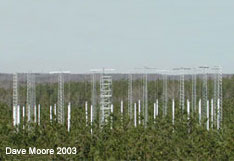
To determine the carbon balance of forests we need to either continually measure carbon exchange or scale carbon exchange from few periodic measurements. Continuous measurement is possible using techniques like eddy flux but in FACE systems eddy flux is disrupted by the fumigation system.
We measure the carbon exchange or fluxes of ecosystem components e.g. leaves, tree stems, soil etc. and then add all the fluxes together. We can't measure everything all the time so we interpolate the times when data is absent.
Respiration is known to be very sensitive to temperature and many researchers interpolate or scale respiration measurements based on the temperature of the respiring tissues. |
|
|
|
 |
|
|
|
|
|
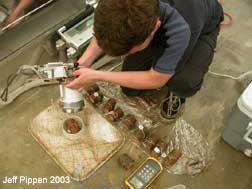
It is extremely difficult to change the temperature of a woody stem and the temperature change over a single day is not large enough to derive reliable temperature responses. In and attempt to find a temperature function that I could use to scale woody respiration I cut branch sections from trees in the field and brought them into the lab. I used a temperature controlled growth cabinet to change the temperature of 10 branch sections (from 5 different trees) and I measured the CO2 efflux from them using a LiCor 6400 infrared gas analyser. I changed the temperature from 6 degrees C to over 30 degrees C over the course of several hours and found the expected exponential temperature response for the apparent respiraton.
Although this technique has the obvious limitation of excised tissue it can be repeated at different times of year. Resent evidence suggests that temperature responses of respiration change throughout the year and acclimate to different temperature situations. |
|