| For
printing out long articles on the net (like this one), I have found
FinePrint
to be a great paper and ink saver. It's a piece of software that
installs as a dummy printer and reformats pages before passing them
on to your real printer, enabling 2, 4 or 8 pages to be printed on a
single sheet of paper. Try it.
From Aaron
Is
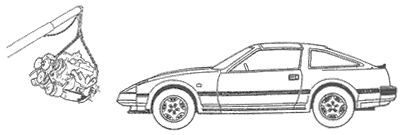
it a ‘P300’ or a ‘ZX76’?
Or is it a ‘Pissan’ ?
To start with...
This article was originally written for a small car club magazine.
The car club editor posted it on the net at this address, purely as
a reference for club members. Apparently, a number of other people
have accessed this address, after doing searches for 'alloy V8 conversions'. I
apologise to those people for not tidying it up sooner.
I am in Australia. The P76 you will see mentioned in this article was
built here during '73-'74. Less than 19000 were produced. The
V8 version used a 4.4 litre all-alloy V8 which was derived from the
Rover 3500 (same 3.5" bore, but stroke was lengthened to 3.5"
from the Rover's 2.8"). I understand the Rover was in turn
derived from a Buick/Oldsmobile alloy V8 engine.
In Australia we drive on the left side of the road. Consequently, the
steering wheel is on the right side of our cars. The P76 starter
is on the right side also, making things a bit tight there. If
you are putting this style of engine in a left-hand drive car, you may
find things easier than I did.
The original
article:
At the end of 1996 I wanted to try a different type of car. I bought
a 1985 model Nissan 300ZX (Z31 series) from a guy in Sydney. He had
bought it for his son. His son didn't want it, so it was left
in the garage to run out of registration. The guy then bought his son
a brand new Corolla and had to dispose of the 300ZX.
Because the car was unregistered and had an electrical problem, I got
it for a good price. I took it to my Mum and Dad’s (Jessie and
Wal’s) house and a few days later I had it ready for rego. I soon
started calling it ‘The Cockroach’ because I thought it
looked a bit like one with its half closed, flip-up headlights.
I greatly altered it about 18 months later, but originally it was a
fuel injected 3 litre V6 with auto transmission, air conditioning, power
steering and cruise control. The colour of the body is what’s
commonly called ‘Champagne’ (although if I was offered a
glass of champagne that colour I definitely wouldn’t drink it).
It has a glass targa roof and the interior has a nice, two-tone, dusty
beige finish in velour. The build quality is excellent.
Apart from the electrical problem, the car was a good, clean, straight
and original unit when I bought it. Even over the longer term it was
a very nice car to own and seemed to have almost everything I wanted
in a car. On the open road it was quite OK, having an overdrive (of
sorts) on the transmission, four wheel disc brakes and independent rear
end, however its acceleration was very sluggish.
Much seems to have been said about the handling of the Z31 300ZX in
standard trim. It’s all subjective. It stuck to the road better
than most cars but by sports car standards it felt relatively heavy
and it understeered a lot. When pushed very hard through a corner, it’s
transition to oversteer was quite sudden.
The workshop manual says that the standard car weighs 1360 kg, but I
am inclined to think that it is closer to 1400 kg in reality. This is
fairly heavy to us that are accustomed to the P76, which weighs no more
than 1270kg, fully optioned.
The
Possibilities
In mid 1998 the auto transmission gave up and was going
to be costly to replace. Since I had to spend a lot of money on the
car, I saw it as an opportunity to improve the performance. I looked
at other engine and transmission options:
- Imported Japanese engines in multi-cam and turbo charged versions
were complex to install (some with as many as 15 “appliances”
to be mounted in engine bay), computerised (which didn’t suit
me), required premium unleaded fuel (expensive to run) and still required
an engineer’s certificate after installation. The turbo alternatives
would have been very expensive to insure. Also, most of these options
were cast iron engines and therefore, heavy. The best of these imported
Japanese engines, I believe, would be the Lexus 4.0L alloy V8. Thanks
to Chris Dale for his advice on various options.
- American cast iron V8’s (and their Australian descendants)
were too heavy for what I wanted.
- Non computerised, alloy V8’s: There is a Toyota V8 which
I would have had to buy from Melbourne before even trying it (no thanks).
There is the Rover 3500, but why bother when you can use the P76 V8?
I had a spare one and the more I looked and measured, the surer I
was that I could make it fit into the 300ZX. It became something
of a personal challenge.
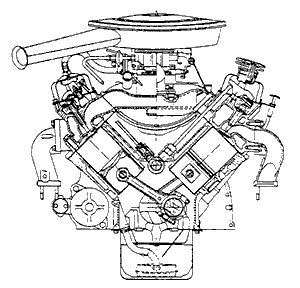
For me, the P76 V8 was the best option because: it’s light; I
had it handy to measure and try for basic fitment without cost; I had
access to a non computerised, inexpensive transmission that was proven
to work with it (Borg Warner); it was easily convertible to LPG fuel;
it did not require a computer (I prefer it that way); it is cheap to
maintain; I’m familiar with it; comprehensive insurance for the
package was relatively inexpensive; I’ve got more pride in it,
being a P76 fan; etc, etc, etc.
The
Conversion
Getting the engine/gearbox position correct was very
important. The drive line through the crank and gearbox should be parallel
to the drive line through the diff, within a tolerance of 1 degree,
so that there is no vibration. However, with an independent rear end,
it should not be in direct line with it, as this doesn’t give
the uni joints on the tailshaft a chance to move and lubricated themselves,
I have been told. (This problem would not arise where a live rear end
is used.)
It took a long time get the engine/gearbox position correct. I used
a spirit level, square, tape measure, ruler, string lines, trolley jacks,
car stands and numerous chocks and shims. The job was made harder because
the sump would not fit in its original form and had to be modified during
the positioning exercise.
I had to chop a section out of the sump so that it would clear the steering
rack, which is mounted behind the crossmember in the 300ZX. I made a
custom oil pickup to fit and added a wing to the side of the sump to
restore normal oil capacity.
Also, the original starter was hitting against the intermediate steering
shaft. When I was having trouble with this Chris Dale showed up and
suggested a Rover starter, which has the solenoid beneath it instead
of on the r/h side. Unfortunately the Rover solenoid was too long and
it the fouled on the steering rack, but thanks anyway Chris - it got
me thinking along other lines. Thanks also to David Waters, Russell
Nicholson and Garth Morris for advice on starters.
I found the ultimate solution at Adamstown Auto Electrics (Newcastle).
Kevin, the owner, was terrific. He trusted me to bring home and try
2 new starters. The Lucas LRS196 for some of the Land Rovers (and Range
Rovers?) is the same layout as original, with the solenoid on the side,
but very much smaller overall. It is much more powerful, being rated
at 1.4 kW, but the main reason I liked this alternative was because
there was no cutting, filing or welding required. I simply had a ring
made up (for $20) to enlarge the diameter of the locating lip. It’s
a beautiful little starter, and although labelled as a Lucas, it’s
apparently made by Magnetto Marelli.
The original oil filter would have hit the sway bar. Russell Nicholson
had previously converted an oil filter housing for me to take the Holden
Z30 filter (That's a Ryco part number). Thanks again, Russell. After
some investigation, I discovered that the small Z160 filter for the
late model V8 Holden Commodore has the same seal and thread size as
the Z30. This meant that it screwed straight onto my converted filter
housing and fitted beautifully in the small space.
Russell Rygrok did a great job of putting together an indestructible
automatic transmission for me. At first glance it looks like the original
Borg Warner 35 from the P76, but it has a Ford Falcon XD case, late
model Mitsubishi Sigma (Borg Warner model 40) internals, some 6 cyl
P76 parts and some V8 P76 parts. Thanks, Russell.
It took me three hours just to get the auto trans dipstick tube bent
to the right shape and mounted so that it clears the firewall.
I fabricated engine mounting brackets and a gearbox mounting/crossmember
to bolt to the original holes in the Nissan. I used the common Ford
Falcon rubber gearbox mount. Tacking the engine mount brackets together
‘in situ’ was an incredibly awkward job.
Throughout the project I refrained from making structural changes to
the car, altering original parts or cutting up wiring harnesses where
I could so that in the future, with an original style Nissan engine
and transmission, the car can be quickly and easily restored to its
original form. I have stored away the unused original parts for that
reason.
I used the original Nissan power steering pump by making a mounting
bracket to go on the top r/h side of the P76 V8, where the air conditioning
pump is normally mounted. A Mitsubishi Colt heater hose currently connects
the pump to its reservoir. I haven’t sorted out the air conditioning
yet, but to do this I may have to remount the power steering pump and
extend the hydraulic lines.
I was able to retain the original Nissan radiator. It simply needed
a proper clean out at a radiator shop and proved quite efficient. It
is mounted at its standard 45 degree angle, leaning forward in the 300ZX,
and has 2 thermatic fans on it. The harmonic balancer on the V8 clears
the bottom tank by about 13mm. As a matter of interest, the radiator
hoses I am using are bits cut from: Ford F100, Mazda RX3, Torana 4cyl
and P76 V8.
It took a full day to make the complex r/h engine pipe, and a total
of three days to sort out the exhaust system.
The original tailshaft (drive shaft) was a two piece affair with a rubber
bearing in the centre. In keeping with my ‘non-butchering’
plan, I saved the original and got a Nissan Nomad (van) tailshaft with
the same rear flange and had it cut and altered for the conversion.
The speedo cable had to be custom made with a Borg Warner gear on the
drive end and a Nissan fitting on the speedo end. The P76 drive gear
has 18 teeth, the Sigma one has 20 teeth and I used another with 22
teeth that I got from a transmission place. As a result, the speedo
now reads correctly.
I made adaptors for the Nissan oil pressure and water temperature senders
to fit on the P76 engine, so the Nissan gauges read correctly.
There are a million other little things like that to do in this sort
of conversion, and they take up an amazing amount of time. For example,
sorting the auto trans gearshift arms so that the ratio is correct and
the transmission is in exactly what gear the shift markers indicate.
Similarly, the ratio of throttle pedal travel to carby operation and
auto kick-down cable pull is important.
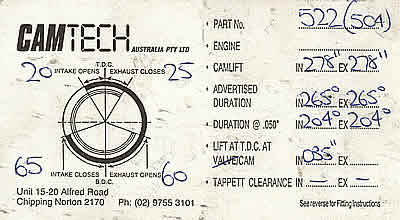
Following is the specifications of the camshaft I am using. I recommend
it for LPG conversions to P76 V8’s. It has a smooth idle and seems
to have good low end torque, but also delivers a good increase in horsepower
through the rev range. It’s a beauty.
The
Result
The car is now considerably lighter in the front end, so much so that
it sat 20 to 25 mm higher on the front suspension. I put a pair of lowered
King’s Springs in the front to sit it back down again. Even before
the lowered springs went in, it was obvious that the lighter engine
made a huge difference to the way that the car handles. It has lost
all of its understeering tendency, turns quicker, stops better and generally
feels a lot more nimble on the road. It’s not only safer but also
a lot more fun to drive.
Acceleration is quite brisk, but this is partly because the diff still
has its original 3.7 to 1 ratio. I’m hoping to get hold of a 3.3
to 1 diff centre from overseas, which will lessen the punchy acceleration,
but make the car cruise more easily on the freeway.
Comprehensive insurance quotes for the Z31 300ZX are interesting:
|
Engine type |
Agreed value |
Insurance co. |
Annual premium |
|
StandardV6 |
$12000 |
NRMA |
$607 |
|
Standard turboV6 |
$12000 |
NRMA |
$1100 approx. |
|
Converted to V8 |
$13500 |
Shannon’s |
$675 |
It now costs me only $68 more per year to insure the car as a V8. Big
deal. Interestingly, Shannon’s can also provide inexpensive ‘Laid
up’ insurance coverage for stored, unregistered cars.
Generally...
Having fold-down back seats and a lift-back, the 300ZX is very practical
and carries quite a lot. There’s plenty of head and leg room in
the front for tall people. The glass targa tops are, of course, removable
and although they have to stored away in the back, it’s well worth
the bother. It makes the car very enjoyable in summer.
The conversion took a lot of time and effort but to me it was worth
it. I now have an ‘alloy V8’ powered sports car that is
very comfortable, looks really nice, accelerates, rides, handles and
brakes very well, is cheap to run, easy to maintain at home and is affordable
to insure. And in dollar terms this can be done for less than the cost
of a Hyundai Excel. Although there are still a few things to sort out,
I’m really happy with it.
There is an incredible amount of time consuming ‘mucking around’
in a job like this. I’ve kept my description brief in this article.
I hope other club members still find it interesting.
A big “Thank you” to my dad, Wal and my mum, Jessie. They
gave me lots of assistance and had heaps of patience.
Aaron
P.S. (September 2002)
Soon I will publish an update/addition to this article. The car has
travelled nearly 80000 klm since mid 1998 when I did the conversion.
It has been quite reliable, which is just as well because I use
it as a daily driven 'hack'. No shudders or broken engine mounts
- which would have indicated mis-alignment of drivetrain. Cheap
to run, but the biggest benefit has been in the handling and braking
due to having less weight at the front. It's as if I hit on the
perfect formula with the lightweight all-alloy engine in a Z31.
|