New Flinders Ranges photo galleryThis page is fairly popular so on 2003/04/13 I created a new gallery for anyone to contribute to. If you have exceptional photos of the Flinders Ranges, I'd like to include them. Hopefully this new Internet site will become a collection of all the best photos of the beautiful Flinders Ranges. See Flinders Gallery and pass the word. |
This page provides a selection of photographs from South Australia's
Flinders Ranges: a unique area that combines interesting and
beautiful landforms with fascinating native fauna and flora.
The traveler can indulge in walks of up to several day's duration,
perhaps climbing peaks that offer wonderful views,
or if less energetic can tour by road.
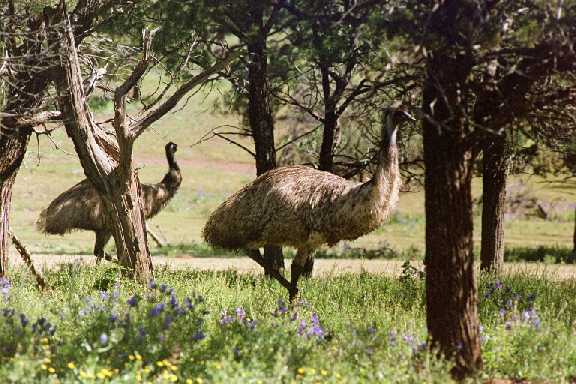
These emus at Rawnsley Park were very curious. If my wife and I sat on the ground for a break from walking the emus would come close for a look.
Click on the pictures that have a bright border to see them full size. Then use the 'back' button to return to this page.
|
Home Top Bottom |
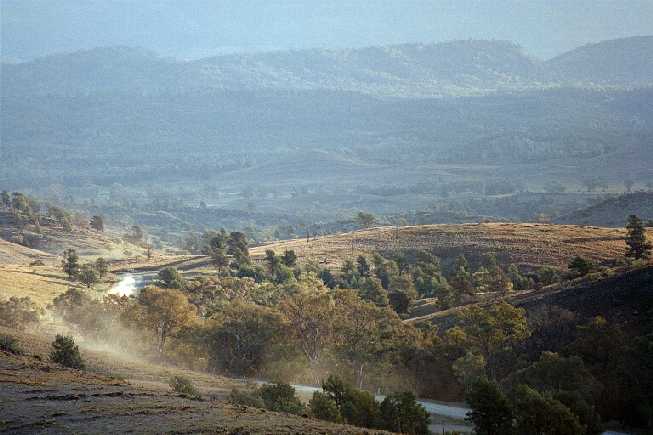 The Flinders Ranges are an extension of the Mount Lofty Ranges in
South Australia.
The Flinders Ranges are an extension of the Mount Lofty Ranges in
South Australia.
The rocks which make up the greater part of both Flinders and Mount Lofty Ranges date from late Precambrian to early Cambrian. The fossils that can be found are of very primitive life-forms. A paleontologically very significant group of fossil animals is preserved in the Flinders Ranges, called the Ediacaran Fauna. They lived a little before the great explosion of multicellular life at the beginning of the Cambrian Period.
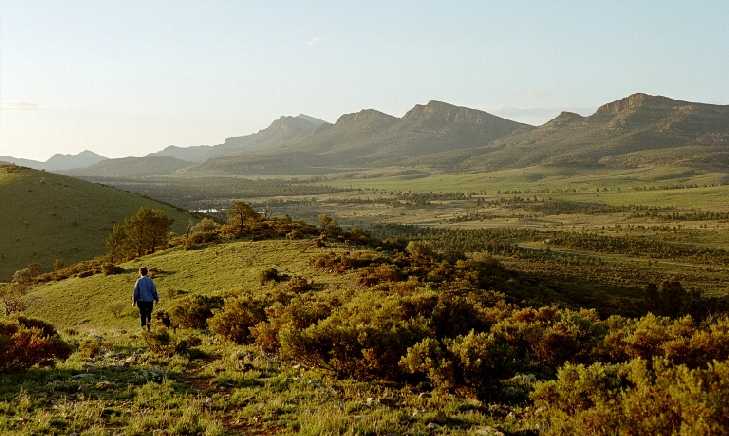
Wilpena Pound, in the background of this photo, is one of the most
picturesque parts of the Flinders Ranges.
|
Home Top Bottom |
 Left
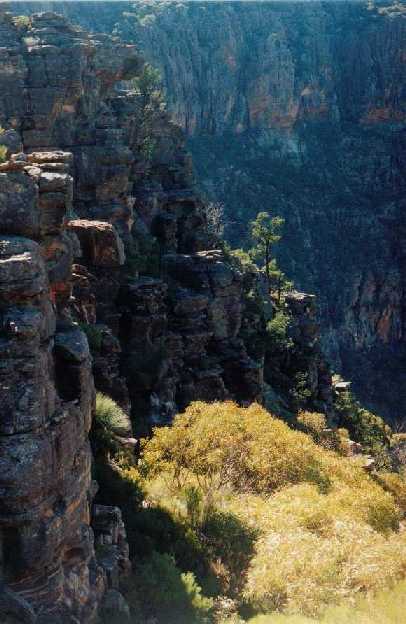
LeftThese cliffs, with their Callitris (native cypress pine) trees, are on the face of Rawnsley's Bluff. There is a well marked walking trail from near Rawnsley Park (about 35km north of Hawker and 20km south of Wilpena) up to the top of Rawnsley Bluff.
Right
A yacka (Xanthorrhoea) close to the trail up St. Mary's Peak.
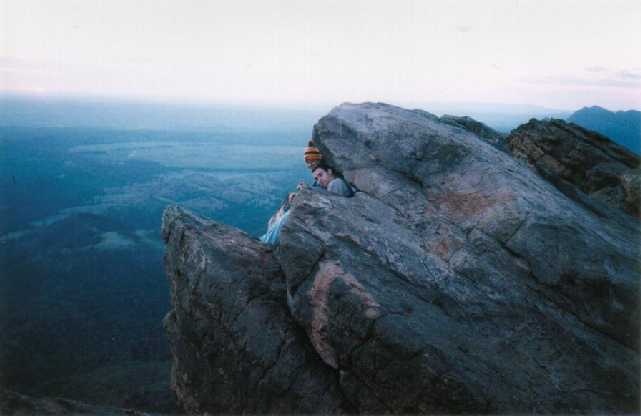 My family and I once camped on top of St Mary's Peak overnight.
It was cold, windy, and there was the occasional thundery shower,
but the 270 degree rainbow and the shadow of the mountain climbing
into the air as the sun went down made it all very worthwhile.
My family and I once camped on top of St Mary's Peak overnight.
It was cold, windy, and there was the occasional thundery shower,
but the 270 degree rainbow and the shadow of the mountain climbing
into the air as the sun went down made it all very worthwhile.
We had to find crevasses between the rocks and each of us slept in our own little hole.
I've been to the top of St. Mary's Peak at least eight times.
The view is stunning, as good as the best in the world, I
believe. It's a fairly long and strenuous climb, but if you
haven't climbed St. Mary's Peak you haven't seen the Flinders
Ranges.

|
Home Top Bottom |
 Hosted by www.Geocities.ws