| Weaverville, California |
| Weaverville is not a ghost by definition, but it does contain a great deal of history. The town was founded on July 8, 1850 by three men: James Howe, John Weaver, and Daniel Bennett. They built a small log cabin at a location to the right of the present day court house. The three men wanted to name the new town after each ones self and decided to draw pine needles (straw) for the honor. John Weaver won; thus Weaverville. In 1851 a post office was established. The first piece of mail was a letter brought to town in the hat of the mail carrier named Mr. Weed. By 1853 a school and a hospital had been established. Church services were conducted in hotels or saloons by circuit riding clegymen. By 1854 the town had 22 stores, two banks, two drug stores, six hotels, four restaurants, six saloons, three bakeries, four markets, three blacksmith and carpenter shops, seven lawyers, four physicians, and a population of 1,000 plus many Chinese. Weaverville was divided up into areas. Faggtown was the area south of town "near Weaverville", now called Mill Street. French Town was the area northeast of where Mill Street leaves Main Street. English Town was east of what is now Highway 3 and north of Lowden Park. Chinatown took in both sides of Main Street near the Joss House. Irish Town was the area near the courthouse, and German Town was up Taylor Street. During the first decade gold mining focused alonge the streams of the Weaver Basin. Gold pans, long toms, rockers and ground sluicing were used. After the "easy pickins" were finished and claims abondoned by white miners, Chinese miners came in and re-worked the area. In the 1870's hydraulic mining came into practice with the use of large monitors. |
 |
 |
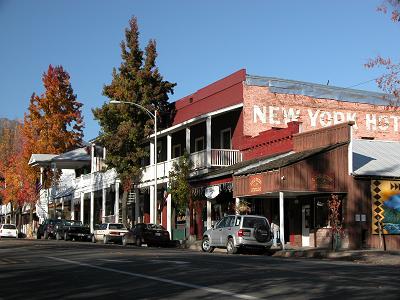 |
| These two pictures show the historical downtown district of Weaverville looking west during a sunny day in November. |
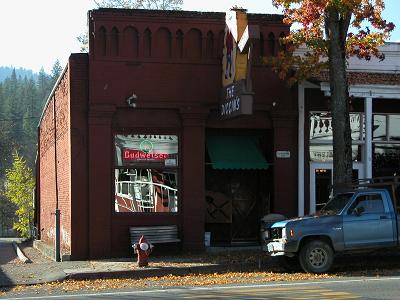 |
| The F.W. Blake Bank was built in 1856 by Moss, Mabie and Company. It originally had an awning that covered the sidewalk. The Wells Fargo Express also operated out of this location. From 1909 to 1934 the building served as the headquarters of the Trinity National Forest. The driveway next to this building once had a two-story 20'x70' brick building known as the Fagg Building. It was built in 1854 and served as a dining area for the Gibson Hall nextdoor (not seen). |
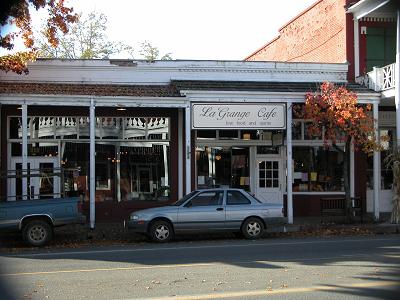 |
| The Solomon (left) and Fagg Buildings (right) are shown together in this photo. The Solomon Building was built in 1854 by A. Solomon and measures 21'x56'. In 1858 it was used by the Greenhood and Newbauer Bank. Trinity County Bank purchased the building in 1900 and stayed there until it failed in 1932. The Fagg building measures 20'x60' and was built by R. A. Fagg. In 1856 it housed the City Drug Store. The business eventually was sold to the Weaverville Drug Store across the street. In 1877 it became a warehouse. |
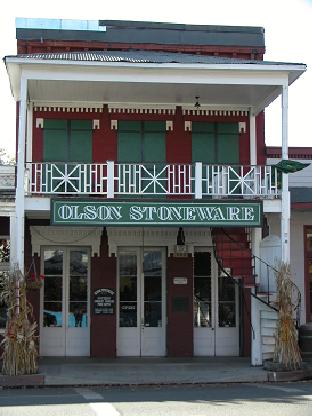 |
| The Buck and Cole building was built in 1856 and measures 23'x'57'. John Cole and his family lived upstairs while a store operated on the ground floor. In 1860 the spiral staircase was erected and the building had two owners - one for upstairs and one for downstairs. The North Star Lodge #61 of the IOOF in 1862 used the upstairs as their meeting hall, and then purchased the upstairs for $650 in 1865. Various grocery stores have operated in the downstairs location. The building still has dual ownership today |
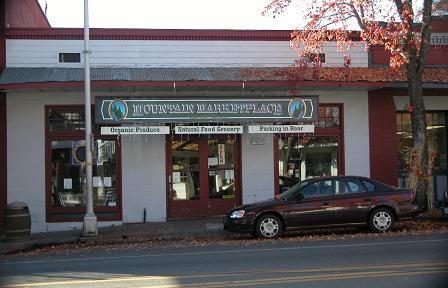 |
| In 1890 Henry Junkans built a covering between the two large brick buildings on each side. This became warehouse space for various companies. It even showed cars when the Dodge dealership came to town. A sketching from 1860 shows a two-story frame building standing here called the New Orleans Bar. |
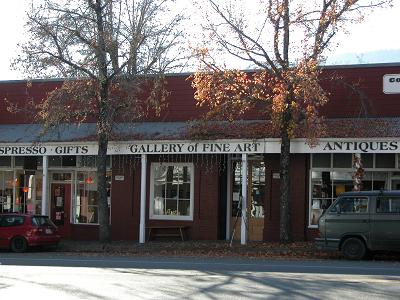 |
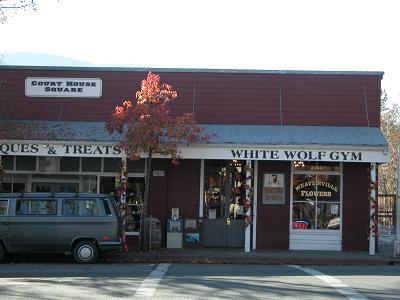
| This picture is a combination of the Eder Building (gift shop), Rhodes and Whitney Bank (gallery of fine art), McCain and Company (antiques & treats and white wolf gymt). The Eder Building was built in 1854, measures 20'x70', and is the first "fire proof" building built in Weaverville. In 1857 Mr. Eder sold the building to Joseph Kahn who operated a clothing store. In 1870 it was used as a town hall and in 1893 it was a warehouse. In 1895 Blake and Reed Company used the building to sell "gents" furnishings. The Rhodes and Whitney Bank building was constructed in 1854 and measures 21'x70'. It cost $7,000 to build. In 1867 James and Peter McCain ran a dry goods and clothing store here. In 1895 Blake and Reed Company used this building along with the Eder Building. The Weaverville Supply Company succeeded Blake and Reed until 1945. James S. McCain and Thomas Gallagher of Weverville bought the land for what became McCain and Company on August 2, 1852, and started a hardware and general merchandise business. In 1854 Mccaion hired Francis W. Blake to construct a one-story "fire proof" brick building measuring 21'x40'.. Later that year McCain hired J. M. Rhodes to build a 20'x70' The two units stand together as the McCain building. The buildings have always been some type of grocery or general merchandise business. Blake and Reed took over. Weaverville Supply Company took over in 1901 until 1945. |
 |
 |
|
| Homes |