| Running the Proto1 |
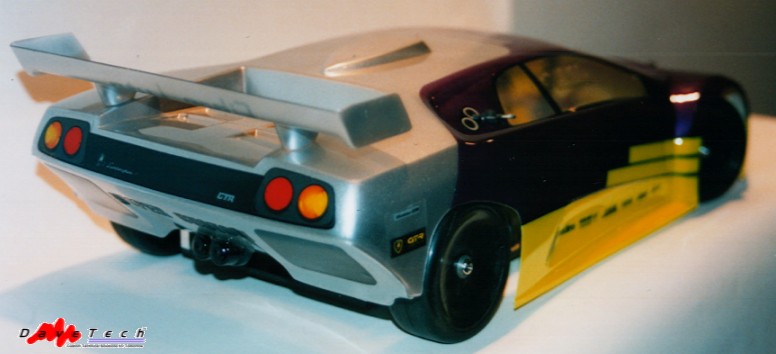 |
| The HPI Lamborghini Diablo GTR 200mm shell is a very good replica of the real car. It has a very flat windscreen and low profile. It is still not as smooth as a Pro-10 style body, but this is one of the conpromise areas of the Speed car/touring hybrid. The chassis can take any 200mm shell on the market, and as such the Toyota GT-1 may prove a better choice for flat-out running. One excellent feature of the Lambo GTR is the under-molded rear bumper, which is removable for less wind resistance. It makes the body look much more like a real car than most other RC car shells. |
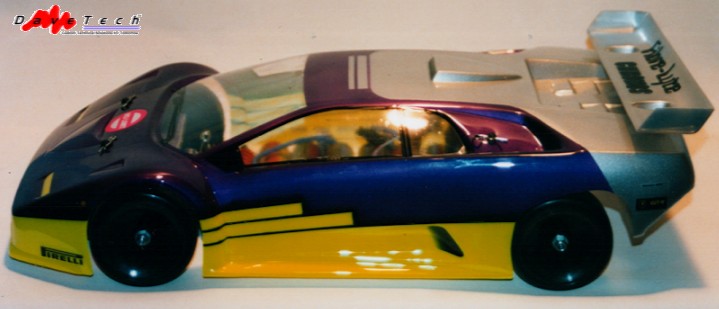 |
| A side view of this sleek body. The real yellow is a dazzling fluorescent colour which does not show up in photographs. More decals are to be added, this was a hot out of the spray booth shot. |
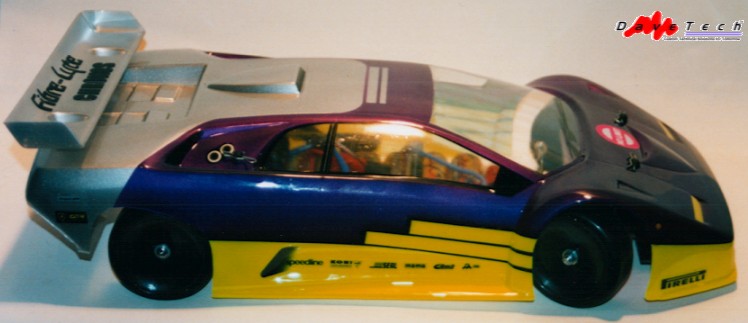 |
| The right side. Its not hard to imagine this baby slicing through the air at a fair pace. |
| OCT 2001: Initial test runs on 6 cells have been performed, one run using a standard silver-can 540 motor and RC2400 batteries, the other with an Orion 10*3 modified motor on RC2000 cells. No prizes for guessing which one was faster. The tests showed that the car has massive amounts of initial turn-in, and as with all 2wd cars, over generous throttle application gets the back end dangerously loose. This is of particular consideration here because the rear setup is obviously zero degree camber and toe in (solid axle), so traction is only gained by pure rubber-on-tarmac adhesion. I think turning response throughout a curve will be improved by increasing the caster, which is only small at the moment, and going to the circuit-type rear pod and axle configuration (pod same width as motor length - yet to be made). All in all the initial slow test runs show extremely pleasing results. The diff held up perfectly with the acceleration of the 10-turn motor. Can't wait to get my brushless in there! |
| Running a 1:10 scale car at speeds around 100mph poses the problem of where to run it. My car will go faster and be much more stable in a straight line. Large enough flat, smooth circuits are practically impossible to find anyway. Preliminary testing needs to be carried out on a stretch of wide, smooth tarmac that is straight and at least a quarter of a mile long. Luckily I just found this site today! It is a large access lane for the Cambridge Physics department. It is flood lit at night (which means I can run undisturbed in the wee hours), has practically no traffic even in the daytime and is a long way from residential areas or people who might get annoyed. Initially, timed runs will be made through a pair of markers, timed with a stopwatch by an accomplice. Not the most accurate method, but it will give me an idea of how close I am to the big boys, or if 100mph is just a pipe dream (let alone 111mph). |
| OCT 2001: Further 6 cell 10*3 motor testing, grip is now far better and some real power can be laid down. It is beginning to feel like a very fast touring platform indeed. This improvement is partly due to the extra caster added and to the tyres being broken in more, I find fresh tyres grip poorly initially. Strangely nobody else ever thinks this! Got some glitching problems though, all that ali and carbon not doing me any favors in that department. If all else fails I will change to a standard, external aerial. Aerial type changed, and car tested on speed run course for the first time. Gearing 16-81 on the 10*3, WOW this thing is fast! Because the gearing is high compared with a touring car, you have to give it a bit more time to wind up some speed, but it certainly isn't lacking in that department. Things are looking very good for the car, I can see it is going to be stupidly fast with the brushless motor even on 6 cells - however, the speed run course may not be quite big enough. The 5 or so metre wide road seems much narrower when you are travelling at these high speeds, and I am not even close to the record yet! The Proto1 is quite twitchy too, I had the steering endpoints turned down to 30% which was a vast improvement but more aerodynamic stability will be needed for the faster runs. |
| NOV 2001: First runs performed using the ModelTech B8XR brushless motor. The car has been transformed. Although extremely quick with the 10 triple brushed motor, it is now in a totally different league. I never actually pushed it all the way to full throttle, but would estimate that it was pulling over 50mph. Timed runs will only be performed when I believe I am getting close to the 80-100mph mark. There is now no doubt in my mind that this car can get to at least those speeds! The problem with these latest runs was the front of the body shell - it was being pushed onto the ground by the downforce and was scraping the tarmac badly. I have yet to make the front body support, but can not continue speed runs until this has been done, or the car will just flip forwards. Gearing is 16-81, and the car must be accelerated smoothly from a standstill because the motor's immense power will spin the wheels with ease at any throttle setting. Strangely, the faster the car goes, the quiter it becomes, and by the time it passes my standing point it sounds like you can almost hear the air buffetting off the body more than the power train. I can't wait to run this at full throttle, and that is with only 6 cells! Will my running site be big enough to handle 12 cell speed? I am beginning to have serious doubts. I am almost sure it will be too small for 18 cell running. |
| DEC 2001: The first test for the Proto1 on a touring car course under race conditions! Down at my local track at Colchester, the car had its first burn on a proper course against other cars, all 4WD touring cars. To break down the race, in the first heat I was getting used to the car, and I noticed a considerable increase in grip after the first couple of laps. It was easy to spin the car at the start, but after those first few circuits the car pulled itself together very satisfyingly, and I was able to put the power down very early and drift around the corners, sometimes with a small amount of opposite-lock, very satifying. A very smooth driving style has to be adopted with this car, but it carries way more corner speed than a 4WD car. Acceleration is worse, because of the 2WD and the very high gear ratio (even using my smallest pinion I was on a much higher rollout than everyone else). I was running a Yokomo Zero 13*2 motor, and it performed well. Actually a lot better than my Orion 10*3, due to it having more torque. I won the first heat, but was forced to retire half way through the second with a broken front bumper. It was only siliconed on and an impact dislodged it. I will make a proper bolt-on bracket and be back for sure, athough Easter is my next chance! Be warned, Colchester racers, the Proto1 is out to get itself banned from the track by kicking all your butts! |
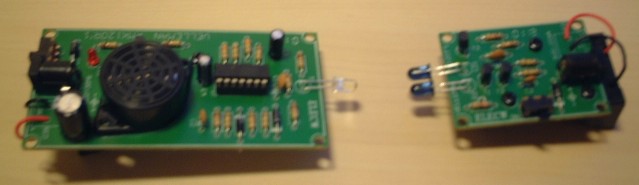
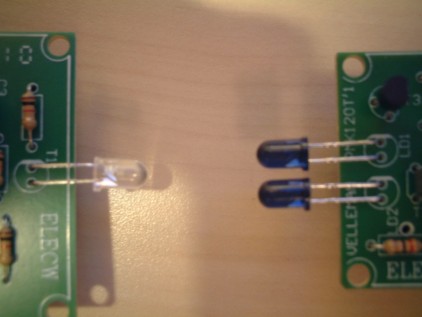
| JAN 2002: I have completed construction of light-gate number 1 for the timing system for the speed runs. This is a really nice IR beam breaker circuit that is available from Maplin Electronics, or the manufacturer's web site at www.velleman.be. It will be combined with a second IR light gate to form a speed trap. As beam no.1 is broken, the signal from the gate starts a stopwatch to which it is hard wired. The car travels the set distance, which has been accurately measured, and passes through the second gate, stopping the watch. Now you have a value for the average speed through the speed trap, which CAN NOT be more than the maximum speed of the car (i.e. there is no chance this method could be used to 'cheat'). Testing of the gate shows it to have a very narrow beam (good) and a quick response time, which is essential because, at 100MPH, the car will spend only about 1/100th sec in the beam! You don't want the gate to miss it. This is a better method than my other plan, an on-board GPS system. Although accurate to 0.1 nautical MPH (roughly 0.1MPH), the risk of smashing up a �130 GPS is a bit too great I feel. But I might buy one anyway, they look really cool! |
 |
 |
| MAR 2003: Lack of time over the past year for this project has caused little progress to be made on the run timer. However, I will be helping out in Science Week 2003 at the Cavendish Lab, Cambridge. Kids construct rubber band powered dragsters and we need a method of timing them, so I will get the IR gates rigged to work for this. I have developed a double-latching relay system with a very high rise time, to work in conjunction with a TC17 counter-timer unit which will time the interval between gates being broken. Hopefully this will work OK... a computer model of the circuit shows it to work as desired, lets hope it does in real life. Timer still needs work for use with the Proto2, because the TC17 needs an 240V AC power supply which I will not necessarily have at my test site! |