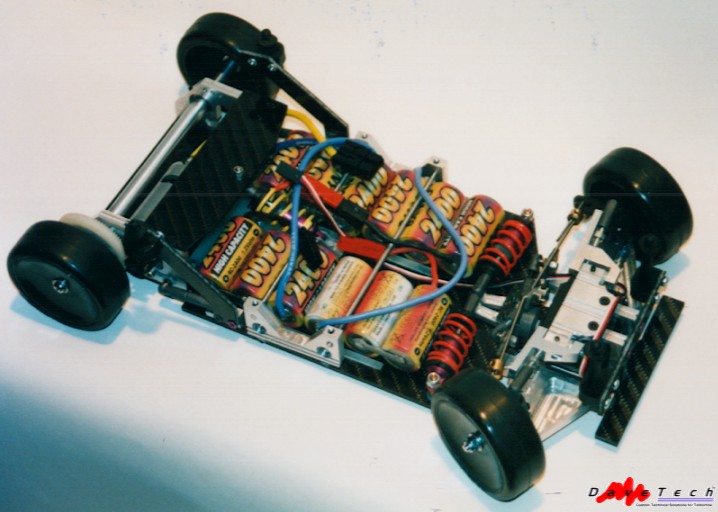
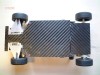
Cut from 2.9mm carbon fibre sheet, with all the screw holes countersunk such that the entire underside of the car is completely flat and smooth. Accuracy is a key factor here, drilling mounting holes as little as 0.25mm out of position can result in a terribly distorted car that would be practically useless. The use of a calibrated milling table to accurately place the workpiece under the tool helped a lot here, and a I used a centre-drill to cut the pilot holes for maximum accuracy.
BATTERY MOUNTING
There are no battery slots cut in the chassis, to stabilise the airflow underneath the car. Instead the batts are kept in position by thin fibreglass runners siliconed to the top of the chassis plate, and are held down with steel rods clamped at the chassis sides in their machined aluminium holders. 6 cells can be clamped in many different locations to suit a track, and there are clamps for 12 cells. Additional cells 13-18 are taped on top.
KEEPING IT ON THE GROUND
No matter how well the chassis flows through the air, the chassis-body combination will always find a way to send high pressure air under the car rather than over it, at high speeds. Rather than adding a large wing on the top of the car to balance these forces, I will try to decrease the pressure of the air that does travel under the car, resulting in the car staying on the floor and a large decrease in aerodynamic drag. So far this has not been made, but when the time comes to run in excess of 65mph it will quite likely have to be employed, or a wing added. |