| Magnetodynamic Damper |
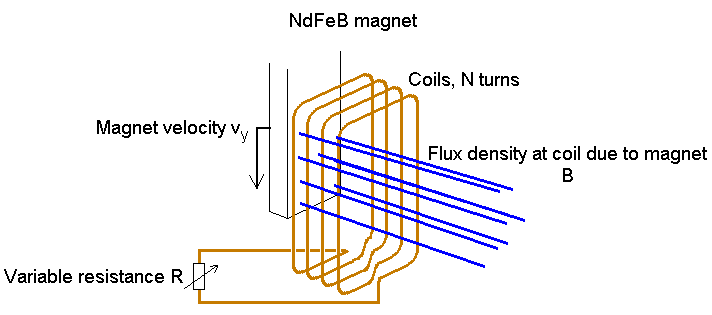
| Here's an idea I am toying with which could be used on all types of RC vehicle. I have often been frustrated when, no matter how well built, shocks leak silicone oil everywhere. Particularly on off road cars, this makes a lot of mess. The best shocks I have seen are those on 1/8 off road cars, which don't leak in my experience, but can wear out inside. The magnetodynamic damper gets around all those problems, and injects a healthy cool factor to boot. Simply, you replace the piston and oil-filled cylinder of a conventional viscous damper with a powerful Neodymium-Iron-Boron (NdFeB) magnet and a series of copper coils, connected to a (variable) resistance. You still have a spring, it is only the damping mechanism that is changed. When the suspension compresses (or extends) the magnet moves further past the coils and the amount of magnetic flux linked by the coils changes. This causes an induced voltage in the coils which drives a current so as to create a magnetic field which opposes that of the moving permanent magnet - a force opposes the direction of motion. This is Lenz's law. Another big benefit of this idea is that the force is proportional ONLY to the velocity of the moving magnet, other things remaining constant. So there is absolutely NO STICTION whatsoever. This means, assuming your pivot pins etc are bind-free, the suspension is much more sensitive to smaller bumps and ripples. BUT... Here comes the cool factor...: Because the retarding force is proportional to the CURRENT in the coils, we can change the magnitude of the force (damping coefficient) by limiting the current flow using the variable resistor. So you then have an adjustable damping coeffient just by turning a dial. If you link that to a servo in the car (small 9g type, used for indoor electric planes) you can have on-the-fly adjustable damping. Imagine in a 1/10 off road race, most of the course is small rippling bumps so you have the resistance set high, i.e. small current flow in coils and so less damping, more sensitive. Then you come to a huge jump, no problem, you will not bottom out because while sailing through the air you ramp down the resistance and increase your damping coefficient, and you land the jump with ease. If you think that's awesome, what about mixing the steering channel to the outside-corner dampers only, making the suspension slower to compress on the outside and therefore limiting body roll, allowing you to run higher and take bumps on the track better, but corner as fast as a low car. Plus, no chassis scrapes ;) THE THEORY Here's the real fun bit, read on if you are interested! |
 |
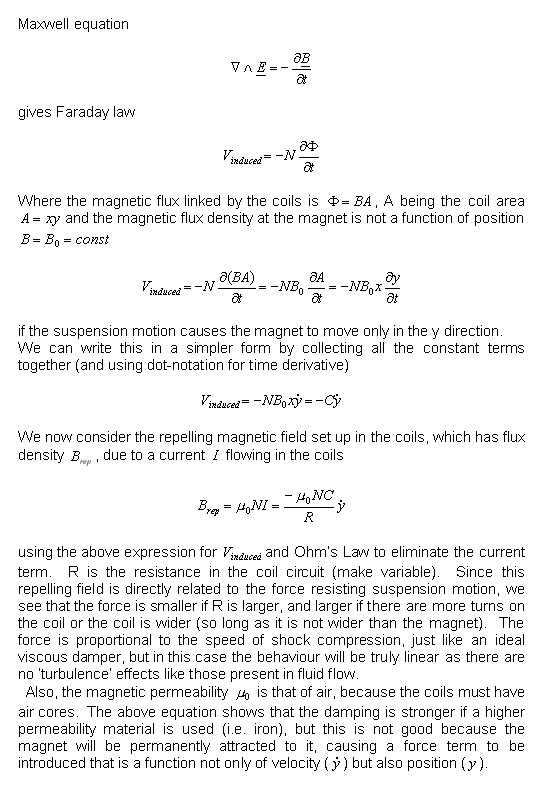 |
| Now, the final stage is to form the relation between the repulsive magnetic field and the force retarding the piston's motion. The easiest way to do this is to go back to the current I which flows in the coils and to avoid working out the repulsive magnetic field. The force on the piston will be equal and opposite to that on the coils (Newton's 3rd law) and we can work out the force on the coils by considering them as a sum of small elements of current. As before, we model the coils as N turns of wire wound into a rectangular shape, of width x. |