FILE
11:
KIBER
THE
CRUEL
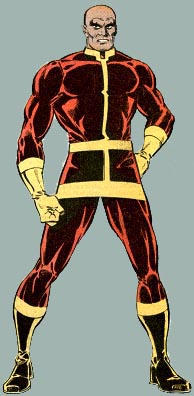 The life of Frederick Kiber is largely unrecorded; we do not know his place of birth, nationality, or relatives, if he had any. He was an imposing figure, six feet tall, black, muscular and bald, with penetrating brown eyes and a grim visage, and most importantly, he was a brilliant scientist. Kiber's speciality was matter transportation, although we do not know where he studied. He seems to have worked in isolation and was a controversial figure, since the sceptical scientific community often derided his ideas. Nevertheless, his theories on the instantaneous transmission of matter were published in a number of scientific journals, and on one occasion he was quoted as saying, "I'll make the matter transmitter a reality" in a report on the annual Science Congress meeting in America. Matter transmission was not unheard of - several criminal masterminds such as Chinese potentate the Mandarin, and also MODOK, the leader of the scientific terrorist organisation AIM [Advanced Idea Mechanics] had access to such technology [see file 93: MODOK] - but it was not generally available to the public and it was both risky and expensive. Because of the scepticism surrounding his work, it seems likely that Kiber obtained funding from some private source, quite possibly his own wealth, which must have been either inherited, earned through an enormously lucrative early career, or obtained through elicit means. However he acquired it, he did indeed obtain funding and established a laboratory complex inside a mountain island in the South Atlantic Ocean. There, he set to work, with a work force of his own creation. Because of his radical ideas, his status within the scientific community was that of a pariah; as such, he found it difficult to get lab assistants and colleagues and so constructed his own. Kiber's androids were squat, ugly humanoids with strength slightly greater than that of a human. Nonetheless, he also seems to have had at least one human assistant or colleague, as well shall see. From his mountainous island base, he continued his research into matter transmission, at some point discovering how to make objects intangible; he conferred this ability on his androids, allowing them to pass through solid matter. Finally, his experiments reached the point of success and he achieved matter transmission. He quickly tried transmitting himself with the technology, with catastrophic results.
Frederick Kiber was transmitted through space, but when his matter was reassembled, it was not reassembled, as it should have been. Twisted and altered, Kiber's body materialised halfway into the floor of his laboratory; he was bonded permanently to the ground. Deformed and bonded to the molecular structure of the floor, he could not move and could barely speak. The large portion of his body that was visible above the tiles was horribly misshapen, with bulging veins running across the swollen yellow mess that was his skin, and his bloodshot eyes protruded from lidless sockets. His legs were fused completely into the floor, but his arms remained free, although this was of little practical use. In such a predicament, he would soon die. However, one further change had been wrought upon him as a result of his accident; despite his situation, he was unable to ignore a growing hunger, which gnawed away at his thoughts. Still in control of his androids, he instructed them to provide food, he devoured ravenously; after several days however, he realised that he was still not sated and that death was still rapidly approaching. Then somehow, he discovered a new source of nutrition and everything changed. I have noted above that Kiber must have had at least one human associate in his isolated island laboratory, and it is here that we see why this must have been the case; Frederick Kiber discovered that he could satisfy his insatiable hunger by draining the life-force of others. The process worked by converting his victim from matter to energy, in much the same way that the first stage of matter transmission works. Rather than then transmitting this energy to a destination point and reassembling the subject, Kiber absorbed it and fed off the unique spectrum of energy produced by the human body. Exactly how he discovered this and converted his first victim into energy is uncertain, but somehow he did and it sated his hunger in a way that food had not. Suddenly realising that by feeding thus he could remain alive not only in the short term, but indefinitely, he began ordering his androids to complete his experiments into matter transmission, and also building apparatus that could easily convert humans to energy and channel this energy into Kiber. They quickly accomplished this task and from his position fused to his laboratory floor, Kiber, with his head now supported by a skeletal life-support system, began to direct them to find more food. Kiber's modus operandi was simple; his androids used his now perfected transmat technology to materialise in some populated location and abduct people to transmat back with them to Kiber Island. By using their intangibility, they could hide inside walls or other solid objects, and thereby operate with stealth, to avoid detection. They were also equipped with devices that could make others intangible, allowing them to pull victims into solid objects and overpower them out of sight. Furthermore, he presumably only allowed his androids to take so many victims from a particular location before ordering them to move on, thus also helping to prevent discovery. In this way, he orchestrated the kidnapping and deaths of numerous people, until his deformed body had been swollen to gargantuan proportions by his endless feeding. Then one day, he made a fatal error, as his androids were ordered to switch to a new location for their harvesting, the tiny African nation of Wakanda.
Wakanda was a country like no other. Centuries before, it had been the site of a meteorite landing, which had resulted in the huge meteor forming a small mountain in the Wakandan soil. The local people had discovered that the strange alien metal comprising the mountain had unusual properties, most notably the ability to absorb sound waves and other energy. The named the metal vibranium and the mountain the Sacred Vibranium Mound. It became the centre of their culture. Using the vibranium, the created technology that made that of the Developed World seem primitive, and their lifestyle became extremely sophisticated; however, they kept their traditional tribal roots and achieved an enviable balance between science and respect for the largely jungle environment of their country. Wakanda grew strong, but managed to maintain their isolation, preferring to avoid the outside world. Under the leadership of the Black Panther, they flourished. The Black Panther was a hereditary title passed down through the Panther tribe, although it could be won through a successful tribal challenge. The Black Panther wore a costume designed to resemble his namesake, and which was original made from the skin of a real Black Panther, and they ate a strange heart-shaped herb that grew on the slopes of the Vibranium Mound, which gave them enhanced strength, speed and agility. The Black Panthers had ruled Wakanda for generations. One day, a German prospector named Ulysses Klaw came to Wakanda in search of the legendary Vibranium Mound, of which he had learned. The Greedy Klaw had befriended T'Chaka, the Black Panther at that time, only so that he could betray him and take control of Wakanda's vibranium. Treacherously Klaw killed T'Chaka. His plans were undone however by T'Challa, T'Chaka's son. He used Klaw's own sonic weapon, which was powered by vibranium, to shatter Ulysses's hand, then as the new Black Panther he drove the invaders from his country. That had been years ago, and since then T'Challa had ruled his country successfully. He had also come to prominence by joining the American Super-Hero team the Avengers, after an encounter with their fellow hero team the Fantastic Four had made him take notice of the growing size of the super-human population. During this period, he had often spent time in America, whilst a regent ruled in his stead, but he was currently back in Wakanda, reigning benevolently over his people. It was during this period that Kiber sent his androids to Wakanda to procure fresh victims.
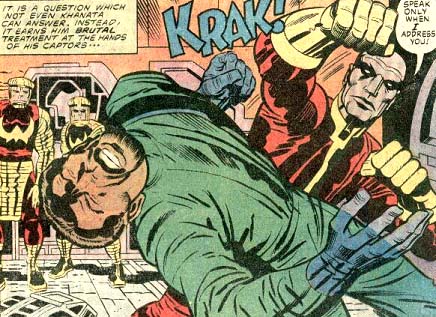 Kiber's androids arrived in Wakanda inside a rock face of Panther Mountain, one of the major obstacles to anyone wishing to easily enter or leave Wakanda by land. Their first victim was soon detected; a young man had driven out to the mountain in a sports car for some peace and quiet, and simple because he loved the thrill of car racing. Emerging from the rock face, they approached from behind and seized him, making both themselves and their captive intangible and drawing him back into the rock face, from where they then teleported back to Kiber Island. By coincidence, their captive was Khanata, a cousin of the Black Panther. Once he arrived in Kiber's lair, he came face with his true captor. More accurately, he came face to face with a projected image of Kiber, which looked like the scientist had done prior to his accident. Thus, Khanata found himself in the company not of a bloated, deformed cadaver, but an intimidating and impressive figure, garbed in a red and gold uniform that matched the colour of the androids. Through this projection, the real Kiber could see and hear all that was occuring; moreover, like the androids, the projection could be either tangible or intangible, which meant that Kiber could make it solid and take a direct hand in operations. For some reason, Kiber liked to explain to his captives that they had been talent to provide him with power, although he never told them about his true predicament. I believe that, given the matter-of-fact nature in which Kiber's projection relayed this information, that his arrogance genuinely made him believe that he was justified in killing people in order to feed, and that he wished to justify their fate to them. However, he also enjoyed toying with his prisoners; Khanata was armed when he arrived and opened fire on the Kiber image, only to see him vanish and reappear out his line of fire; panicking, he threw the now-empty gun at the scientist, and watched in disbelief as Kiber made himself intangible and the weapon passed through him. Amused, Kiber then made himself invisible save for his hands, which now tightened around Khanata's throat:
"It would defeat my purpose to destroy you! But you must be aware that I can!"
Releasing Khanata's throat, Kiber made his facsimile fully solid and visible once more, and threw him through the hatchway leading to the holding cell. So far, he had only told Khanata that he needed him and others to provide power; not fully aware of the truth yet, Khanata assumed that he needed slaves to serve him and provide him with an army, a misapprehension that Kiber did nothing to correct. Khanata would find out what was truly in store from the other prisoners.
Kiber's androids arrived in Wakanda inside a rock face of Panther Mountain, one of the major obstacles to anyone wishing to easily enter or leave Wakanda by land. Their first victim was soon detected; a young man had driven out to the mountain in a sports car for some peace and quiet, and simple because he loved the thrill of car racing. Emerging from the rock face, they approached from behind and seized him, making both themselves and their captive intangible and drawing him back into the rock face, from where they then teleported back to Kiber Island. By coincidence, their captive was Khanata, a cousin of the Black Panther. Once he arrived in Kiber's lair, he came face with his true captor. More accurately, he came face to face with a projected image of Kiber, which looked like the scientist had done prior to his accident. Thus, Khanata found himself in the company not of a bloated, deformed cadaver, but an intimidating and impressive figure, garbed in a red and gold uniform that matched the colour of the androids. Through this projection, the real Kiber could see and hear all that was occuring; moreover, like the androids, the projection could be either tangible or intangible, which meant that Kiber could make it solid and take a direct hand in operations. For some reason, Kiber liked to explain to his captives that they had been talent to provide him with power, although he never told them about his true predicament. I believe that, given the matter-of-fact nature in which Kiber's projection relayed this information, that his arrogance genuinely made him believe that he was justified in killing people in order to feed, and that he wished to justify their fate to them. However, he also enjoyed toying with his prisoners; Khanata was armed when he arrived and opened fire on the Kiber image, only to see him vanish and reappear out his line of fire; panicking, he threw the now-empty gun at the scientist, and watched in disbelief as Kiber made himself intangible and the weapon passed through him. Amused, Kiber then made himself invisible save for his hands, which now tightened around Khanata's throat:
"It would defeat my purpose to destroy you! But you must be aware that I can!"
Releasing Khanata's throat, Kiber made his facsimile fully solid and visible once more, and threw him through the hatchway leading to the holding cell. So far, he had only told Khanata that he needed him and others to provide power; not fully aware of the truth yet, Khanata assumed that he needed slaves to serve him and provide him with an army, a misapprehension that Kiber did nothing to correct. Khanata would find out what was truly in store from the other prisoners.
Inside the cell, Khanata met his fellow inmates. They were apparently American, implying that the last location of Kiber's harvesting of victims had occurred somewhere in that vast country. More importantly, they were utterly terrified; they had tried, and failed to overpower the android guards as they had taken victims one at a time, but more than that they were afraid of their ultimate fate. Sadistically, Kiber had set up the apparatus designed to convert his prisoners into pure energy directly opposite the transparent hatchway leading into the cell. Shortly after Khanata was thrust into the cell, the androids took their next victim, who was a bespectacled young American man. Khanata tried desperately to pull the screaming prisoner free of the android guards' grip, but they were too strong and his fellow captives were too demoralised to try and help him. Frustrated by his failure, Khanata picked himself up off the floor, where a casual blow from one if the androids had sent him sprawling, and moved over to the hatch to see what was happening. The other prisoners had refused to discuss what was to happen to them, and Khanata now realised why. As he watched, the androids forced the young man into a steel cabinet with a heavy door, which slammed shut, trapping him inside. Atop the chamber was a dull crystalline polyhedron. As Khanata watched through the glass, the projection of Kiber manipulated the control panel off to one side of the room and with an accompanying thunderclap the metal chamber suddenly glowed like a star. When the glow faded and the metal door swung open, the chamber's smoking interior was empty and the crystalline polyhedron now shone brightly. Moving towards the equipment, Kiber reached up and lifted the crystal down, holding it almost reverently. Hearing Khanata's disbelieving remark that the young prisoner had vanished, Kiber smugly corrected him:
"Instead of existing as mass, he now functions as energy... ...sorely needed energy! Power for Kiber! Life for Kiber!"
Now realising the true reason that Kiber had not wanted to kill him earlier, Khanata yelled his defiance and cursed the scientist; trapped behind the transparent barrier however, he could do little. Little that is, save communicate with his cousin in Wakanda...
Several days prior to Khanata's abduction, T'Challa had been buried in the slopes of the Vibranium Mound. This had happened during a fight to the death with the hideously mutated Jakarra, an enemy who had deliberately used the mutative powers of Vibranium to empower himself. It had worked too well, and he had become a mindless monster which would have destroyed the world had the Panther not stopped him. Whilst defeating Jakarra, the Panther had been trapped amidst falling rubble and although he had been rescued, he had discovered that this short-term exposure to so much Vibranium had temporarily given him limited psionic abilities. The first he had known of these was when he had been plagued with a recurring nightmare in which grotesque red and gold figures tried to kill him. These were Kiber's androids and although he had not realised it at the time the dream was actually a partial premonition of his future. Later that day, he also discovered that besides limited clairvoyance, he had other abilities; suddenly, a feeling that Khanata was in trouble overwhelmed him. He was of course quite correct; deciding to trust what his new instincts were telling him, the Panther set out in search of Khanata and soon tracked him to the cliff-face at the foot of Panther Mountain. There, he realised that he dreams were not mere dreams; in one such vision his red and gold attackers had passed through solid rock, and all of his instincts told T'Challa that Khanata had somehow been taken through the rock face. The silent attackers were real and had taken his cousin. Returning to his palace, he pondered his new abilities and whether or not they could help him rescue Khanata and stop whomever was kidnapping his subjects. He thus discovered a third ability, which was limited telepathy. Reaching out blindly with his mind he managed to locate Khanata's terrified thoughts. Khanata could scarcely believe that the Panther was communicating with him from afar, but he was too frightened to question the fact at this time. Instead, he begged T'Challa to save him from Kiber. Before he lost contact with Khanata, the Panther promised to save him. He then ordered his aide Joshua Itoba to find out everything he could about something or someone named Kiber, and then set off back to Panther Mountain to try and find some way of tracing the kidnappers.
Back on Kiber Island, Khanata had no sooner lost contact with T'Challa than Kiber was ready for another victim. Once more Khanata tried in vain to stop the androids and once more he failed. Kiber activated the chamber once more and another prisoner was transformed into energy and stored in the polyhedron atop the machine. The Kiber projection again removed this "energy tube" and held it aloft almost reverently. This time however, as Khanata once more watched and listened, he revealed plans far beyond mere survival:
"My power grows each time I fill these tubes! Soon I'll be strong enough to make them legion! And that will be the day when I control this planet!"
Kiber's megalomania had grown to proportions as disproportionately large as his real body. Since the energy tubes were now charged with enough regularity to sate his hunger, he could begin stockpiling them until such time as he needed not only to feed, but also to massively increase his own power and perhaps even devise some method of freeing himself from his laboratory floor. Regardless of his ends, his means were clear; he intended to expand his operations and farm the entire human race. Enraged but helpless, Khanata defiantly yelled that his cousin T'Challa would soon arrive and stop him. Unknowingly, he guaranteed the Panther's arrival; intrigued by the man Khanata described. Kiber demanded to know more of him and subsequently sent his androids back to Wakanda to fetch him. Kiber's ego was such that the possibility of defeat at the hands of the Panther never even occurred to him, whilst on the other hand it appealed to him to absorb the life force of a Monarch, and especially one with powers greater than those of a normal human.
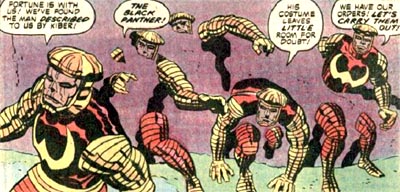 Back in Wakanda, the Black Panther had reached Panther Mountain once more when the androids appeared from within the rock. Recognising them from his dreams, T'Challa attacked. The androids were stronger than a normal human, but T'Challa's body was honed to the peak of human fitness and his reflexes had been enhanced by the properties of the heart-shaped herb that he had eaten long ago. The Panther managed to stun two androids through brute force alone and sent another careering into its fellows. Realising that they would need different tactics to complete their mission, one of the androids used the device capable of rendering objects intangible to change T'Challa's atomic structure so that he could be pulled into the cliff-face. The shock of transformation knocked T'Challa out. He was dragged into the cliff-face and transmatted back to Kiber Island. Meanwhile back in the royal palace, Joshua Itoba and the Panther's personal physician N'Gassi had found out who Frederick Kiber was. They had cross-referenced a variety of scientific journals and had found his old papers on matter transmission. They immediately realised that his research had succeeded and that he had used his matter transmitter to reach Wakanda and take Khanata. Unfortunately, by the time they had deduced this, news reached them that the Black Panther had vanished just as Khanata had done. T'Challa was learning the truth about Kiber firsthand.
On Kiber Island, the Kiber projection faced his black-garbed guest. The Panther already knew enough from Khanata's experiences to now that he was dangerous; deciding to explore all his options he tried his new telepathy on Kiber but found that he could not lock onto his thoughts. He quickly changed tack and launched himself at the imposing figure before him; his reflexes were fast, but not fast enough and Kiber had vanished by the time he had crossed the distance between them. Whirling round, T'Challa saw Kiber standing behind him, and as he looked on the scientist made parts of himself invisible to emphasise his abilities. Having exhausted his repertoire of tricks designed to impress new guests, Kiber ordered the Panther to move over to the conversion chamber whilst Khanata and the other prisoners watched through the cell door. It appealed to him to destroy the man in whom Khanata had placed so much faith while Khanata looked on unable to help. What Kiber did not realise was that Khanata could help and that the Panther was already instructing him as to how. Telepathically, T'Challa told Khanata to rally the other prisoners and break out of the cell. Despite their previous apathy, Khanata's faith in the Panther had given them hope and in any case they realised that they had nothing to lose; if the guards did not kill them, then Kiber would turn them into batteries. Surging forward they forced open the cell door and erupted from their prison. Immediately the Kiber projection vanished, leaving the androids to tackle the escapees. As the prisoners fought the guards, T'Challa seized his opportunity and made his break for freedom. Kiber had seriously underestimated him; whilst Khanata and the Americans had been impressed with Kiber's vanishing trick, T'Challa had realised that he was just a projected image, in part because of his own failure to lock onto Kiber's mind, and in part simply due to his long experience with unusual foes both alone and as a member of the Avengers. As he neared Kiber's laboratory, the scientist sent his image to confront him. Facing T'Challa, the projection acknowledged that it was a hologram, but added that this did not make it harmless; it channelled energy through its eyes and unleashed the twin beams at the Black Panther. T'Challa easily dodged and the floor where he had been exploded under the onslaught. Before the Kiber image could fire another blast, the Panther tore a steel strut from the damaged floor and hurled it at the image. As the iron-based metal penetrated the intangible image, it shorted it out. As it dissipated, the Panther moved forward towards the real Kiber. This close to the laboratory he could telepathically feel Kiber's fear of discovery by T'Challa. He suddenly knew that Kiber was frightened because he was "big and clumsy...anchored to the ground". Reaching the laboratory door, T'Challa swung it open and came face to twisted face with the real Frederick Kiber.
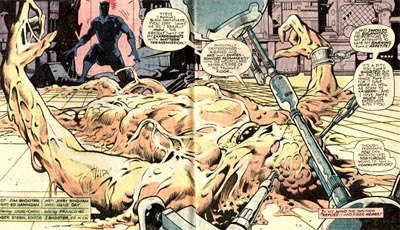 The sight before him surprised even T'Challa. Unable to speak properly anymore, Kiber croaked out a greeting, lamenting that the Panther had destroyed his projected image, since it provided him with a voice. Despite Kiber's crimes, T'Challa wanted to know how he had reached this predicament and why he was kidnapping and transforming innocent victims. Kiber too wished to talk, to explain his plight to someone human, even if they were an enemy. Consequently, when the Black Panther reached out telepathically, Kiber seized the offer of communication and the pair began to confer. Kiber explained the details of his accident, and he also explained why he was feeding off life-energy and why he felt justified in doing so. He explained that his victims did not die; rather they lived on within him. With growing unease, T'Challa began to realise that Kiber's philosophy, whilst fascinating, was also both dark and unshakable. This was confirmed when Khanata ran in. The battle between the prisoners and the androids had been going poorly, and most of the prisoners had been forced into the conversion chamber. The last few had begged Khanata to escape and find the Panther, but by the time he reached Kiber's laboratory, the two Wakandans were the only remaining humans on the Island save for Kiber himself. As T'Challa explained that the misshapen mass on the floor was Kiber, the deformed scientist suddenly struck. He had been stalling T'Challa until help arrived just as the Panther had been seeking to stall his plans, but now he had detected his androids approaching. His massive right arm was fused into the floor up to the elbow, but the forearm, normally supported by a harness, still worked. Taking advantage of T'Challa's distraction, he smashed his fist down on the Monarch, just as androids arrived and seized Khanata. They then attacked the Panther, who had realised that Kiber had been feeding on his life force whilst they had communicated telepathically. T'Challa could still fight, but Kiber had made himself stronger and the Panther could not physically outfight him. Furthermore, Kiber had ordered his androids to employ lethal force and they unleashed lasers. Outnumbered, the Panther nimbly dodged the blasts and dived into the base's extensive air-conditioning system through an open hatch. Furiously, Kiber ordered the androids to find and kill him and they spread out through the base.
In the ducting, it occurred to T'Challa that the androids had not perused him through the walls. He deduced that the walls must have been constructed of a material through which they could not pass. Deciding to test this theory, he kicked an air vent grill out of the wall, jumped down after it and then wrapped it round the android waiting in the corridor below. The android stopped moving. The Panther was growing increasingly skilled at disabling the androids, having realised that a hard blow to the head would deactivate them also; thus, when he spotted a group of androids heavily guarding a door, he realised that it must be important. Disabling the guards, T'Challa opened the door and found himself outside. It had opened near the peak of the sheer rocky protrusion from the ocean that was Kiber Island. Sea gulls circled the cliffs and near the base where it met the sea some sparse vegetation clung, but aside from that nothing gave away the fact the rock was habitable. T'Challa determined the Island's position from the stars, and then annexed it in the name of Wakanda. This was an unusual move, but an effective one; it gave him absolute authority over the Island and its occupants; the Black Panther now legally had the power of life or death over Kiber.
Back in his laboratory, Kiber was demanding more energy. Khanata had been dragged away to the conversion chamber, and since Kiber's projected image was no more, he had arranged for the energy to be transferred to a waiting energy tube in his laboratory. Unbeknown to him however, T'Challa had reached the holding area and had overpowered the androids attending to Khanata. The tube atop the chamber was already glowing with the energies from the other prisoners, but most of their essence, including their psychic energies, had already been transmitted to Kiber. Realising thanks to his telepathy that the remaining energy was non-sentient, but still considerable, T'Challa pulled the tube from its housing and then smashed it down upon the conversion chamber. The release of energy destroyed the chamber and most of the holding area. Making sure the unconscious Khanata was safe and uninjured, the Panther made his way to the laboratory and a final confrontation with Kiber the Cruel.
In his lair, Kiber listened as the T'Challa's voice rang out through the intercom, promising to come and finish the conflict. Angry and afraid, Kiber ordered his remaining androids to find him and bring him to the laboratory in chains. For many minutes, Kiber remained alone, waiting for news. He waited and waited until the gnawing hunger returned and he cried out to his guards for sustenance. Finally, the Black Panther appeared in the doorway. The guards were all destroyed and Kiber was finished. As he begged T'Challa to give him the energy of the full tube perched atop the console nearby, but just out of his reach. T'Challa picked it up, weighed it in his hand, and announced that he would have his scientists try and find some way to restore the people whose energies and essences were trapped within the globe. Desperately, Kiber begged T'Challa to feed him, making one last, slurred plea:
"You don't underrsstand. It'ss like paradisse - - eternal - - with none of the problemss of individual exisstencce. No loneliness, no warss - - no conflict. It iss a grreat contribution."
The Panther disagreed; the occupants of the energy tube had their own lives to live. He turned his back on Kiber and turned his attention to returning himself and Khanata home. As he left, Kiber said "But - - I'll perish!" T'Challa simply replied, "I know."
The Black Panther returned home with his cousin and his psychic abilities did not last long before the effects of the Vibranium exposure wore off. We do not know how long it took Frederick Kiber to die. Kiber Island remained Wakanda's and as such it was quarantined until after Kiber effectively starved to death, deprived of the life-energies he needed and unable to help himself. What became of his body is unknown, but we can assume that it was cut free and destroyed. It was an ending more than deserved by this man who had stolen hundreds of lives to preserve his own warped existence.
References:
"Kiber the Cruel" and "The Kiber Clue" from Black Panther (vol. 1) issues 11 and 12, both by Kirby (writer), Kirby (Pencils), and Royer (Inks); and "What is... ...and What Never Should Be" from Black Panther (vol. 1) issue 13 Shooter (plot), Hannigan (script), Bingham (Pencils), and Day (Inks); Jack Kirby's Black Panther series was unpopular at the time and remains a source of mixed opinion today. I like it because of the art, but this is not solely the reason. With his stint as writer and artist on Captain America around this time, he was criticised for poor characterisation, seeming to concentrate more on plot. His introduction to Black Panther of a supporting cast in the shape of aides and a Royal Family seems to me to be an effort to avoid that with Black Panther and to an extent he succeeds; Khanata for example is a reasonably well-rounded character and it's interesting to see his awe of his cousin. Kiber gets the bio treatment because of this; Kirby's villains tend not to be as memorable as those he created with Stan Lee [or Joe Simon in the case of a certain Star-Spangled Avenger's arch-nemesis], but there are exceptions such as Arnim Zola or Warlord Kro - Kiber is hardly in their league, but his modus operandi is so unpleasant that he impressed me when I read these issues.
With Kirby off the title with issue 12, the story's finale takes place under the direction of Jim Shooter, although Kirby presumably provided the story idea. The ending, with the Panther coolly acknowledging that Kiber is going to die, nicely highlights the differences between T'Challa and Cap. The art in issue 13 is great too. All in all, this story gets a 6/10.