The criteria for
the judgement of correctional methods for crime with specific reference to
sentenced prisoners, consists of two main groups. Although the present regime
in Australia focuses on only one of these groups, recent research in Missouri
has shown good measure for what works by accounting for two treatment criteria.
This has a similar theme to the investigation strategies for fraud, defined as
complex and standard fraud investigations (Working party team, 1992), however
in this paper it shall be stated that two categories for offender management
exist. These two categories are (i) low risk offender & (ii) special needs
offender (See Chart 1, p 3.). Both groups of offenders invite the standard
aspects of re-socialization however the special needs groups invite extra
special considerations based on individualized needs. Wether or not that these
programs are fully and appropriately developed in special needs groups is most
controversial although Day and Howell (2000) report that the present criteria
for effective treatment is having an increasing effect on recidivism despite
the recent statistics that show no change and if not a worsening situation
(Prisoners in Australia, 2001).
The recommended
treatment for low risk offenders however has shown a statistically significant
decrease in recidivism though the results pertain to the Missouri justice
departments parallel universe project (Schiro, 2000). Perhaps this is why an
associate of mine who lives in Missouri, claimed how Missouri was the sixth
safest state in terms of crime rate in The United States (Lee, 2000). The
decrease in recidivism in the Parallel universe program is attributed to
targeting development factors that cause weak internal behavioural tendencies
to emerge many of which are not internally criminogenic and more likely to be
external to the individuals such as dysocial circumstances or poverty.
|
Chart 1. Basic 2 Class corrections model plus Effective Treatment
Principles. |
||||||||
|
* High co-morbity
with offenders in special groups ** An
exception for substance abuse co-morbity: for low risk offenders this issue
presents the most complexity often mimicking high-risk symtomology. *** Substance
abuse is often accountable as the pathological cause of deterioration of
internal behaviour mechanisms – once treated offender may be completely
eligible for low risk offender management. ****
Criminogenic: factors directly relating to offending behaviour; Non
criminogenic: needs which in them self may not cause offending, though need
to be addressed. *****
Offenders should be advised that the prison system is not there home. |
||||||||
The focus of Parallel
Universe (Schiro, 2000) was to apply positive normative socialization with an
emphasis on strengthening pro-social behaviour through processes that
internalise these values with positive reinforcement. The fact that some
offenders have special needs and attract special needs treatments slightly
confounds the explanation of which offender group is benefiting the most in
terms of the reduction of recidivism. It is believed however that many
individuals in the special needs groups who receive treatment for specific
individual criminogenic needs also have non criminogenic needs similar to low
risk groups. It is therefore possible that special needs offenders will require
greater resources and longer treatment programs however it is not sensible to
say that one group receives a priority over another because the rights of all
offenders are equal.
Every day each individual faces situations or dilemmas were one might have to resist temptation or run the risk of committing an offence, though some people manage to resist the temptation. Of those who offended and were sentenced in 2001, 59% had already served at least 1 prison term, which indicates that being sentenced to prison in Australia is not an effective deterrent if we judge it by recidivism (Prisoners in Australia, 2000). The principle which is paramount to effective treatment of crime at the correctional level centres on wether or not those who receive a prison sentence benefit or not by not offending again and receiving another prison sentence, which is referred to as recidivism. Recidivism refers to the chronic tendency towards repetition of criminal or antisocial behaviour patterns, or simply a repeated or habitual relapse into crime. It should be noted however that mandatory sentencing is only available in a small number of serious offences such as Murder, or Burglary in circumstances of aggravation at most Australian Jurisdictions (Criminal Code of WA). The Judiciary must use imprisonment as a means of last resort (Kenny, 2000). In this way prison serves as a means of incapacitation for those who offend habitually and those who commit a serious offence were mitigating factors are absent or minute. Distinguishing between high risk and low risk offenders may be difficult as a majority are recidivists. Special groups by offence type and further special classification helps to distinguish between high and low risk offenders (Day and Howells, 2001). For example Hare, Hart & Harpur reported that 80% of all prisoners are diagnosed with APD however of these there is only 15-25 % who qualify on the PCL as psychopaths (Hare, Hart and Harpur, 1991). The major differences between the PCL and the DSM IV anti social personality disorder arises from the additional personality components outlined in factor 1 which are not a feature of the DSM IV. Pscyopaths offend 90% more often and there offences vary more (co morbity) with a greater degree of seriousness. Making this distinction with offenders helps establish a varying degree of risk among sentenced prisoners thus aids a thorough assessment of treatment applications.
It is strongly
identified by correctional psychologists (Day & Howells, 2002; Howell &
Day, 1999; Howells, Day, Byrne & Byrne, 1999; Howells, 2000) that
identifying the needs of offenders based on empirical data can help in a number
of ways to maximise the effectiveness of any means of reforming any offender.
Presently however Howells and Day (2001) report that there are 5 principles for
maximizing the appropriate matching of offenders to effective treatments. These
are outlined in table 1, being risks, needs, professional discretion and
program integrity. Hollin (cited in Day and Howells, 2002) also report the same
principles though has included the fact that most treatments for treatment of
special needs offenders were most successful at a community based level in
comparison to the results of prison based programs. This is related to the
restricted function of imprisonment though this is discussed later on in the
paper in terms of promoting decision making (Schiro, 2001).
|
Adapted from C Carcach,.
& J., Chisholm., (2000) Imprisonment in Australia: Sentenced Prisoners.
AIC: Canberra. |
Day and Howells
(2002) report strictly on psychological treatments for high risk offenders with
specific criminogenic needs, such as illicit substances related offenders,
violent related offenders sex offenders and the co-morbity of such offences and
they do not focus there reports on the low risk offenders. They also report
that low risk offenders do not suit such programs (Day & Howells, 2002).
This is an interesting aspect since the Judiciary have stated in at least one
case that certain offenders who lack insight into there behaviour will not be
eligible for psychological treatment programs (Luckman v Leucas, 2001). However most offenders in prison can be
rated according to the length of sentence they receive particularly due to the
last resort sentencing options of the Judiciary. Firstly the offence has to be
considerably serious as a social concern to warrant mandatory sentencing.
Secondly the fact that all other sentences require a certain degree of habitual
nature before a judge would impose a term of imprisonment would imply that
imprisonment alone with out some addressing of the causes of offending would
only be a short term solution. If this is so then it is well represented in the
rate of re imprisonment in Australia, which in 2001 accounted for 59% of
sentenced prisoners (Prisoners in Australia, 2001).
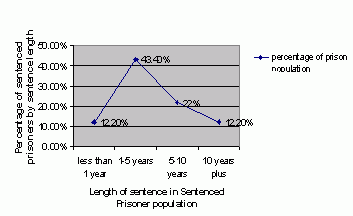
The dominant
sentence of the majority of prisoners is less than 5 years. Given that the
seriousness of the majority of offences demand sentences less than five years
in duration it is suggested that a large portion of these offenders are low
risk offenders (see chart 2) and whose offences may be property crime related
and therefore drug related. As Makkai (2001) has said 70 % of property crime is
drug related. Many will also have special needs such as “Aboriginal offenders”
(Howells, Day, Byrne & Byrne, 1999) and “Female offenders” (Howell, 2000).
It is suggested that a standardized set of treatment components based on the
norms that govern day to day social behaviour in the community would reduce
recidivism by at leas 20 % or more. This has been demonstrated in the Missouri
parallel universe program (Schiro, 2000). The emphasis is on developing a
“moral sense” (Wilson, cited in Schiro, p 4, 2000) and this is acquired by
guiding the participant through a lifestyle program of dominantly acceptable
lifestyle factors.
The Parallel
Universe prepares prisoners for release from the moment offenders enter prison.
As Schiro stated, “Life inside prison should resemble life outside of prison
and that inmates can acquire values, habits and skills that will help them
become productive, law abiding citizens”(Schiro, p. 1, 2000) . Schiro states
that the restrictive nature of imprisonment impedes offenders reforming as
offenders are restricted form decision-making tasks and are rarely held
accountable. Offenders can make decisions through the program and can be held
accountable for there behaviour. Offenders can be rewarded for good behaviour
with psychological rewards of satisfaction when one graduates from an education
program for example. Schiro states that the values that are rewarded become
internalised and offenders develop a “Moral sense” (Wilson cited in Schiro, p.
4, 2000).
|
High-risk
offenders may be those who need treatment as a matter of public safety however
this does not necessarily mean that any offender will have a positive attitude
towards treating recidivist behaviour. High-risk offenders are considered most
in need of psychological treatments and other treatments. This however does not
mean that any offender will have a positive attitude towards treating
recidivist behaviour. For example the case of Luckman v Leucas [2001] WASCA 57
demonstrates how serious criminal acts may result from pathological problems
that cause treatment to be desired. The defendant was at the time subject to
two violent restraining orders and two charges of threatening to kill. The
defendant presented himself as unremorseful. The defendant did not display any
insight into the nature of his offences. The psychological report prepared for
sentencing stated that the defendant suffered from a narcissistic personality style
(see chart 3). Consequently the offender was imprisoned as he was considered at
high risk of offending and his personality style disqualified him from access
to Psychological counselling. However
similarly to the attitude of sex offenders the judge may have overlooked that
fact that the offenders lack of insight was related to denial which has been an
important aspect to overcome in initial stages of treatment with sex offenders
and drug use offenders. Offender may realize that what they did is bad and would
not admit to it instead opting for a distorted view of what they did and
denying the real state of affairs (Denov 2001).
Perkins
(1991) has studied the attitudes of sex offenders in Brittain. In Britain notes
Perkins (1991), a small minority of sex offenders will receive imprisonment a
there punishment. This states Perkins is due to “circumstances of persistent recidivism or the violent nature of
the offences” (Perkins, 1991, p. 152). Helping the sex offenders to over come
denial can sometimes be achieved by comparing and contrasting the outcomes of
treatment and non-treatment whilst positively promoting the treatment option to
offenders (Perkins, 1991). Perkins (1991) notes that there are many aspects of
the legal system and culture that foster attitudes of denial. For example, the
sex offenders are at risk of inmate attacks therefore qualifying for protective
custody that also fosters an attitude of silence as a defence mechanism.
Perkins (1991) states the importance of breaking the silence stating that an
offender can start to become aware of how the victims of such offences feel by
talking about it, which creates the beginning stages of gaining an insight in
to the offensive acts. Perkins (cited in Perkins, 1991) has reported that
counselling skills can break down denial over a period of time and offenders
develop open attitudes towards revealing motives and methods and identifying
future risks associated to there behaviour. The important counselling noted
Perkins (1991) were development of a good relationship with an offender, open
communication fostered through general friendly conversation not rather than
focusing specifically on the offenders criminal acts. A high level of
counselling Responsivity is important for offender to willingly trust the counsellor.
Howell and Day
(2002) have reported that Prochaska and DiClemente’s (Levinthal, 2002) spiral
model of the stages of change in the recovery from drug abuse and dependence is
assisting to
J. O. Prochaska., C. C. DiClemente., J.C.
Norcross. (1992) In search of how people change: Applications to addictive
behaviours. In C, Levinthal (p. 357, 2002) 3ed. Drugs, behaviour and modern
society. Boston: Allyn and Bacon. |
reduce the level of recidivism in substance dependant offenders.
The model includes a 5-stage process. An important consideration in the
application of this model are that prisoners are predominantly in the action
stage as they have no means of attaining substances (although some do manage to
find a way around security, Prisoners home brew kit: covert production in
prison, 2002). Further more the longer the sentence the greater chance an
offender has of being denied access to restricted psychoactive substances. The
offender may however have no intention of changing and may be in the
pre-contemplation stage and the action stage simultaneously. This is similar to
sex offenders in custody who plan to offend upon release. The importance of
overcoming denial through effective counselling techniques such as developing a
good relation ship with offenders that fosters open communication (Perkins,
1991) will help to bring about stronger internalisations of healthy and
prosocial choices of behaviour. Prochaska and Diclemte et al (cited in
Levinththal, 2001) note that offenders will cycle through the various stages
frequently before fully acquiring the maintenance stage. The cyclic nature of
the behaviour is an important issue of complexity and is paramount to successful
treatment as keeping good relationships will be important when offender
experiences cravings and has sensation seeking behaviour as a result, thus
experiencing the pre-contemplation phase over again. It is proposed that this
model is generalizable to most behaviour modification.
IN conclusion it has been shown on the evidence that recidivism is
very high in Australia. Missouri has reduced recidivism with a broad
organisational approach for the treatment of recidivism. The practical aspects
for the treatment of recidivism includes a multi dimensional analysis,
paramount to which is the distinguisment between criminogenic and non
criminogenic needs (Day and Howells, 2002). Once a needs assessment is
completed an analysis of any individual needs will assist to properly classify
offenders. A not of caution however surrounds the ability of any stat to put
infrastructure into place to facilitate these programs, social justice is not
cheap. Further more political motivated campaigns focus on the treatment of offenders
as rewarding offenders for criminal behaviour, thus reducing the opportunity
for offenders to receive help. For prisoners who graduate from prison reformed,
they will still have to deal with prejudice on the outside associated to spoilt
identity. A focus of future research would be to recognise the effects of
spoiled identity on the opportunities of ex-convicts and develop services to
help ex-convicts cope and overcome any identity crisis associated to spoiled
identity, especially if the crisis would cause strong external locus of control
factors that would lead to recidivism.
References
Carach, C., & Grant,
A,. (oct, 1999) Imprisonment in Australia in Australia: Trends in prison
population & imprisonment rates, 1982-1998. Australian institute of
Criminology Canberra.
Day, A,. and Howells, K.,
(2002) psychological treatments for rehabilitating offenders: evidence based
practice comes of age, Australian psychologist, 37 (1), p 39-47.
Hare R. D., Hart, S. D.,
& Harpur T. J. (1991) Psychopathy and the DSM iv criteria for anti social
personality disorder. Journal of abnormal psychology, v 100. n 3, 391-398.
Howells, K., (2000)
Treatment, Management, and Rehabilitation of Women in prison: relevance of
rehabilitation principles.
Howells, K., and Day, K.,
(1999) The rehabilitation of offenders: International perspectives applied to
Australian corrections systems. Australians Institute of criminology, trends
& issues in crime and criminal justice, Canberra
Howells, K., Day, A.,
Byrne, S., and Byrne, M., (1999) Risk, Needs and Responsivity in violence,
rehabilitation: Implications for programs with indigenous offenders. Paper
Presented at Best Practice interventions in corrections. Available http://www.aic.com.au
Kenny, R. G. (2000) An
introduction to Criminal Law in Queens land and Western Australia. Australia:
Butterworths
Lee, C (2001) Personal
Quote. Columbia University student exchange. http://www.missouri.edu/index.cfm
Levinthal (2001) 3rd
ed Drugs, Behaviour and Modern society. Boston: Allyn and Bacon.
Luckman v Leucas [2001]
WASCA 57
Perkins, d. (1991)
clinical work with sex offenders in secure settings. In C.R., Hollin and K.
Howells (Eds), clinical approaches to sex offenders and their victims, ch 7. p
151-177, Chichester: John Wiley and Sons.
Prisoners in Australia
(2001) 4517 Canberra: Australian Bureau of Statistics
Schiro, D., (2000)
Correcting Corrections: Missouri’s Parallel Universe Sentencing & Corrections
issues for the 21st Century: papers form the executive sessions on
sentencing and corrections may [8] US Department of Justice: Office of Justice
Programs National institute of Justice.
Working party team (1992).
Streamlining the investigation and preparation of briefs of evidence in complex
white-collar crime cases. Paper presented at the national complex white-collar
crime conference. (p. 10-35).
.