Motivated Offenders: Falling into alienation.
Criminology 2: Assignment 2. People most likely to offend.
Chris ?
Edith Cowan University: Management and Public administration law.
Justice Studies
There are many variables available that have been used to estimate the number of individuals motivated to offend. This paper outlines who the motivated offenders are and why are they motivated to offend. The facts are strong that personality traits[1] and in particular temperament which forms as young as 5 and stays consistent throughout the lifespan[2] are a framework upon which the social life of each individual is constructed[3]. The difficulty however is that there are individuals with no personality problems or neurological problems who decide to offend. This however is a point that personality psychologist believe to be influenced by learning, environmental and socio-environmental factors.
Braithwaite[4] stated that criminal behavior has two general motives. Needy offenders are individuals deprived of needs. Deprived needs however have been associated with property crime focusing on social inequality as origin for motive[5]. Rich People have the largest portion of wealth and acquire and control many precious resources[6]. Individual’s from lower socio economic status (SES) however are compromised in a social inequality equation. The needy are motivated to steal to satisfy their needs[7]. Thus people protect their interests through the law while the motivated break the law to further their interests. The needs of the rich can become frustrated which is motive for crime to avoid loosing control
It’s difficult to define what constitutes rich and poor however establishing a midpoint with the average wage earned by all workers (the poverty line) helps. The further left of this point an individual is the higher their SES and vice versa. It is difficult to know if this is a good indicator of wealth in criminals. For example black markets in stolen property and drugs (ETC) do not show up on income statistics.
Sociologists have claimed that individuals are situated at a fixed point in terms of SES[8]. Though there are a handful of exceptions such as entrepreneurial investors (going up) or victims of market crashes or wars (going down). Stability however seems to predict that individuals will predominantly remain at a fixed point in terms of socioeconomic status throughout the lifespan. Anyone, Kiyosaki asserts, may benefit from doing without luxuries and save/invest their income a quality described as the essence of being rich[9]. Based on the stability hypothesis the needy-greedy theory is somewhat validated. Research on employment and education has shown that students of greater SES have more stability and get qualified faster for better jobs[10]. It is difficult for lower SES individuals to compete thus, ‘competitive resistance’ limits the odds of moving into a better SES. Poorer individuals are marginalized into depression motivated offending an issue that is related to Alienation[11] prevalent as a motivation for offending.
Many crimes are not profit-motivated offences. An examination of adjudicated offences[12] shows that there are two dominant offence groups (see chart 5, p. 11), property related and injury/health related. Property related offences includes robbery, extortion, unlawful entry, burglary and break and enter which tend to be profit motivated however there are exceptions such as burglary[13] where assault or damage was intended to cause the victim a loss. Injury and health related offences consist of acts intended to cause injury, ranging from assault to attempted murder and illicit drug use. It would be nonsense to classify any of these offenders as simply needy or greedy however it can’t be denied that many of the motivated offenders were in-fact motivated by need or greed.
|
Table 1. Predictive aspects of criminal trajectory. Offending |
Non offending |
|
Predominantly males aged 15 to 24 Unmarried Situated in High density populations Settlements are highly mobile. Lacking in educational achievements High prevalence of delinquent co-association. Low socio economic status associated to all offences with the exception of complex crimes |
Stable education predicts non offending Positive attitude towards education predicts non offending Parental protection factors exceed risk factors. Strong law abiding attitudes. Adapted from. Braithwaite, J., (1991) Poverty, power, white-collar crime and the paradoxes of criminological theory. Australian and New Zealand Journal of Criminology, 24(1) 1991. 40-58 |
Whetherburn (1993) states that when an opportunity to offend presents one individual offends and another abstains. This makes it difficult to ask why offences are committed. Braithwaite (cited in Whetherburn, 1993) states that there are 2 factors in the correlates of motivated offenders (see table 1, p 5.). A number of studies have outlined facts associated to Braithwaith’s model. These studies identified variables associated with offending behavior, Moffit[14] for example has shown that there are developmental differences between the life course persistent (LCP) offenders and adolescent limited (AL) offenders. Adjudicated offences in the court statistics shows how prevalent offences peak in the 20 to 34 year age groups (See chart 1) and this shows that AL offenders seem to be detained in the justice system longer than Moffit has accounted for.
Moffit's work implies that AL offenders are individuals who get into conflict with the law based on the way they navigate the transition into young adulthood[15]. The offending however ceases when living a law abiding life is more productive than breaking the rules[16]. It is here that the adolescent limited offender may face some difficulties[17][18]. Further more in an ageing society there is an increasing level of frustrated opportunities for employment etc. AL offenders may have decided to pursue a life that they can identify with due to pre adolescent conditioning and resolution of issues relating to the transition of adolescence into adulthood[19] however they may be trapped in the vicious circle.
Some adolescents may be caught in a criminal career scenario where contact with the justice system, spoiled identity, missed or blocked opportunities and substance use disorders keeps the rate of recidivism in this group resistant to extinction. In contrast one program that has dealt with low education levels and social skills (ETC) has reduced the rate of recidivism and attempted to reverse any prior alienation[20]. The majority of AL offenders do not commit a serious offence that results in imprisonment; those who do however are caught up in a vicious circle. This fact is further validated by the fact that AL offenders won’t be classified with antisocial personality disorder. Harpur and Hare[21] may offer some statistical validity for this in that 15-30% of 18-34 year old inmates in a prison sample were diagnosed with CB aka criminal behavior only rather then anti-social personality disorder (APD)[22]. In contrast LCP offenders are characterized by abnormal personality present in early childhood that persists through the lifespan[23]. Trait behavior of the LCP child has been associated with exclusion from beneficial development activities due to the disruptive impact they have on other students and on parents[24]. LCP offenders are also implicated in a trend to have a similarity attraction to other LCP offenders that creates a subclass of delinquency.
Based on the research of male prison inmates the extent of the antisocial personality has been estimated to have a linear decline with increasing age [25].The prevalence is estimated at 65% from 15 to 25 year olds declining steadily to 30 % for 41 – 45 year olds. Given that to be diagnosed with APD an individual needs also to be assessed with conduct disorder in childhood[26], which is more evidence that AL offenders get caught up in the vicious circle and trapped in the Justice system between 20-34 years of age. The decline in both the number of adjudicated offences[27] and prevalence of APD among 35-44 year olds however suggests that the LCP offender has 2 types. Hare makes this distinction with the Psychopath Check List (PCL-r). Hare [28]suggests that the PCL-r shows that in those with APD there is a subpopulation of offenders that Hare describes as the clinical psychopath (CP)[29] based on the difference between APD and PCL-r ratings. The CP is the most likely individual to display the characteristics of Moffit’s LCP developmental trajectory[30].
|
Chart 1. Male v Females for Adjudicated cases in high and intermediate court cases.[31]
|
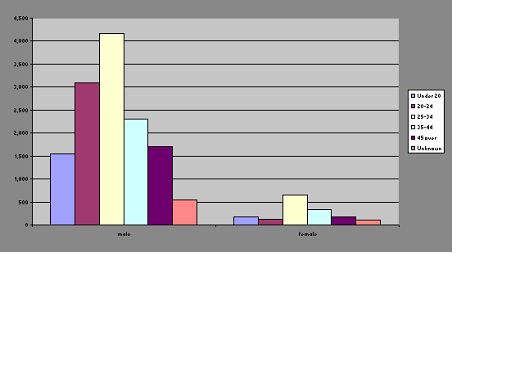
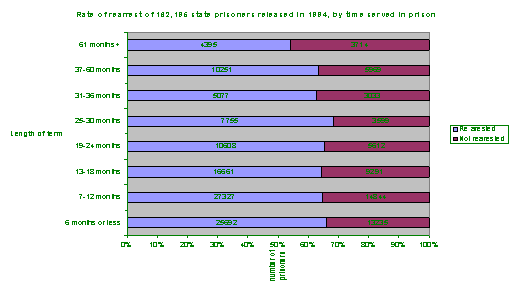
Official statistics for Motivated Offenders show that a majority of offenders are male and most offences peak in frequency from 15-35 years of age and then steadily decline with increasing age[32]. A study of recidivists in the US has shown that re-arrest rates are highest for robbers, burglars, larcenists/thieves and weapons offences (possession, using, selling)[33]. Specialists are prisoners who after release commit the same crime and Non-specialists are those whose new offense differs from what they were in prison for[34]. The length of sentence prior to release did not impact on the rate of recidivism to a significant extent (see chart 2 p. 8).
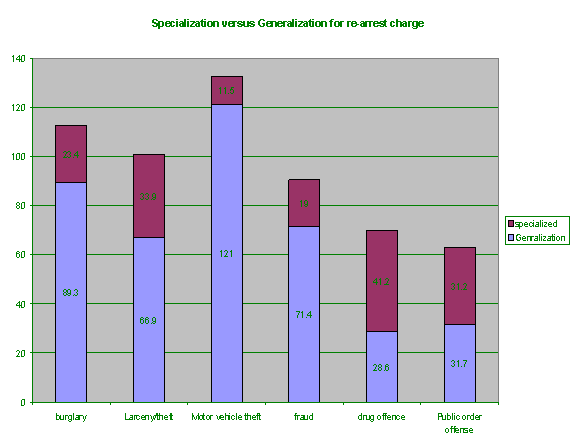
The specialization rate of all offenders after prison release is compared with the rate of generalization of offences different from the offence last sentenced to. (See chart 3 & 4 and table 2).
|
Chart 2. Rate of re-arrest for released prisoners of 1994 in 10 states by sentence length. |
|
|
For example People who get a prison sentence for car theft, when released are less likely to steal a car again. However some offenders did commit the same offence after prison release. Only a small proportion of the violent offenders had specialized re-offending patterns (Table 2, p 10). The most specialized violent offenders where in assault and robbery. The top 4 most likely offences after release are for Drugs, Larceny/theft, Public disorder and Assault (See table 2). With the exception of assault, 3
of the four specialist offences were greater than any of the non-specialist offences alone however the total non-specialist recidivism was greater than non-specialist recidivism. (See table 2). Released offenders are also ranked by non specialist status in all of the top 4 non-specialist offender groups as offences other than prior to prison release. Drug offences were the highest ranked specialist offence and for non-specialist offence groups drug offences rank 1st or 2nd as non-specialist offences for the non-specialist recidivists[35]. Burglary was another offence that rated 5th highest in prevalence for specialist recidivists however Burglary rated 4th most prevalent for all non-specialist offence groups in chart 2.
|
Rearrested rate of Specialist offence after release versus non-specialist offence by ranked prevalence of released prisoners 1994.
|
This pattern shows that Crime in general is specialized among versatile offenders despite the fact that some offenders have specialist recidivism rates. Further more the dispersion of non-specialist offences in recidivism accounts for the Crime School Theory[36]. From table two specialists may have learned methods of operation(MO’s)[37] from others who had already learned to complete the offence, though perhaps a drop out rate as they get older pertains to how the MO’s have evolved to include the exception of not getting busted[38].
|
Chart 3. Non-Violent offences specialized and non- specialized re-arrested repeat offenders 1994-1998.
|
|
Chart. 4 Violent offences specialized and non- specialized re-arrested repeat offenders 1994-1998.
|
|
Chart 5. Top 4 most prevalent offences for adjudicated cases in High and intermediate level courts for Australia, 200-01.
|
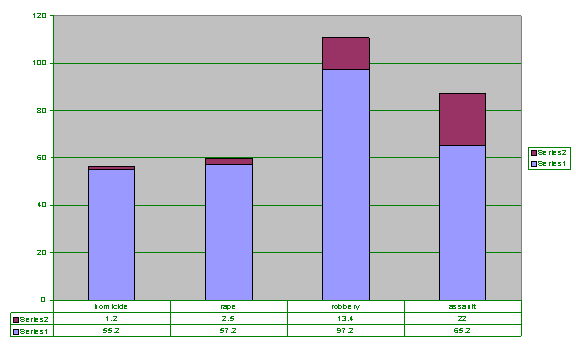
A similar pattern of offending exists in the Australian statistics for
adjudicated offences[39].
(See chart 4). The four most prevalent offences are Acts intended to cause
injury, Unlawful entry with intent / Burglary & Break and Enter, robbery
and extortion related offences, and Illicit drug offences. A high proportion of
released prisoners have been re-sentenced to another term of imprisonment[40].
The implication of the study of recidivism in America suggests that the
majority of recidivism is property, drug and disorder related offending also
(see Table 2, p. 10). Even though the majority of the offences are minor many
are re-sentenced for breaching parole or on their prior criminal history[41].
The Drug
Use Monitoring Australia research shows that 70 % of violent offenders, 86 % of
Property offenders, 89 % of drug offenders, 73 % of traffic offences and 62 %
of disorder offence tested positive to using illicit drugs[42].
The question that has been asked is what is the link between substance abuse
and crime? A high proportion of offenders from the most common offence groups
have tested positive to one or more of the illicit drug groups. Are drug users
likely to commit crime or are those who commit crime also predisposed to use
drugs? Further more why are the majority of offender’s male? The answers to
these questions are not simple to explain however it has been found that Males
rate higher on 2 personality aspects of the Multi Dimensional Health
Questionnaire (MPQ)[43].
Moffit’s LCP and AL offenders have different onset of delinquency
however both have the issue of alienation presented as a causal factor for
offending, which is a key concept of the MPQ research[44]. Adolescent limited offenders faced with a transition
into young adulthood are often deprived of parenting styles most productive of
a successful transition (moderate control factors and moderate monitoring
factors)[45]. High or
Low control and monitoring is linked to either Authoritarian or Neglectful parenting
styles that favour the development of neurotic needs[46]
for the adolescent in transition. The main fact is that the transition is not
always smooth for all. Those with difficulties ultimately feel alienated from
the productive areas of the community. The life course persistent offenders are
alienated as young as 5y/o[47].
Both groups are found with an attraction to deviant associations especially
were aggressive/violent boys begin to associate together despite parental
advice to remain separate[48].
This tendency towards falling into alienation is explained by CB and
Personality variables, rotated into strict correlation constructs[49].
|
Chart 6. Differences in scores rated on the MPQ from a study of 18-26 year olds.
|

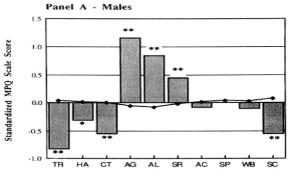
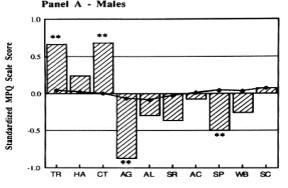

Krueger et al[50] measured personality at 18 and criminal versatility was measured at 21 and 26 rated on the MPQ. CB three and eight years apart correlated with negative emotionality and constraint trait constructs. The results derived 3 groups, Abstainers, Normative delinquents and Versatile offenders[51]. Abstainers are individuals who do not engage in drug use or other partying activities. Normative delinquents are individuals who tend to become delinquent in adolescence[52] however as with Moffit’s Adolescent limited offender this group finds that pro-social behavior becomes more rewarding than offending and thus it becomes the dominant behavior over delinquency with increasing age whereby a large portion of offenders should drop out of the offending statistics. Normative delinquency tends to show that all the behaviors associated with non-offending traits are in a stage of inhibition, however unlike the versatile offenders, normative delinquents have rated in the same direction as the non-offending individuals (see chart 6.) indicating only lower levels of non-criminal behavior. Versatile delinquents are individuals who continue to offend and develop criminal careers. These individuals have a wider variety of criminal behavior than normative delinquents.
Female abstainers however rated high on the achievement factor whereas males over all rated lowest[53]. This was not directly related to criminality however it may explain Male propensities for criminality in comparison to Females. More females abstain from delinquency than males possibly because the guidance they receive in their activities is taken more seriously, as they are more likely to stay committed to the activity and work hard at it in comparison to males[54]. In comparison a successful recidivism program aimed to condition the development of higher achievement and work related goals[55]. The rate of recidivism reduction however is suspected to account for individuals with a normative delinquent pattern rather than a versatile offender pattern. Women have substantially lower rates of offending (See chart 1.). Women who offend however as opposed to non offenders have a similar pattern to male delinquents for both normative and versatile groups on MPQ ratings[56] however the ratings were not as pronounced.
The Kruger’s study found that criminals tend to lack constraint in the expression of impulses. Agreement with constraint scores indicate a tendency to obey the law in the age group were offending is most prevalent (i.e.: abstain v normative delinquents on tr, ha & ct constructs)[57]. Versatile criminals have directly opposite ratings to Abstainers (see chart 6). The Kruger (et al) study (1994) identifies negative emotionality as a causal factor in the link between personality and crime. From the age of 21 to 26 there was only a small variance in criminal behavior[58]. The small variance shows that from the age of 18 to 26 attitudes towards offending or non-offending, and rates of frequency seem to be consistent. A follow up study of the same participants is expected to show why some offenders drop out of offending groups and why others persist. It is likely however that those who persist are most likely to be those who will rate high on the PCL-R as mentioned earlier.This is consistent with the fact that personality is resistant to change, however the decline in numbers in offenders after the age of 35 has yet to be fully explained empirically.
It has been shown that the majority of motivated offenders are male. The underlying personality factors (etc)[59] however are the same for males and females however the reason fewer women offend is because traits for non-offending behavior patterns in women are strong yet weak in males. Lower level SES predicts for some a predisposed environment productive of rationalization of profit motivated offending[60] however it doesent necessarily connote violence. Personality variables however most strongly influence the likely hood of identifying with offensive behavior, role models and peers. This is a similarity bias derived from feelings of alienation. Those individuals who are the most persistent tend also to be emotionally[61] and cognitively neurologically impaired[62] inhibiting learning from punishment and processing emotional stimuli[63]. Funder[64] states that women have a brain that evolutionary wise has pro-adapted to processing emotional cues due to the mother-childbearing scenario. Processing information in this way is less pronounced in most males[65] accounting for why men predominantly in comparison to women become alienated as a result of nature. ‘Motivated Offenders: falling into alienation’ simply attempts to show that research in the personality arena is backed up by physiological data that supports the results found in the MPQ model for casual factors of criminality. Personality research shows how personality builds upon a framework of temperament[66] where the body is how the traits interact with the social and environmental aspects of development. Inadequacies in the social and environmental resource pools limit the individual’s ability however if the framework is incomplete the individual needs firm structural support. One example of successful structural support for underlying personality disorder problems has been the use of Dex-amphetamines by those diagnosed with AADD. The final conclusion is that the evidence in support of this paper is relatively recent however it is becoming increasingly clearer that Personality is primarily the most effective way for predicicting criminal behavior in any individual and a minority of individuals will be more prone than the majority of individuals. A secondary factor to personality is the social environment within which social emededness arises however when these factors are negative, more severe effects emerge in those with more serious underlying personality attributes. The two areas of research however are now more than ever intertwined and offer a modern interaction perspective[67] that clearly outlines who the motivated offenders are.