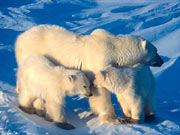
|
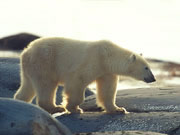

Behavior
1. Polar bears are more active the first third of there day and less active the two thirds of there day.
2. They are generally solitary as adults, except when
during breeding and cub rearing
3.
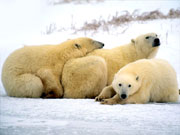
On warm days polar bears sprawl out on the ground or ice, sometimes on their backs with their feet in the air.
4. On cold days polar bears curl up and often cover their muzzle area.
5.
During the winter, some polar bears excavate temporary dens or find natural shelters to stay warm. They may use these shelters for several months at a time.
|
|
Habitat
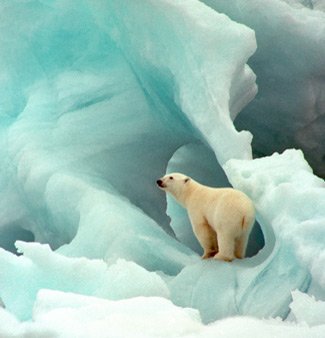
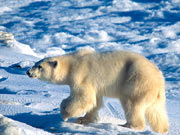
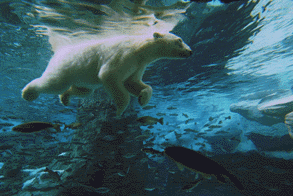
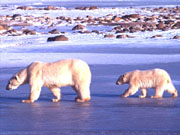
1. Polar bears inhabit Arctic sea ice, water, islands, and continental coastlines.
2.
Polar bears hunt seals in the leads, using sea ice as a platform.
3.
The "Arctic ring of life" is a biologically rich system of leads and
polynyas. It runs parallel to the polar basin coastline.
4.
Polynyas are areas of water, surrounded by ice, that remain open throughout the year due to winds, upwellings, and tidal currents.
5.
Polynyas are important breathing and feeding areas for wintering or migrating marine mammals and birds.
|
|
Characteristics
1. Polar bears are among the largest living land carnivores.
2. A polar bears fur is white and provides good camouflage and insulation
3. The fur may yellow with age
4.
The fur acts as miniature greenhouses, and turns sunlight into heat, which is absorbed by the bear's black skin.
5. Unlike other Artic mammels, polar bears do not shed there coats in the summer.
|
|
Diet
1. Polar bears feed mainly on ringed seals and bearded seals.
2.
Depending upon their location, they also eat harp and hooded seals and scavenge on carcasses of beluga whales, walruses, narwhals, and bowhead whales
3.
When seals are unavailable, polar bears eat other marine mammals, reindeer, small rodents, sea birds, ducks, fish, eggs, vegetation , berries, and human garbage.
4.
Polar bears need an average of 2 kg (4.4 lb.) of fat per day to survive. A ringed seal weighing 55 kg (121 lb.) could provide up to eight days of energy for a polar bear
5.
Polar bears don't always eat the entire kill. Carcass remains are scavenged by other bears, arctic foxes, and gulls.
|
|
Breeding
1.
Breeding takes place in April and May on the sea ice.
2.
During the breeding season, males and females find each other by congregating in the best seal-hunting habitats.
3. Male polar bears have been seen following the tracks of breeding female polar bears for more than 100 km .
4.
Competition for females is intense. Females breed about once every three years; therefore, there are about three adult males to every breeding female.
5.
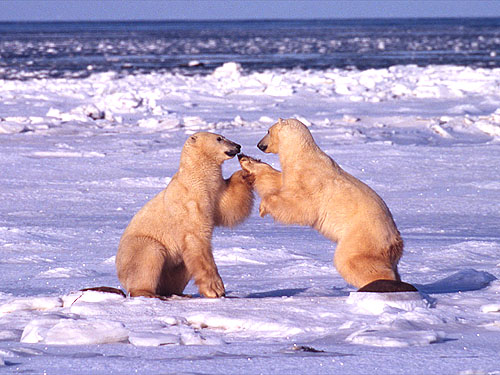
Before mating, a female polar bear may be accompanied by several males. The males fight fiercely among themselves until the strongest or largest male succeeds in chasing the others away.
6.
Dominant males may succeed in breeding several females in a season.
|
|
Resources
|
|
Top |