
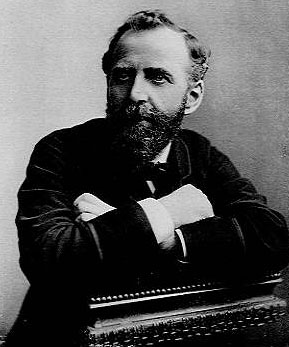
A Titanic fatality and fellow correspondent of Francis Thompson's, was the journalist, author, and spiritualist William Thomas Stead (1849-1912). In 1888 Stead worked as the editor for London's 'Pall Mall Gazette'. Stead, who was seen as an alleged Ripper informant, wrote articles questioning the fitness of the investigating CID. Stead concentrated on Dr. Robert Anderson's absence from London during the Ripper murders, when he wrote:
"The chief official who is responsible for the detection of the murderer is as invisible to Londoners as the murderer himself."
Another officer of the force was Major Henry Smith. While acting ashead of the City Force, during the time of the murders, Major Smith was also often derided, particularly his account of his own unsuccessful attempt, in September, of 1888, to trace the identity of the Whitechapel murder. Smith told that;
"After the second crime I sent to Sir Charles Warren that I had discovered a man very likely to be the man wanted. He certainly had all the qualifications requisite. He had been a medical student, he had been in a lunatic asylum; he had spent all his time with women of loose character, whom he bilked by giving them polished farthings, two of these farthings having been found in the pocket of the murdered woman. Sir Charles failed to find him. I thought he was likely to be in Rupert Street, Haymarket. I sent up two men, and there he was; but polished farthings and all, he proved an alibi without the shadow of doubt"
{CRIMES p121}
Francis Thompson left his Manchester home on Monday November the 9th 1885. The last murder directly attributed to Jack the Ripper, that of Mary Kelly, occurred on Friday November the 9th 1888. The Ripper's murder spree began on August the 31st, of 1888, with the slaughter of Mary Ann Nichols. Her murder took place whilst police were diverted to a nearby dock fire started by arson.
Everard Meynell's biography of Thompson 'The Life of Francis Thompson,' recalls Thompson's social life whilst living on Panton Street Haymarket, between himself and;
"The murder to whom he makes several allusions...In a common lodging-house he met and had talk with the man who was supposed by the group about the fire to be a murderer uncaught. And when it was not in a common lodging-house, it was a Shelter or Refuge that he would lie in one of the oblong boxes without lids, containing a mattress and a leather apron or coverlet, that was the fashion, he says, in all Refuges. "
{LIFE. 1913. p64}
Everard Meynell, the Son of Wilfrid Meynell, the editor, who rescued Thompson from the streets in late 1888, also records Thompson's tale of two coins;
"But who can ever have been deceived that here was any one save a timorous defaulter in the matter of savoir-faire? Not certainly, an A.B.C girl or an observant tramp. Among the miracles is that of The Golden Halfpennies. They came to him one day when he had not a penny to invest in a box of matches that might bring him interest in his money. He was, he told me, walking, vacant with desperation, along a crowded pavement, when he heard the clink of a coin and saw something bright rolling towards the gutter. He stopped picked it up, looked around, found no claimant, and put into his waistcoat pocket, as he affirmed with the many repetitions that characterised his anecdotes, bright new halfpenny. He proceeded some distance on his way, pondering the things he could or could not procure with his money, when it struck him that the other direction would lead him to the shop with such wares as he had decided on. As he neared the place where he had found the first coin he saw another glittering on the road. This too, he picked up, and again thought he held a halfpenny. But looking closer he discovered it to be golden and a sovereign, and only after much persuasion of his senses would he believe the first-found one to be likewise gold. "That was a sovereign too, Evie; I looked and saw that it was a sovereign too!" he ended, with rising voice and tremulous laughter."
{LIFE 1913 p67}
Panton Street and Rupert Street are each in Haymarket. Perhaps Everard's subject and Major Smith's suspect are one in the same?
WT Stead first reached the public eye through his reform publications upon crime and child prostitution. Stead's reforms won the approval of the likes of Cardinal Manning. In 1886 Stead wrote an article called 'How the Mail Steamer Went Down in Mid-Atlantic, by a Survivor.' The story was upon a collision, at sea, between two ships in which the surviving passengers battled for the few remaining life rafts.
From 1893 to 1897 Stead edited the 'Borderland' a periodical upon spiritualism and the occult. It was on January the 12th, of 1891, that WT Stead wrote to Francis Thompson.
"Dear Sir-I beg to forward you herewith a copy of the 'Review of Reviews', in which you will find your admiral article quoted and briefly commented upon. Permit me to say that I read your article with sincere admiration and heartfelt sympathy. "
{LIFE p106}
Francis Thompson signed his 'admiral article' by the name of Francis Tancred. His article
'Catholics in Darkest England', was in response to General Booth's 'In Darkest England'. Of Thompson's article WT Stead claimed:
"Tancred sounds a bugle-blast...He, therefore, cries aloud for the creation of a Catholic Salvation Army."
{LIFE p106}
The 1892 edition of Stead's Review of Reviews' contained a story titled 'From the Old World to the New'. In the story a fictional White Star Line vessel, named the Majestic, had on board a clairvoyant who gained a vision of the disaster of a nearby ship that collided with an iceberg.
Everard Meynell wrote upon Thompson and the Titanic.
"There perished with Mr Stead in the Titanic disaster in 1912 a Catholic priest, who had shortly before sailing recommended 'The Hound of Heaven' (the strangely significant line 'Adown Titanic glooms of chasmed fears') to a friend, as antidote to decadent poetry."
{nb. all brackets are as in original.}
On Sunday, April 14th, 1912, at 11:40 p.m. the Titanic struck an iceberg. It held 2,200 people. By 2:20 a.m. The Titanic, including WT Stead, sunk 13,000 downwards to the seabed of the Atlantic. Stead was last seen alive reading a book in the Second Class Smoking Cabin. 1513 people drowned.
Everard Meynell 'The Life of Francis Thompson' 1913.
Martin Fido. 'The Crimes. Detection and Death of Jack the Ripper.' Copyright 1987. Martin Fido.
R.A.Patterson 'Paradox'. Copyright 1997. R.A.Patterson.