| If you have accessed this page any other way besides through my homepage, please Click Here, Thank you. |
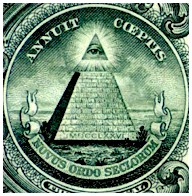
| The American dollar bill is probably the world's best known banknote,but how many people appreciate why the Great Seal of the United States of America is printed on it, or understand what these ancient symbols mean? "On July 4, 1776, the Continental Congress passed a resolution authorizing a committee to devise a seal for the United States of America. This mission, designed to reflect the Founding Fathers' beliefs..."[1] The symbols of the Great Seal, which are featured on the dollar bill, are clearly intended to embody the beliefs of those who founded the United States of America. The current design of the Great Seal was approved by Congress on 20 June 1782, and the seal was introduced to the dollar bill in 1935. The continued official use of Masonic symbols today indicates that these beliefs remain at the heart of the U.S. establishment. What were the beliefs of the founders of America? Numerous sources [apparently] outside Freemasonry report that the vast majority of the American founders and signatories of the U.S. Constitution were Freemasons. Anti-Mason material[2] routinely claims that almost all of America's founding fathers were members of a Masonic Order. Official sources within Freemasonry counter-claim that some but not all of America's founders were Freemasons, and point out that the Masonic status of many of the alleged Masonic founding fathers cannot be proven conclusively. The aforementioned school of thought is corroborated by well-documented reports from some authoritative Masonic sources; thus, Manly Palmer Hall, a thirty-third degree Mason, wrote: "Of the fifty-five members of the Constitutional Convention, all but five were Masons."[3] One side of the Great Seal shows an ancient Egyptian pyramid, beneath a triangle containing a glowing eye. The shining eye in the triangle is a certainly a famous and common Masonic symbol, although some Masonic sources prefer to deny this. The All Seeing Eye is one of the most important and spiritual Masonic symbols, and the distinguished Freemason George Washington, first President of the United States of America, wore it emblazoned boldly on his Masonic apron. The front of the Great Seal displays an Eagle, which is also an important symbol in Masonic traditions. The use of the blazing eye in the triangle motif, surrounded by rays of light, in the official seal of the Ordo Templi Orientis, confirms the occult significance of this symbol. The sacred number 13 is encoded in the Seal, in the the bundle of thirteen arrows, the thirteen stripes on the shield, and the thirteen stars of the constellation that can be joined to form the Star of David shining above the Eagle's head. The reverse, sometimes referred to as the spiritual side of the seal, contains the thirteen-step pyramid with the year 1776 in Roman numerals on the base, heralding the beginning of the new American era. Incidentally, every American state has its own official State Seal. For instance, the Great Seal of the State of Colorado bears the ubiquitous radiant eye inside the triangle, together with other relevant symbols. The motto inscribed beneath the pyramid in the Great Seal of America is "Novus Ordo Seclorum" which is Latin for "New Order of the Ages", and synonymous with the "New World Order". The momentous decision to print the Great Seal on the dollar bill was taken in the 1930s by the government minister Henry Agard Wallace (1888-1965), who later became Vice-President of the United States, second in command to President Roosevelt, from 1940 to 1944. Henry Wallace literally believed that America was chosen by God to lead the world in establishing the New World Order. In his biography of this prominent American politician, D. McDonald wrote that: "Just as Wallace thinks of America as the nation destined by God to lead the world, so Wallace thinks of himself as a Messiah, an instrument through whom God will guide America onward and upward."[4] Wallace was a prominent Freemason, and he made no attempt to conceal the extent of his true beliefs when in 1934 he wrote, almost with prophetic religious fervour, about the profound esoteric significance of the Great Seal: "It will take a more definite recognition of the Grand Architect of the Universe before the apex stone [capstone of the pyramid] is finally fitted into place and this nation in the full strength of its power is in position to assume leadership among the nations in inaugurating 'the New Order of the Ages'."[5] It is difficult to elucidate the full meaning of the symbols in the official Great Seal of the United States, because they are occult symbols which carry profound esoteric meaning from a truly ancient secret society which may be older and more far-reaching than the Masonic order. There are various interpretations in the public domain, but the truth is known only to initiated insiders. What is most important in the context of this article is that these are ancient religious symbols which hold special hidden significance, and their use by the American government reveals something about the secret beliefs of those in power. ----------------------------------------------------------------------------------- American Masonic History What Are America's True Roots?* There is much speculation on the religious nature of the United States of America as it was founded. Many Christians assert that the United States was founded as a Christian nation and, therefore, it is not only our right but our duty to reclaim it for God. But is America a Christian nation in the true sense of the word? To call anyone or anything "Christian," whether an individual or a nation, certain criteria must be met. If we are speaking of an individual, the Biblical requirements are that he must be born again by the Spirit of God, understanding all that this entails. If we are speaking of a nation, its purpose must be that of ministry in the name of Jesus Christ alone, without regard to any other gods. Its primary charter must be the Bible, and all who hold positions of authority must be individuals who meet the criteria necessary to call themselves Christians. A true Christian nation would be a theocracy governed by God through His prophets. His law would reign supreme in the hearts and minds of that nation's founders, and all who founded the nation would have to meet the criteria necessary to call themselves Christians. Just as important, the nation would have to have been created in response to a covenant initiated by God with those who founded it. As a point of information, the Pilgrims did not found the United States; they founded a small colony that eventually got swallowed up by the states and the newly formed federal government. The belief that the Mayflower Compact was the basis for a Christian nation has caused many to attempt to reestablish what never existed: a Christian nation based upon Biblical precepts and founded upon a covenant relationship with God. What is overlooked is that the Mayflower Compact reaffirmed loyalty to the King of England; its framers never intended to found an independent state. Ignoring, and even twisting the facts of history, "Christian" dominionists quote some of the founding fathers whose words seem to indicate faith in Jesus Christ. But many quoted were Freemasons who highly regarded Jesus as a man who attained the highest degree of moral enlightenment. The words of many Freemasons might lead the uninformed to believe that they are true brethren in Christ. An example is this statement from a Masonic publication: God may have other words for other worlds, but His supreme Word for this world, yesterday, today, forever, is Christ! He is the central Figure of the Bible, its crown, its glory, its glow-point of vision and revelation. Take Him away and its light grows dim. He fulfilled the whole Book, its history, its poetry, its prophecy, its ritual, even as He fulfills our deepest yearning and our highest hope. Ages have come and gone, but He abides-abides because He is real, because he is unexhausted, because He is needed. Little is left today save Christ-Himself smitten and afflicted, bruised of God and wounded-but He is all we need. If we hear Him, follow Him, obey Him, we shall walk together in a new world wherein dwelleth righteousness and love-He is the Word of God (Joseph Fort Newton, "The Great Light in Masonry," Little Masonic Library, Vol. 3, p. 177). Unless we recognize that the theosophical philosophy of Freemasonry attributes its own definitions to Biblical language, we won't understand the author's meaning. We might welcome him as one of our own. Only the most naive would not know that many who claim to be Christians do not meet the required criteria. Such is the case with Freemasons. While Freemasonry has an outward show of religious faith, the tenets of Freemasonry preclude any truly born-again believer from belonging. Space doesn't allow for a full treatise on Freemasonry's religious philosophy, but true Christians will recognize from another statement in the same publication that the Faith is not compatible with Freemasonry: Into Freemasonry have been poured the irradiations of the mystical schools of antiquity. Particularly is this so in the higher degrees of the Order, such as the Scottish Rite, where undeniable traces of Cabalism, neo-Platonism, Rosicrucianism, and other mystical cults are plainly discernible. I do personally contend that Freemasonry is the direct descendent of the Mysteries, but that our ritual makers of the higher degrees have copied the ancient ceremonies of initiation so far as the knowledge of those ceremonies exists (Henry R. Evans, A History of the York and Scottish Rites of Freemasonry, p. 8). Because most Christians today are unaware of the manner in which Christianity was melded with the esoteric philosophies of theosophy and Jewish Cabalism to produce a hybrid mystery religion known as Freemasonry, they offer quotes from many of our founding fathers as evidence that they were Christians. Indeed, some were even clerics. But just as one of today's most famous clerics, Norman Vincent Peale, was a Freemason (prelate of the Grand Encampment of the Knights Templar of the United States), many of the nation's founding fathers were also Freemasons who used peculiar definitions of Biblical language in asserting their beliefs. This is not to say that they were not noble men. Freemasons pride themselves in their noble attitudes and adherence to strict moral codes. These are not "evil" men in the classical sense. But they are blinded to the true revelation of God's Word, and their religious philosophy embraces all religions as valid. To be a Freemason, one must believe in a supreme being, but he need not be a Christian. Based upon the evidence of Masonic influences in the establishment of this nation, there is no doubt that the criteria necessary to classify the United States as a Christian nation were not met. An objective study of the Masonic affiliations of the founding fathers must cause Christians to reevaluate their own political philosophy. For if the United States is not a Christian nation then we must choose to whom we will commit "our lives, our fortunes, and our sacred honor" -- our Lord or our country. 20 GREATEST NAMES OF THE AMERICAN REVOLUTION John Adams - Spoke favorably of Freemasonry -- never joined Samuel Adams - (Close and principle associate of Hancock, Revere & other Masons Ethan Allen - Mason Edmund Burke - Mason John Claypoole - Mason William Daws - Mason Benjamin Franklin - Mason Nathan Hale - No evidence of Masonic connections John Hancock - Mason Benjamin Harrison - No evidence of Masonic connections Patrick Henry - No evidence of Masonic connections Thomas Jefferson - Deist with some evidence of Masonic connections John Paul Jones - Mason Francis Scott Key - No evidence of Masonic connections Robert Livingston - Mason James Madison - Some evidence of Masonic membership Thomas Paine - Humanist Paul Revere - Mason Colonel Benjamin Tupper - Mason George Washington - Mason Daniel Webster - Some evidence of Masonic connections Summary: 10 Masons, 3 probable Masons, 1 Humanist, 2 Advocates of Freemasonry, 4 no record of connections. SIGNERS OF THE DECLARATION OF INDEPENDENCE Known Masons (8): Benjamin Franklin, John Hancock, Joseph Hewes, William Hooper, Robert Treat Payne, Richard Stockton, George Walton, William Whipple Evidence of Membership And/or Affiliations (7): Elbridge Berry, Lyman Hall, Thomas Jefferson, Thomas Nelson Jr., John Penn, George Read, Roger Sherman Summary: 15 of 56 Signers were Freemasons or probable Freemasons. It's true that this represents only 27% of the total signers. But this 27% included the principle movers of the Revolution, most notably Benjamin Franklin and Thomas Jefferson, the primary authors of the Declaration. The former was a Freemason, the latter a deist and possible Freemason. If one were to analyze the Declaration, he would see the humanistic influences. In any event, there is no evidence that even 27% of the signers were true Christians. In considering whether or not this is a Christian nation, it isn't the number of Masons that is as important as is the number of founders overall who were non-believers. SIGNERS OF THE CONSTITUTION Known Masons (9): Gunning Bedford, Jr., John Blair, David Brearly, Jacob Broom, Daniel Carrol, John Dickinson, Benjamin Franklin, Rufus King, George Washington Evidence of Membership And/or Affiliations (13): Abraham Baldwin, William Blount, Elbridge Gerry, Nicholas Gilman, Alexander Hamilton, Thomas Jefferson, John Lansing, Jr., James Madison, George Mason, George Read, Robert Morris, Roger Sherman, George Wythe Those Who Later Became Masons (6): William Richardson Davie, Jr., Jonathan Dayton, Dr. James McHenry, John Francis Mercer, William Patterson, Daniel of St. Thomas Jenifer Summary: 28 of 40 signers were Freemasons or possible Freemasons based on evidence other than Lodge records. MASONIC INFLUENCES IN EARLY AMERICAN HISTORY - Lafayette, French liaison to the Colonies, without whose aid the war could not have been won, was a Freemason. - The majority of the commanders of the Continental Army were Freemasons and members of "Army Lodges." - Most of Washington's Generals were Freemasons. - The Boston Tea Party was planned at the Green Dragon Tavern, also known as the "Freemasons' Arms," and "the Headquarters of the Revolution." - George Washington was sworn in as the first President of the United States by Robert Livingston, Grand Master of New York's Masonic Lodge. The Bible on which he took his oath was from his own Masonic lodge. - The Cornerstone of the Capital building was laid by the Grand Lodge of Maryland. Even if the initiators of the Revolution had been Christians, the fact remains that the Revolutionary War and the nation's government were structured by the tenets of Freemasonry, not God's Word. It was an unholy alliance at best. Scripture tells us that God has made one nation of all: the Church. It is the Church that is our "Christian nation," not the social and political institutions of the world. We can thank our heavenly Father that we enjoy the freedoms that this republic grants us. But as citizens of Heaven, our allegiance is first to our brethren in foreign countries. Otherwise, we may find ourselves killing true Christians for political causes. We must be vigilant to the dangers of becoming embroiled in political and social causes in the name of Christ. Else we will find ourselves unequally yoked, storing up for ourselves wood, hay, and stubble for the day of judgment. |
 |
|
-------------------------------------------------------- Bibliography -----------------------------------------------------------------
1. Federal Consumer Information Center website, page about the Great Seal of the U.S. 2.a. Still, W. T., 1990. New World Order: The Ancient Plan of Secret Societies Louisiana, USA: Huntingdon House, p 61. 2.b. Picknett, L. & Prince, C., 2000. The Stargate Conspiracy: The Truth About Extraterrestrial Life and the Mysteries of Ancient Egypt. New York, USA: Berkley Publishing Group. 3. Hall, M. , 1951. America's Assignment with Destiny. Los Angeles, USA: Philosophical Research Society, pp 96-97. 4. MacDonald, Dwight, 1948. Henry Wallace: The Man and the Myth.. New York, USA: Vanguard Press, p116. 5. Wallace, Henry A., 1934. Statesmanship and Religion. New York, USA: Round Table Press, Inc, pp 78-79. ------------------------------------------------------------------------------------------------------------ * This material has been excerpted from a 6/90 Media Spotlight Special Report -- "A Masonic History of America," by Al Dager. |
| AMERICAS FREEMASON ROOTS |
| WHY DOES THE U.S. GOVERNMENT PRINT ANCIENT MASONIC SYMBOLS ON EACH AND EVERY ONE-DOLLAR BILL? |