
By: Brendan Carmicheal
2005) and about 5% of the Canadian population each year (Firestone and Marshall 2003). This disease takes a toll on Canadians - costing the population $27 billion dollars annually in health care, medications,
unemployment, days absent or permanent disability expenses (Firestone and Marshall 2003).
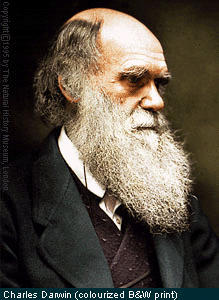
The Darwinian perspective states that any given genetic mechanism or trait has evolved due to its survival value. Therefore depression should be no different. Yet how could something that creates so much misery be adaptive? Read on and find out the possible reasons!!
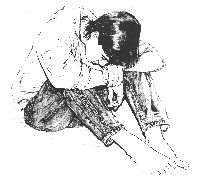
- Persistent feelings of sadness
- Loss of interest or ability to feel pleasure
- Feelings of worthlessness or guilt
(Source: Firestone and Marshall 2003. For further information on symptoms please see:http://www.mentalhealth.com//dis1/p21-md01.html )
Some people inherit a diathesis (a genetic predisposition for developing depression) that is only initiated when the person experiences a stressful life circumstance (Pinel 2002). Support for this approach comes from the evidence that demonstrates how depressed subjects have much higher levels of certain stress hormones then people who are not depressed (SFN 2001). (For more info please see:
http://web.sfn.org/content/Publications/BrainBriefings/brain_depression.html)
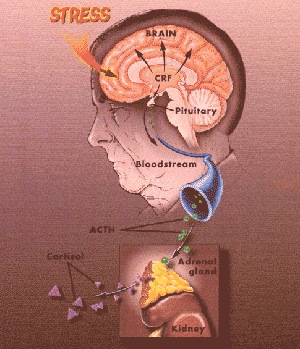
Those who have a shortage of certain types of monoamines such as dopamine, norepinephrine or serotonin experience depression due to decreased amount of activity in certain brain regions (Firestone and Marshall 2003)
 http://www.telegraph.co.uk/
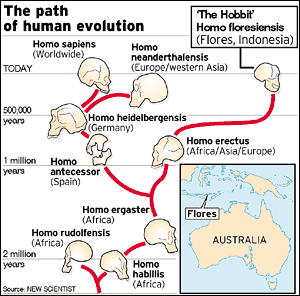
In primates, depression evolved as a mechanism to inhibit the given primate from challenging those of higher status (Rossano 2003). Advantages include: 1) signaling to others a non threatening status; 2) allowing for involuntary submissiveness and 3) it withdrawals the individual from costly competition (Rossano 2003). The bout of sadness that may follow a loss, perhaps forces the individual to take "time out" and focus on a new strategy for interacting with the environment.
Interestingly, men who loose social status (perhaps as a result of competition), tend to display symptoms of depression (Rossano 2003). Similarly, the authors of the book �Why We Get Sick� (Nesse and Williams 1996) describe cases of how when alpha monkeys loose their dominant status their serotonin levels drop and they display human like symptoms of depression (Nesse and Williams 1996). The bout of sadness that may follow a loss, perhaps forces the individual to take time out and focus on a new strategy for interacting with the environment.
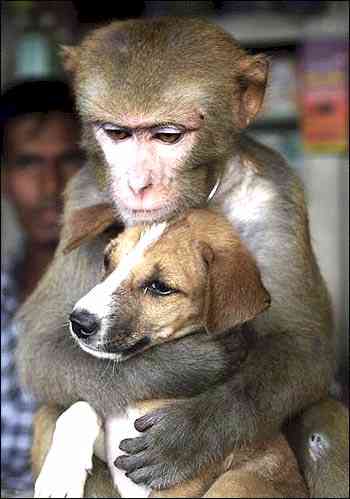 http://flatrock.org.nz/topics/animals/dont_blow_it.htm
The most successful treatment for depression is a combined treatment of cognitive-behavioral therapy plus medication (Firestone and Marshall 2003). Cognitive-behavioral therapy entails targeting thoughts and behaviors that lead to depression and replacing these actions with more beneficial ones in their place. Popular choices of medication include Selective Serotonin Reuptake Inhibitors (SSRIs) such as Prozac or Paxol.
Firestone P, and Marshall WL. 2003. Abnormal Psychology: perspectives. 2nd ed.
Toronto: Pearson Education Canada Inc.
Long PW. 1996 Oct. Internet Mental Health. Available from:
http://www.mentalhealth.com//dis1/p21-md01.html Accessed 2005 June 25.
Nesse RM, Williams GC. 1996. Why we get sick. New York: Vintage Books. 290 p
Pinel, J.P. 2003. Biopsychology. 5th ed. Boston: Allyn and Bason. 566 p.
Rossano MJ, editor. 2003. Evolutionary Psychology. Hoboken NJ: John Wiley &
Sons, Inc. 488 p.
[SFN] Society For Neuroscience. Oct 2001. Brain Briefings. Available from:
http://web.sfn.org/content/Publications/BrainBriefings/brain_depression.html Accessed 2005 June 20.
[SFN] Society For Neuroscience. 2005. Depression � Making a Difference Today. Available from:
http://web.sfn.org/content/Publications/BrainResearchSuccessStories/BRSS_Depression.pdf Accessed 2005 June 20.
COUNTER
