
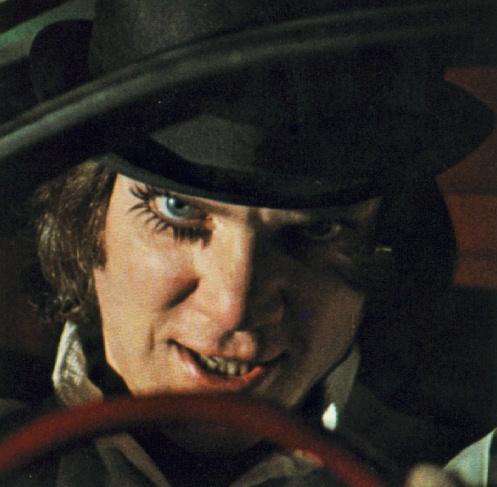

It is obvious from the beginning of Alex�s story that he is a rebel. He narrates using slang words from a language called Nadsat. It consists of a combination of Russian and common English words that are identified by the context in which they are used. A good example of Nadsat is in the opening line of the movie when Alex tells the viewers he is sitting with his three �droogs� (friends) in the Korova Milk Bar trying to make up their �rassoodocks� (minds) about what they should do for the evening. After partaking in a bit of �ultra-violence�, they are �feeling a bit shagged (exhausted), and fagged (tired), and fashed (worn-out)�. Even �nadsat� is from the Russian language, being the suffix of the numbers eleven through nineteen, representing the range of ages of the people who speak it. This use of Russian is most likely due to the fact that A Clockwork Orange is from the Cold War era. Nadsat is used as a means of offering a softer image to the �drats� (fights), the �old in-outs� (rapes), and other acts of ultra-violence committed by these �oranges� (young men).
Alex is not crude and inconsiderate in all cases, though. While addressing authority figures Alex�s impression is opposite of what the audience sees. His speech contains less Nadsat and he is more polite, which make him come across as innocent and sincere. This demonstrates that Alex also has a softer side. Included in this kind demeanor is his devoted passion for �Ludwig van�s Ninth�. After a night of committing heinous crimes, he retreats to his room and listens to Beethoven�s Ninth Symphony. To truly see these two drastic sides of Alex, the viewer is shown a pornographic painting on one wall of his bedroom, contrasted with a picture of Beethoven on the opposite wall.
As Alex continues the story, his voice retains the same unemotional quality it had in the beginning. Perhaps it is this lack of emotion that makes Alex such an intriguing character. While telling of the events that led to his arrest, he sounds neither excited nor remorseful; the monotony is still present. The only time Alex has an outburst of emotion is while he and his gang are raping a woman and beating her husband. Alex sings a rendition of �Singing in the Rain� and punctuates his syllables with a kick to the helpless man and a snip of the woman�s clothing. The use of this popular song and the violent actions together make this scene one of the most disturbing in the movie.
Alex�s crudeness is also shown through his body language and actions. When his gang talks him into going to a desolate house where a middle-aged woman resides with her cats, Alex goes to her room is immediately drawn to a white phallic sculpture next to the door. As the woman attempts to ward him off, Alex attacks her with the offensive figure. His actions and movements as he assaults her are quick and punctuated, yet ballet-like and smooth.
Though Alex seems to encompass all aspects of manipulation through his speech, the viewer soon realizes that this cannot work well for him all of the time. After Alex is put in jail he displays examples of how his manipulative conduct around authority figures can easily backfire. As he sits reading the Bible in the prison library, he imagines himself in all of the gory stories. The prison chaplain takes Alex�s interest in the book as a sign of remorse, however, and Alex is able to get information from him about a new treatment for inmates. The procedure involves Pavlov�s method of conditioning and associates acts of ultra-violence with acute sickness. Alex is accepted for the treatment, but when Beethoven�s Ninth Symphony accompanies the ultra-violent images he begins to protest. Because of his manipulative nature, however, the doctors are used to his sensitive side and assume he is just going through the recovery process.
After successfully completing treatment, Alex is released from jail and attempts to continue on with his life. He is not able to return to his normal self, however. In contrast to walking around cockily as he did in the beginning, Alex has a look of discontent on his face because he can no longer partake in what he once loved � violence. He is not able to fulfill this longing by turning on Ludwig van�s Ninth, either, because of the involuntary conditioning against it. When he hears the beloved song he begins retching and gagging. This helplessness and sadness that he reveals to the viewer is excruciating. It accompanies Alex until he attempts suicide by jumping out of an upper story window to escape these discontented feelings.
By now the viewer has gone from fearing Alex to feeling resentment for what the government has done to him. This resentment does not last long, though. In the end Alex is his old self, thanks to a little rectification from the doctors who conditioned him in the first place. Alex�s subtle humor is brought out as he is shown cartoons and is asked to fill in phrases for the characters. The viewer is certain that Alex is back to himself again as he looks at a picture of a man crawling through a window into a woman�s bedroom. Alex�s response to the picture is, �No time for the old in-out, love. I�ve just come to read the meter!� This crude response shows that Alex is once again the rebellious young man he had been in the beginning.
When put together, Alex�s characteristics, from his made-up Nadsat language and persuasive speech pattern to the outrageously offensive outfit he wears, makes him the kind of character that the viewer is reluctant to say they like and sympathize with. No matter what, though, it is hard not to feel sorry for Alex. He truly is a �clockwork orange,� a man who responds mechanically to acts of ultra-violence, whether he has been conditioned against them or not.