Climbing Krobo Mountain
By Debbie Walter
Photographs by Daniel Walter
Climbing
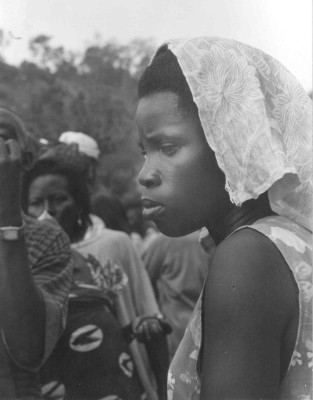
Krobo mountain during the annual festival is both a unique cultural adventure
and a harrowing experience. Each November hundreds of people of the Krobo tribe
of Ghana return to their ancestral homes high on Krobo Mountain. The festival is
a remembrance to their ancestors and their valiant struggle against the British
colonialists. Travelling to the festival with a Krobo friend, we thought that
this low-lying mountain would be a simple stroll. What neither my husband nor I
had accounted for, was the hundreds of festival happy Krobos plying the narrow
path in both directions.
At the base of the mountain, a celebration rages for days, as vendors hawk their goods, and tired participants relax from the days climb. The Krobo pilgrims wind their way up the narrow pathway that has been cleared of thick undergrowth for the occasion. Some climb slowly, while the hardy run full tilt up the mountainside, with the average climber reaching the top in about 30 minutes. Once the mountaintop is reached, hundreds of people mill about in celebration, while fetish priests perform the traditional ceremonies of the Krobo people.
There are in fact two such celebrations, as there are two sides of the mountain belonging to separate subdivisions of Krobos. There is the Yilo Krobos and the Manya Krobos, each celebrating the festival on different days. The Yilo side of the mountain is somewhat steeper than the Manya side, and a little trickier to negotiate alongside hundreds of other festivalgoers. The festival atmosphere is high-spirited to say the least, and good footing and a willingness to be good sport about the social aspect of the mountain is a must. Many of the climbers have indulged in the local brew, akpeteshie, so there are a few tipsy climbers to watch out for. Since the celebration marks how the ancestors were removed from the mountain by the British, I had been anxious about how our presence, being foreign and white, would be taken. However, all day long we heard two of Ghana’s highest compliments “You’ve done well” and “You’ve tried oh!,” making us feel right at home.
For those who prefer a more tranquil hike, the best time to go is just after the festival has finished, before the thick brush has grown back, and after the clean up crews have had the opportunity to do their work. After the festival, the sounds of birds are the only interlude to the quiet and it is possible to investigate the more subtle charms and history of the mountain.
The pathway winds upwards through thick brush and ancient trees. Along the pathway you’ll easily be able see the remains of the Krobo ancestral homes left behind when the British forces were finally able to force the Krobo from the mountaintop. Climbing from the Yilo side, you will venture through a rock cave.
History tells us that the Krobo chose to settle on the mountain since first migrating from present day Nigeria in the 15th century, as the mountain provided an ideal defense against neighboring tribes. Through the years these other tribes, most notably the Ashantis, fought in vain to dislodge the Krobos from the mountain. The British tried for years to force the people to abandon their mountaintop homes, as their inaccessibility made it difficult for the colonizers to control and ensure tax collection. The Krobo used huge boulders, tree trunks and other weapons in defence, but eventually they were no match for firepower of the British forces, and were abruptly forced from the mountain in1892. Thereafter, Krobos were forbidden to return to the mountain despite their strong cultural ties to the mountains and their homes.
The abrupt departure of the Krobo resulted in much being left behind. Walking around where the community once stood, we can see the remaining foundations of stone houses and defence walls made from crushed rock. Broken pottery is seen scattered around. Deep pockets have been dug into some of the rocks, places to store water as well as dry grains. Grinding stones are still scattered here and there. As we walk, Gaga, a local traditional priest, points here and there, explaining how the village would have looked, and where the most important of ceremonies took place.
With so much history intact, It is easy to imagine the activities of the community - women going about their daily tasks- carrying water, cooking - children running around. We also visited the remains of the Ne Ne Patu Ologo's (Paramount Chief) palace, as well as a rock formed cave, which served as the Krobo’s Bank.
Finally reaching the top of the mountain, the view is spectacular. The mountaintop is mostly rock, leaving an unobstructed view of the land below. The savannah plains stretch for miles around. Lake Volta can be seen off in the distance, while the nearby mountains of Yogaga and Odudok are also clearly visible.
Grass Valleys separate the two sides of the mountains. Farmers cultivate some of the land, but most of the valley is covered in a thick brush, difficult pass even with the use of a machete. The valley, and some parts of the mountaintop are inhabited with a range of wild life. If you look around carefully, you may be able to see baboons or monkeys swinging from treetops in the distance. Baboons are considered scared within Krobo culture, and a taboo exists against killing them. Krobo Mountain is also home to a wide variety of birds. Pythons are said to occupy the mountain, especially within the thick grass of the valleys, so visitors should be aware. The mountain is also home to one of the last stands of the charcoal tree (Talbotiella genetti), the most endangered tree species in Ghana.
Whether
one decides to participate in the Krobo festival, or hike during quieter times,
a visit to Krobo Mountain is a rewarding experience. Other than festival time,
the mountain is quite deserted so hikers should remember to bring water and
refreshments, along with their sun hats and a good machete.
Early morning is the best time. Mostly, visitors should remember that the
mountaintop is an outdoor museum of the Krobo history and culture. Leaving
everything exactly as it is found, is imperative to ensuring that the Krobos
will long have the mountain top as a place to honour their ancestors.