 |
|
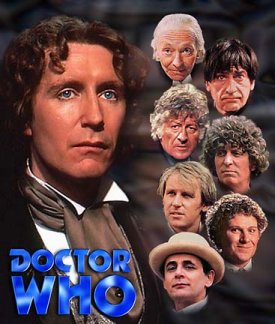
| The longest-running sci-fi program in history, "Doctor Who" debuted in 1963 and ended in 1991. The longevity of the programme was due to the fact that the title character, an alien from the planet Gallifrey, could regenerate, allowing for a string of actors to play the role. There was a certain level of camp to the series due to a budget just this side of zilch, but the writing was often quite good with several memorable quotes, the acting superb, and a general sense of fun. Just when it was starting to take a dark, deeper turn with the Seventh Doctor, the BBC unceremoniously pulled the plug. In 1996, FOX TV aired a film introducing the Eighth Doctor, but sadly it did not lead to a series. Click on the picture of the eight doctors to visit a comprehensive web guide to the series. |
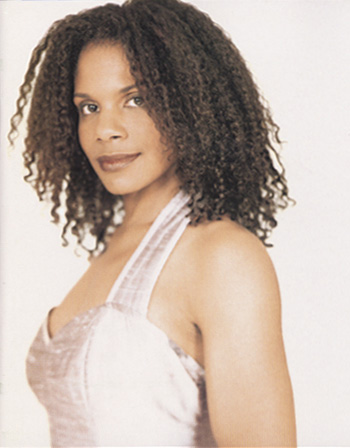 |
| An actress in musical theatre, Audra McDonald is gifted with one of the most gloriously expressive and richly nuanced voices I have heard. Classically trained as an operatic soprano at Juilliard, she chose to return to her childhood love of musical theatre. Her Broadway debut came in the early 1990s, when she appeared as Carrie Pipperidge in a revival of Carousel, which brought her critical lauds and her first Tony Award. Her second appearance on the Gret White Way was as an opera student in the play Master Class, which earned her a second Tony. She next created the role of Sarah in the musical Ragtime, again receiving critical praise and yet another Tony. Most recently, she created the title role in the musical Marie Christine. What makes this all the more astounding is her age: 31. Her most prominent national appearance was as Grace in the 1999 ABC remake of Annie. Click on her picture to visit her official website. |
 |
| A professor in the Cognitive Psychology department at the University of Indiana, Douglas R. Hofsadter is a pioneer in the field of Artificial Intelligence. He has written a variety of works in a wide range of areas, with his AI work always underpinning his writings. His first work, Godel, Escher, Bach: An Eternal Golden Braid, an exploration of the relationship between math, art, and music, written at the age of 27, won Hofstadter the Pulitzer Prize for General Non-Fiction. Another important work was a collection of articles he wrote for Scientific American, Metamagical Themas: Questing for the Essence of Mind and Pattern, and exploration of the origins of human creativity. His most recent tome was Le Ton Beau de Marot: In Praise of the Music of Language, an exploration of language and translation. What I most enjoy about Hofstadter's writings are his unabashed enthusiasm for eclectic topics, about which he is always witty and thought-provoking. Click on his picture to visit his home-page at the University of Indiana. |
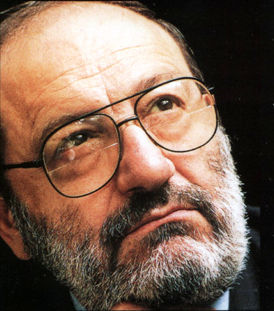 |
| A professor of semiotics (the philosophical study of signs and symbols) at the University of Bologna in Italy, Umberto Eco is one of the most thought-provoking intellectuals of the late 20th and now early 21st Centuries. His novels include The Name of the Rose, Foucault's Pendulum, and The Island of the Day Before. His collections of essays, including the marvelous Travels in Hyperreality, are sparkling gems of witty intellectualism. Eco is also one of the most prominent and respected literary criticism theorists, and is at the forefront of the move past a post-modern paradigm of literature and into what is, for the time being, referred to as post-post-modernism. He has also written extensively on the Information Revolution, and is at work on a ground-breaking approach to the Information Highway along with colleauges in Italy. Click on his picture to visit a comprehensive website. |
 |
| While many would dismiss British author Clive Barker as "just another horror hack," Barker transcends the genre as no author since H. P. Lovecraft. Barker often takes abstract philosophical concepts and gives them concrete physical reality. Perhaps his greatest triumph in this undertaking are The Great and Secret Show and Everville, the first two books in an intended trilogy, in which he posits a reality (the Metacosm) behind our supposed reality (the Cosm), echoing Melville in Moby Dick. His cinematic efforts, including the Hellraiser series, have been subpar, and not indicative of his true talents. Currently, he is working on the Araby Quartet, a mulitmedia fiction-based creation for Disney. Click on his photo to visit the official Clive Barker website. |
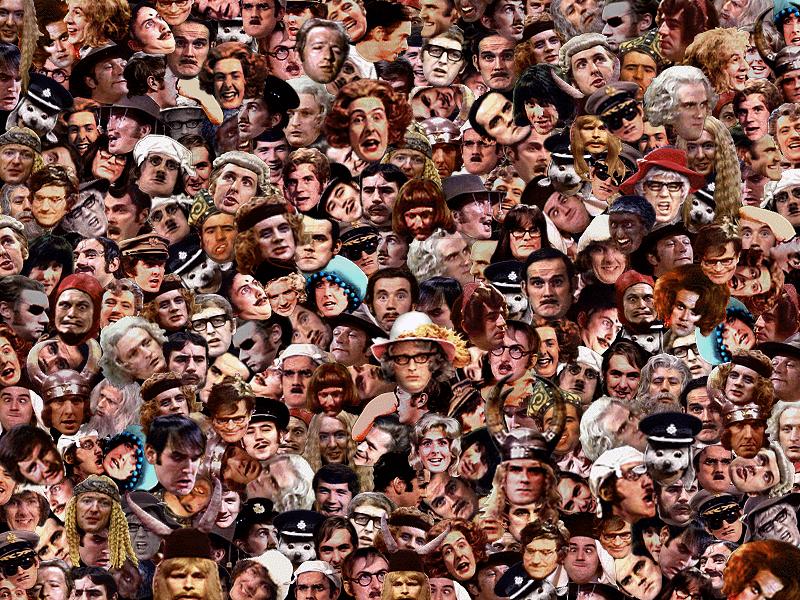
| The pinnacle of post-modern humor, Monty Python struck a delightfully absurd chord that has often been imitated but never repeated. They took sketch comedy to a stream-of-consciousness level in their groundbreaking series for the BBC, Monty Python's Flying Circus. In their three cinematic efforts -- Monty Python and the Holy Grail, The Life of Brian, and The Meaning of Life -- they continued to confound expectations of what film and comedy should be. The five members were John Cleese, Terry Jones, Eric Idle, Michael Palin, American Terrance Gilliam, and the late Graham Chapman. Click on the collage of their faces to visit the official Monty Python website. |
 |