
Japan - April 21st, 1989
America - August 1989
CPU - Custom 8-bit Sharp LR35902
RAM - 8 KB internal S-RAM
Video RAM - 8 KB Internal
ROM - On-CPU-Die 256-Byte bootstrap. Cartridges in 256 kb, 512 kb, 1 MB, 2 MB, 4 MB, and 8 MB.
Sound - 2 Square Waves, 1 programmable 32-sample 4-bit PCM Wave, 1 White Noise
Display - Reflective LCD 160 x 144 pixels
Screen Size - 66 mm (2.6 in) diagonal
Color Palette - 4 shades of "grey" (green to very dark green)
Game Boy Link Cable
Game Boy AC Adapter
Game Boy Camera
Game Boy Printer
4-Player Adapter
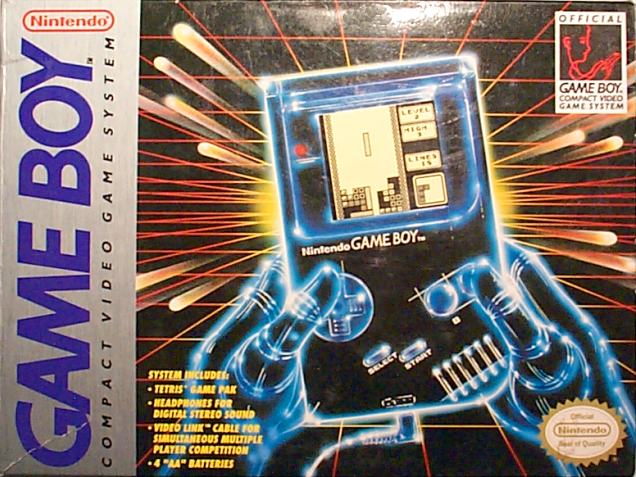
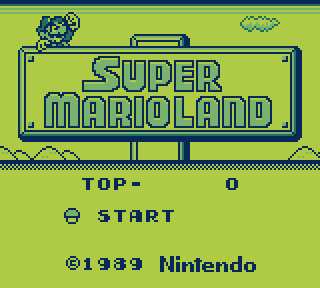
The Game Boy was a hit when it first came out. It came bundled with Tetris, and it had 4 other launch titles at release (Super Mario Land, Baseball, Alleyway, and Tennis). One of the main marketing points made by Nintendo was to have the system appeal to adults as well as children, one of the reasons why the system was bundled with the game Tetris, as it was something that was easily played on the go.
The Game Boy faced serious criticism though, due to it's lack of color and a backlit screen, something it's competitor systems, SEGA's Game Gear and the Atari Lynx had. But this proved to be a key aspect on how the Game Boy sold so well with it's lack of better hardware. The Game Boy's battery life was at 35 hours, more than 5 times long the life of the Game Gear or Atari Lynx's battery life, which was only about 5-6 hours. This strategy of Nintendo's systems lacking better hardware for something more desirable is still seen today in the Nintendo Wii.
But The Game Boy didn't just die out once the Game Boy Color came into the ring. A good amount of Game Boy Color games were also made to be compatiable with the Game Boy, such as Pokemon Gold and Silver, Pac-man, and even the Game Boy Camera accessory. Also, When Game Boy games are played on the Game Boy Color, you can change the game into a series of different palettes, including a monochrome display.
The Game Boy is known to have one of the longest life spans for a system in general, from 1989 to 2002, 23 years. The last Game Boy Color game (which was compatible for Game Boy) was One Piece, made in 2002.