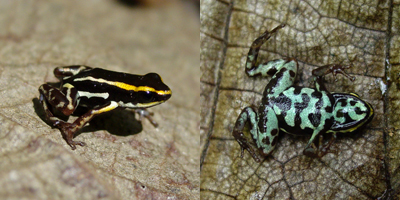
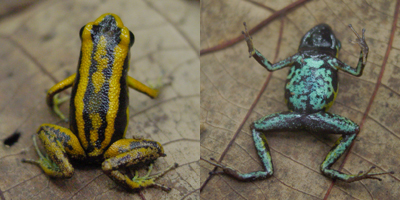
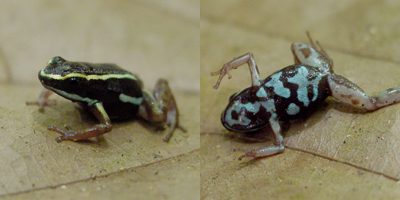
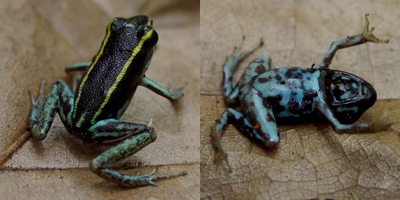
Of course there are quite a few more Dendrobatids know in literature than kept in the terrarium, but the case of one small frog, going unnoticed by both communities while living in a part of the world well known to each, is interesting. Data and images were collected by the author and his partner in crime Tommy Ostrowski of Germany during a month-long stay in the Bocas del Toro archipelago
Dendrobates claudiae (Jungfer et al, 2000) is a small frog (12-15mm) from the minutus group found in Bocas del Toro archipelago and nearby mainland in Departamento Bocas del Toro, Panam�. The type locality is from a mainland peninsula west of Isla Loma Partida (Split Hill) and southeast of the small town Cerro Brujo, (82� 11� W/09� 09� N). Here D. claudiae is found sympatricly with several other Dendrobatids, including D. auratus, D. pumilio (dark blue), Phyllobates lugubris, and two species of Colosethus (C. talamancae, C. flotator).
The author also found D. claudiae on several of the larger islands: Isla Bastimentos, Isla Popa, Isla Col�n, and Cayo de Agua. There is slight morphological variation between these populations, with that of the Isla Col�n frogs being the most markedly different. This population has a bright orange and white dorsal pattern and is slightly larger than the other populations, which are for the most part like the nominate form.
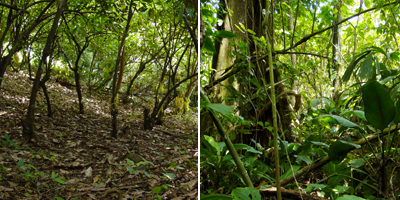
Dendrobates claudiae lives in shady regions, forest floor leaf litter and heliconia stands, and is regularly associated with steep hillsides. Populations are dense, and favorable sites often contain 2 or 3 animals per square meter (Ostrowski, in press). The male produces a short, buzzing call during most of the day, but takes a siesta at lunchtime. 1-4 eggs are laid in the leaf litter and then tended by the male. Likely deposition sites for the larvae include ground level phtotelmata such as low tree holes or dieffenbachia as well as small pools formed in leaves on the forest floor. In the terrarium, larvae should be raised individually to avoid cannibalism. The adults take only springtails as Drosophilla are too large to elicit a feeding response (Ostrowski, in press).
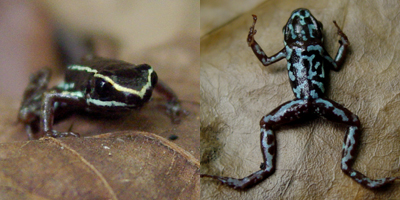
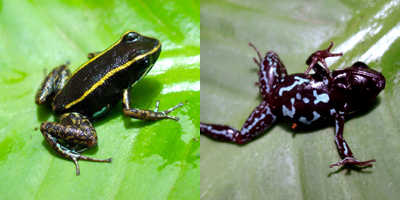
Two interesting points came up while hunting D. claudiae in Panam� last winter. Firstly, why was such a common frog, living in an accessible place, not described until recently? One idea that seams likely to the author is that D. claudiae, being superficially similar to Phyllobates lugubris in both dorsal and ventral pattern, was and still is mistaken for juveniles of the latter species. Because of this similarity, a brief guide for field identification has been prepared.
Specimens shown to exhibit a combination these morphological traits can be labeled Dendrobates claudiae:
- A ventral pattern of blue maculation on a black base extending from chin to vent and also the underside of the legs. This same pattern covers only the area from neck to vent in P. lugubris, leaving a solid black throat.
- Dorsolateral stripes coming to a labialy directed point, often forming a vertical stripe, on the tip of the snout. P. lugubris invariably shows a rounded union of the dorsolateral stripes across the top of the snout.
- A plain, brown coloration, without obvious markings, on the outer surfaces of the limbs. P. lugubris typically shows a pattern of brown (also yellow or light green) maculation on a black base on the limbs.
- A short stripe, parallel to the dorsal markings, through the center of the flank. Absent in P. lugubris, however the ventral markings often extend across the flanks forming an irregular pattern.
- Of course size a size of more than 15mm can eliminate D. claudiae from consideration, as P. lugubris is larger, about 18-25mm.
The minutus group is very under-represented in American terrariums, if anyone is keeping them at all. They are no doubt very interesting captives, and we could benefit from this type of close study of their habits. Hopefully this article will be useful for anyone planning either to do some frog tourism in the Bocas del Toro area or breed these frogs.
Images:
Fig. 1 - Dendrobates claudiae from Isla Col�n site.
Fig. 2 - Phyllobates lugubris from Isla Col�n site.
Fig. 3 - Dendrobates claudiae from the Loma Partida mainland site.
Fig. 4 - Phyllobates lugubris from the Loma Partida mainland site.
Fig. 5 - Dendrobates claudiae from the Isla Bastimentos site.
Fig. 6 - Phyllobates lugubris from the Isla Bastimentos site.
Fig. 7 - D. claudiae habitat from the Loma Partida mainland site (L) and the Isla Col�n site (R).
Dendrobates claudiae Jungfer, L�tters, and J�rgens, 2000, Herpetofauna, 22: 12. Holotype: ZFMK 73561.
Text and images � Jeff Mette, [email protected]