
The Controversial Author David Walley's Exclusive Interview About Frank Zappa!
The interviewer is Paul Remington, David Walley wrote a controversial book about Frank Zappa which recieved enormous criticism and praise in almost equal measure, here is a great interview in which he gives us his insight into Frank Zappa. . The interviewer talks to David about his controversial book "No Commercial Potential - The Saga Of Frank Zappa", but most of the interview focuses on Walley's perception of Zappa as a musician and as a man, fascinating reading, enjoy. Thanks to David Walley For letting me publish it on my site.
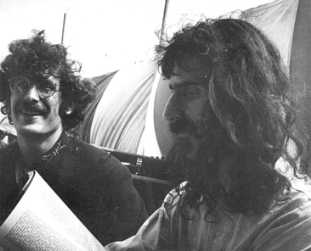
David Walley (Left) hanging out with Frank
Zappa
(right) at Newport Jazz Festivsl, 1969.
The Interview Itself
Key For The interview
PR
= Paul Remington
DW
= David Walley
Zappa=
Frank Zappa
PR:
When and how did you formally present your book, "No Commercial Potential",
to
Frank Zappa?
DW:
Maybe it was in 1970 or 1971 that I approached him with the idea. "I don't
want to
impair your
ability to earn a living," he said to me. "But you're not," I replied.
There's a
passage in
"No Commercial Potential", in the older section, which gives the gist of
our
conversation
on the subject. Don't forget that I was one of the few writers in NYC that
was on his
side, who knew how to write about what he was doing. "You're one of the
few
people who
understand what I'm doing," he told me. I remember when I was winding up
my stay in
LA (around the same time that Nigey [Lennon] was living under his piano)
and
I told him
that I was too overwhelmed by the material, that I was distressed that
he could
live in such
surrounding chaos (the inter-band, family backstage politics, etc.) and
yet be
so alone.
He looked at me very queerly and didn't say a word, but I knew that I had
hit
home. I remember
telling him--must have been four or five in the morning--that I couldn't
do the book,
that I didn't know what to do. And for a change, he treated me like a human
being, not
just someone he was enduring an interview with, imparting information.
He
made me feel
better. "Of course you can do it, you know what's going on. You're a good
writer." You
see, I also knew that the only way I was going to get him to be real with
me
was if I totally
lost control and was real myself; maybe too real. I think that he had trouble
being honest
with people because he thought they were going to hurt him--that, in effect,
that's what
he was always looking for and found. If you want to know the truth, he
knew
that I knew,
but he also knew that I wasn't about to catch him out. What would have
been
the purpose?
I could have talked to all his old girlfriends (well, I did) and used that
material.
I could have talked to his ex-wife who would have had lots to say, but
that
wasn't my
intention. That was small shit. It was always a question of recognition,
if you
will. I knew
who he was, but he didn't have a clue who I was. He had a magnetic
personality
and I could see how easy it would have been to capitulate to him. But,
then
again, I would
no-longer have been my own man and this book would have been a piece
of promotional
trash instead of the serious thoughtful and insightful history it has turned
out to be.
PR:
When you first approached writing "No Commercial Potential", did you intend
to
approach it
from a sociological level, or did that transpire as a result of discovering
how
much American
culture and society was a part of Zappa and his music?
DW:
I looked at the music of Frank Zappa as a cultural historian. It was interesting
from
the point
of view of not only what he was writing (lyrics, musical assemblages of
styles)
but how he
was doing it. If he was just a rock and roll star, though I might have
enjoyed
what he was
doing, I wouldn't have been so obsessed with it. Look, I was a grad student
finishing
up a MA in Modern European History and doing an essay on "Student
Revolutionary
Movements in the Paris Commune". This was 1968. Paris was going up,
and I was
wondering what the use of history could be if not as a predictive tool.
I looked
on what Zappa
was doing as a primary resource, an opportunity to discuss American
culture as
it was happening.
PR:
You were the first to cover Zappa in a biography. What was there about
Zappa that
inspired you
to write a book profiling him?
DW: He
was something more than just a rock and roll star. Well hell, he really
wasn't. He
was a composer
who used rock and roll music like another form of American music. I
was struck
by his use of musical forms of all kinds as well as the satiric edge of
his
lyrics. He
had the words and he also had the music, and he was a unique American
character,
much like Charles Ives and Howling Wolf. What I'm saying is, I was fascinated
that he drew
from all areas of music and made something larger. He had a larger context
than just
a pop star. If he was, as a cultural historian, I wouldn't have been so
intrigued.
Of course,
I would have grooved, but I wouldn't have been so enamored with what he
was trying
to do. He was also a figure that was "serious" and at the time
"counter-cultural,"
but not in the fashion jeans sense of the word.
PR:
What stimulated your interest in writing "No Commercial Potential"? How
did it
begin?
DW:
It was 1967. I went over to see Butchy McCormick and he turned me on. He
also
played "Help
I'm a Rock", and that's all she wrote. [Smiles] Then I saw the Mothers
at the
Garrick [Theater,
New York City]. When I moved into New York City and started working
for Jazz and
Pop, I did a review of "We're Only In It for the Money" and "Uncle Meat."
Since my publisher
was a friend of Frank's, I was able to meet him at the Newport Jazz
Festival where
he read the article and told me that I was one of the few people who know
what he was
doing. So I continued writing about Frank, and was one of the few critics
in
the Underground
Press to give him more of a voice.
PR: How did you decide on the approach you took to the 1972 edition?
DW:
The material decided the approach for me. [Smiles] At the time I was reading
Kurt
Vennegut's
"Cat's Cradle", I was struck by the phrase, "As it was supposed to happen,"
which fed
into the way I was thinking the life of Zappa was set up.
PR: Did you find profiling Zappa to be a difficult task?
DW:
It was hard work because the material was leading me, I wasn't leading
the
material.
I started with the idea of trying to present this man in his own time and
proceeded
from there. One can't help but be influenced by the way Frank makes music,
and I just
wanted, as a writer, to make a prose representation of how he makes music,
i.e., using
his techniques to write history, because that's what I do.
PR:
How broadly was "No Commercial Potential" accepted when it was first published?
Obviously,
it's considered one of the essential Zappa bios now. Was it embraced the
same way back
in 1972?
DW:
It had favorable reviews in all the major music magazines of the day; Rolling
Stone,
Creem, Rock
Magazine, Win Magazine. Of course, that was helped by the fact that
many of my
colleagues who knew me and knew what kind of shit I'd gone through
wanted to
be supportive, it was also a really fine piece of work of which they approved.
He was a formidable
presence in his "original" Sixties configuration after all.
PR: The
material you would have to work with if writing "No Commercial Potential"
today
would certainly
be richer and different than the material you had available in 1971. I
would
assume the
way in which Zappa's life changed over the years might alter how you would
view him as
a biographical subject. How has the way in which you viewed Zappa
changed since
first being inspired by Vonnegut's words?
DW:
I don't know about "richer and different." I wrote "No Commercial Potential"
to
contextualize
Frank, to give readers some idea of where he came from. Most pop stars
have no context
other than the commercial world. Zappa's was much more rich. I mean,
the Sixties
was quite an interesting period in American history, very unique. Once
one
has a context,
everything else follows from there. Look, Frank was not a hippie, he was
a
freak. Hippie
is a made-up merchandizing word. Here's the way it goes:
beatnik-head-hippie-doper-yuppie.
Zappa's satire touched on all those changed.
Contemporary
American political history was also part of the pool from which he drew
his inspiration,
the newspapers, TV. If you're a satirist, you work with what you have.
Well
hell, he was
like Mort Sahl or Lenny Bruce who used newspapers as part of their acts,
to
draw material
from. Zappa drew from the electronic newspaper, so to speak.
PR:
Yes, that's one of things I find so fascinating about Zappa: he embraced
everything,
commercial
and otherwise. He was beyond commercialism. It's interesting he was so
caught-up
with it in terms of desiring commercial acceptance. On one hand he satirically
bashed it,
yet on a personal level he strove for it to embrace him. Do you feel he
was
trying to
fight a losing battle in his attempt to redefine what is commercial, which
is what
would have
had to happen had the commercial world accepted him?
DW:
I don't think he was "beyond commercialism." He had a highly developed
sense of
what was commercial,
or at least how to do that part of the business. I think he was just
trying to
get his stuff sold to as wide an audience as possible. In my opinion, there
are
many other
groups who should have learned something from Zappa--about how he went
about his
little commercial dance too, positive and negative. [Smiles] You see, when
I
blew out of
grad school, I was heavily dosed with the classics: Horace, Petronious,
Heredotus,
Livy, etc. And I was also a very enthusiastic acid-head in terms of the
fact
that I learned
from acid about what metaphors are. So anyway, isn't show biz just a large
stage and
if you've got the eyes to see, there are interesting fables and lessons
to be
learned, positive
and negative, like, "never believe your own publicity." It's all about
the
importance
of having good maps.
PR:
I'm reminded of the phrase, "She's frosting a cake with a paper knife,"
which was
humorous stab
at the stupidity of American commercialism. Later in Zappa's life his
interest in
observing the American way of life was expressed as concern with him
becoming politically
active, striving to make a difference, and to influence us to make a
difference.
Interestingly, unlike Zappa's experience with the PMRC and many other
clashes with
the American "establishment," he never incorporated his displeasure with
how the US
government handled his association with Haval and the Czech government
into his compositions.
Do you have any opinion why, and do you feel Zappa viewed the
outcome of
his work with the Czech government as a "failure?"
DW:
I think he just shined it on. I mean what's the use of pissing off a whole
country full of
fans. Anyway
governments are funny like that. Actually, I've been doing some sleuthing
in
the question,
and contrary to what Frank may have said publicly about the incident (the
Czech government
has said little officially), it more than likely appears that the reason
for
the "demotion"
was due to the fact that Frank started making inflated claims about what
he was gong
to do and didn't vent any of it with the Czech government. At the time,
as
you know,
the government was new in the community of nations, so Frank kind of put
them on the
spot. I've been in communication with the Czech embassy in Washington
DC trying
to track down the "real" story. I've also sent out a few Freedom of Information
Act requests
to the State Department for cable traffic between Foggy Bottom and Prague
and I'm awaiting
their reply (if any).
PR:
"Beyond commercialism" was actually in reference to his music, not him
personally.
As commercial
as Zappa's music can be, it is so often ignored from airplay. Would you
agree?
DW: Depends
on what piece of music you were talking about. I think that for most
program directors,
his music was too difficult to conceptualize. They had to think too
much about
it, and because they had to think too much about it, they figured that
their
audiences
would feel the same way. Not the case at all. The program directors were
just
very un-evolved.
Some of it was too sophisticated, some of it was just too "dirty." Frank
pushed the
limits. Unfortunately, the limits pushed back. [Smiles]
PR: "No
commercial Potential" contains such a focused view of the Freak scene on
LA
during the
late sixties, one wonders if you actually were a part of it, or associated
with it
at that time.
Can you explain your background, and how that background gave you the
knowledge-base
you needed while writing the book?
DW:
At the time I was working for the East Village Other Jazz and Pop Magazine
and
freelancing
around. I was living in the Lower East Side of New York. My paper's office
was above
the Fillmore East on Second Avenue, culture central as it were. Because
of
my work as
a journalist, I had access and a certain amount of freebie flights to the
coast
where I met
the rest of my colleagues. Anyway, the Village was happening and there
I
was on 74
E.7th Street, right in the middle of it. My "background" was as a trained
cultural historian
who was into music generally and rock and roll as it was constructed
then. I guess
I was just lucky to be at the right place at the right time; "As it was
supposed to
happen," in my humble opinion.
PR:
What contact, if any, did you have with Zappa and his associates prior
to writing the
book? Or,
did you develop contact with key personnel during the writing process?
DW: I
actually had no contact with the members of the band before writing the
book.
Well, maybe
in passing to say hello. I developed my contacts during the writing of
the
book, most
specifically with Don Preston and that gang, and later, Mark, Howard, Jim,
Aynsley, Jeff,
and George while I was doing full-time work.
PR: What was Zappa's first reaction to the book, and did it change over time?
DW: He was amused but not overly enthusiastic:
Zappa:
Listen, now that I'm thirty years old, now that I'm over the hill, I don't
give a shit . .
. I don't'
care, really. If you want to make a book about me and put your theories
and talk
balloons and
stuff like that, should I stop you if there's a market? But as far as working
intensively
to produce some historical document with all the hot poop, why just the
mere
fact that
nobody got into it does not interfere with the facts.
DGW: Well as far as writing about the artist and still having the artist around . . .
Zappa:
Yeah, I know. The minute you start doing anything like that in the field
of pop
music it's
automatically . . .
DGW: But I don't consider you a pop composer.
Zappa: Well,
it's irrelevant whether you consider me that or not. The more I think of
it, the
less I'm interested
in impairing your earning power, anyway.
DGW: Well, you're really not.
PR:
Zappa's referred to himself, more than once, as being "over the hill" at
the age of
30something.
Why?
DW:
No, he was just being smart-ass. I mean really the whole concept of being
"over the
hill" comes
from that same fiction perpetrated in the Sixties of "Don't trust anyone
over
thirty" when
Abbie Hoffman and Jerry Rubin were way over it; in their mid-thirties,
I think. I
didn't pay
that comment no never mind, I just used it because it showed how Frank
thought. His
humorous side I suppose.
PR: Did
any of Zappa's associates side with you over this controversy between you
and
Zappa, or
did they stay out of the whole ordeal?
DW:
Many of Zappa's associates approached me and told me that I'd written a
dynamite
book. However
they told me NOT to tell Frank they'd said so because he would have
fired them.
I respected their wishes, naturally, but found some matter of satisfaction
in
their approval
of what I'd tried to do.
PR:
Interesting. A sign of the control Zappa had, not only for his music but
also his band
members. How
did you find his band members felt about the control Frank required?
DW:
They bitched naturally, (cf. 200 Motels), but they also played great things
and had a
good time.
Of course they had to watch what they said around him or in the press.
PR: Did you find Zappa's early band members respected him? If so, on what level?
DW:
His early band were a group of contemporaries, they had their own issues
with him,
i.e. whose
band was it. By the time Frank fired the first Mothers and he was in control--he
was the leader.
He paid them and they worked for him, not, I suspect, with him.
PR: There's
a controversial aura around "No Commercial Potential". I've read negative,
offended opinions
from some readers. Do you feel "No commercial Potential" is a
potentially
offensive book?
DW: No,
it only offended Frank, everyone else told me that whether he liked it
or not,
that's who
he was. I refer you to "Our Bizarre Relationship" which can be accessed
through Bill
Lantz's homepage (http://www.primenet.com/~lantz/pages/walley.html), Evil
Bob's homepage,
or in the BIBLIOGRAPHY FAQ in "No Commercial Potential".
Somewhere
in my files I have the original letter I wrote to Zappa about it, which
of course
he never replied
to.
PR: I
think many may develop the impression that you placed a "spin" on "No
Commercial
Potential" based on your dislike of some sides of Zappa. Not many people
who write
a profile have such sharp things to say about the subject.
DW:
I didn't set out with any sort of "spin" at all. The material that I gathered
presented
itself that
way. As I said, I let the material take me where it could and I just held
on for
dear life
at times. Believe you me, I wasn't looking specifically for any negative
spin. In
my opinion,
the "negative spin" theory came from Frank himself, thinking what I could
have said
but didn't. Maybe he could have dealt with it much, much better had I done
so.
But, I still
don't understand what's negative about saying that human beings are fallible.
He was a human
being in a human universe. He was a great artist, possibly a genius.
Even geniuses
can be assholes at times--so what. Frank spent lots of his time calling
other people
assholes which was his right, but he could never look as clearly at himself.
Then again,
how could he? All I can say is that I was lucky to have found topics which
inspired me
and made me intellectually grow. Each of the biographies I've done, on
Zappa and
Ernie Kovacs (formerly released under the title of "Nothing in Moderation"
or
"The Ernie
Kovacs Phile"), have shown me how to approach my own work.
PR: WE
agree on this, but others may not. My objective view isn't that the "negative
spin"
impression
of "No Commercial Potential" came from Frank. I see it as a matter of
accepting
the human sides of Zappa, which many of his fans (as well as Zappa) find
it
difficult
to do. It's hard for most to see their hero as less than bigger-than-life.
It's easier
to attack
your credibility as the writer. You're the main target. Would you agree,
and how
have you learned
to deal with this?
DW:
I'm too much of a small fry as a writer to give "a good goddamn" about
it. I know
what I did,
I know the care and sweat and toil which went into the writing and research
of
the book.
As a writer, I'm not as heavily invested in myths as fans might be. When
I was
working as
a rock and roll critic in the late Sixties and early Seventies, I met a
lot of
musicians.
Some were decent smart guys while others were just assholes. They weren't
pop stars
to me. They were, for the most part, my contemporaries, and we talked about
a whole range
of things: art, music, politics, literature. They knew it was a joke. I
knew it
was a joke.
We just tried to have good conversations about things that mattered. About
the only really
bad interview I did was with Jeff Beck and Rod Stewart when Rocket
Rodney was
playing with Beck. Between the two of them I couldn't manage to cobble
together a
half of an interview. But, for the most part, the people I met were quite
intelligent.
They all admired Zappa for what he was doing too, especially the Bonzo
Dog
Band and Viv
Stanshall, though I think that there was some sort of mutual admiration
society there.
PR:
That's understandable, as I'm sure a large segment of your audience were
not
offended by
your approach. Have you received any feedback from individuals that really
made you feel
good about the book. I'm sure you've always felt good about it, but when
someone you
admire and respect comes forward to express kind words, that can really
mean a lot.
DW:
As a matter of fact, yes. I've had tremendous feedback from readers who
bought all
the other
editions; from music professors, especially. When I got online and started
talking about
it, it was really gratifying to see how long a shadow my book had cast
on the
Zappa world
in general. One writes, one finishes up one book and starts another. It's
like
making a record
and putting in the tracks. Some of them have "legs" and some of them
don't.
PR: Did Zappa take any legal action towards you for publishing the book?
DW:
None, he, or more importantly, Mutt Cohen, Herbie's brother, made noises
like they
were going
to sue. My publisher was at a loss, thinking that I'd never gotten song
permission.
But I'd done my homework, had given them the permission slip which was
lost when
the publisher's accountant died and the papers were lost on the desk for
six
months. [cf.
"Our Bizarre Relationship"] I was even prepared to personally excise the
offending
lyrics (above the fair use quotient), have each person who helped sign
the book
and place
across the cover "Censored" which would have certainly increased the value
of the book,
at least as a historical artifact. When we finally found the slip, we sent
in the
money which
they returned. We finally said "fuck it" and published the book. It all
seems
to have worked
out well enough in the long run, eh? [Smiles]
PR: Oh
man . . . [Laughs] Censored across the front! Now, that would have been
a real
bold and realistic
statement. I'm sure Zappa wouldn't have liked that, but how could he
disagree with
it? What stopped you from doing it?
DW:
What Frank said publicly was many times in opposition to how he acted.
What does
Whitman say?
"If I contradict myself, I contradict myself." Of course, it would have
sold
the book quick
and made it an instant artifact, and here I'd be using "time and those
waves" which
the book set up to sell it. [Smiles]
PR:
Your answer still leaves us hanging. Why did you refrain from releasing
it with
"CENSORED"
splashed across the cover? He might have, had he been in your shoes.
The controversial
aspect of the entire situation is fascinating to me, although I can
certainly
see a reason for you not going that far.
DW:
I guess, in retrospect, I could have done so, but then it would have been
a lie. Had
he served
me with a restraining order, I and my friends would have gone into the
warehouse
and excised all the material above the "fair use" limits. That would have
been
the only reason
for resorting to that expedient. My publisher thought it was a neat idea.
Anyway, I
knew I was right and fuck him if he couldn't take a joke. [Robust laughter]
PR: If
you're simply relaying facts, then I don't understand Zappa's response
to your
work. As you
said, perhaps he felt the book contained a personal spin based on how you
assimilated
those facts, which is the writer's prerogative.
DW:
Anybody with any grain of sense also sees this, so I never understood why
he
proceeded
to spend years of his life (most of the Seventies) trashing me. I remember
telling him
that if he didn't like the book, he didn't have to mention it. But as they
say,
"Sorrow, sing
sorrow, but good win out in the end."
PR: How, specifically, did he personally trash you?
DW:
He gave interviews in Gallery magazine and in Penthouse where he characterized
me as a psychotic--a
disturbed person who had no understanding of what he (Zappa)
was about.
He said in interviews that I must have made it all up, that none of it
had any
basis in fact!
PR: How did that feel, having your subject turn on you, so to speak?
DW:
I was really hurt by Frank's response to my book since I had nothing but
respect for
his work and
what he was trying to do. I thought it was an unbelievably paranoid
response,
but in retrospect, I suppose it was a product of his world view (which
I amply
demonstrated)
as well as the fact that indeed he was quite sheltered, or better,
demanded that
he be sheltered. He was most stung by what Captain Beefheart said,
though I found
what he had to say very accurate and telling. Frank was big for criticizing
everyone else,
but couldn't take the heat himself. He disparaged his old band, called
Ray
Collins in
an earlier edition of my book before it was cut out because of bullshit
legal
pressure and
because I could no longer produce the tape," "An archetypal acid burn-out
victim," which
was a fair enough assessment--cruel, but fair enough if taken in the
context with
whatever else he was saying. Anyway, Frank's comments really got me,
and in some
ways, inhibited my confidence, though I did go on to write a biography
on
Ernie Kovacs,
and that was in a way therapy because Kovacs was such a wonderful,
quirky and
brilliant man. There wasn't the same kinds of resentments involved with
him
that were
obviously involved with Frank.
PR:
Referring to "Our Bizarre Relationship", how did you view your correspondence
with
Ben Watson?
[Author of the Frank Zappa book, "Negative Dialectics of Poodle Play",
ISBN 0-313-11918-6]
DW:
I found Watson awfully condescending, and that was the major vibe in his
book too.
I found it
offensive, but then again I probably offend too easily. I have no real
love to
pretension,
which is why I liked much of Zappa's music. His music was loaded with
pretension,
so much so that you had to laugh with him, not at him.
PR:
What's interesting about Watson is he's not an American and has never grown
up in
the American
society that influenced both you and Zappa. Do you feel this may have an
impact on
Watson's view of Zappa?
DW:
I did bring that up to him, but it seems my comment was below his notice,
well he's
a Cambridge
educated twit who's just not smart enough. If he was smart, if he was a
real intellectual,
instead of erecting barriers to understanding and insight, he'd tear them
down. Intellect
is the clear sword that makes things if not simple, at least
comprehensible.
It's like Watson's knowledge is only for him and to hell with everyone
else.
PR:
It is interesting to read both your correspondences. It's clear you both
harbor
different
schools of thought. And, perhaps that's good. Having more than one point
of
view can result
in a different view of Zappa, I suppose. For those that see eye-to-eye
with
Watson, his
book becomes valuable.
DW: You
could have blue-pencilled more than a third of the book and still had something
interesting.
His editor obviously was overwhelmed by the force of Watson's bogus-pomp
critical theory
to weigh in with his opinions. God knows, I'd have whacked huge chunks
out of it.
PR:
For me, my main gripe with Watson's book is similar to my gripe with Nigey
Lennon's book,
"Being Frank" [California Classic Books, ISBN: 1-879395-55-X]; I don't
CARE about
Watson. Nigey's book seemed more a book about her during her short
period with
the Mother's of Invention and Zappa than about Zappa. I don't have anything
against Nigey
and respect the work she produced, but I'm not interested in Nigey, I'm
interested
in Zappa. Likewise, I'm not interested in Watson's slant on social and
political
views. I don't
think that slant was helpful to his daunting, yet at times fascinating
book.
DW: I've
been through this with a number of people. From my perspective, from what
I
know/knew
of the man, I thought Nigey's book was an interesting portrait and quite
accurate.
If you perhaps read our two books together, another dimension of Zappa
appears, that's
all I'm trying to say here. Nigey is an extraordinarily bright, competent
writer, very
funny too. It's another context of him, before the accident, which inalterably
changed Frank,
really.
PR:
So, you would corroborate Nigey's view? You also saw the change in Zappa
following
his 1971 injury.
DW:
Absolutely! In fact, during conversations with her, both on-line and on
the phone,
she confirmed
my suspicions. It was a real revelation speaking with Nigey because she's
such a brilliant
woman and one hell of a writer. By the way, you should check out her
books on Artaud
and Mark Twain, "The Sagebrush Bohemian", which deals with Mark
Twain in the
West and her thesis that Twain was actually a Western writer, not an
Eastern writer.
PR:
It's logical you would be associated with Nigey. How and when did you first
meet
her?
DW:
John Scialli [father of asteroid zappafrank] "introduced" us on-line. He
gave me her
e-mail address
and I dropped her a line. We started writing, and writing, and writing,
and
then calling,
and writing and then collaborating.
PR:
Zappa's life was so influenced by American culture, it almost appears Watson
was
unable to
identify with it. Now, as an American, I found this aspect of "No Commercial
Potential"
perhaps the most fascinating. As Frank said about music, there's no right
or
wrong. Your
book and Watson's book are what they are. We decide for ourselves what
is
right and
wrong, accepted or unaccepted, liked or disliked.
DW:
Sure, that's what makes horse races, that's what makes the history of biography
so
interesting.
One thing that's for sure, without me, Watson wouldn't have had a clue.
Anyway I've
been told by real live professors at real live universities and colleges
that if
one wants
to know about America in the Sixties, my book puts them there quickly,
accurately,
and deftly. Don't forget, I've always seen myself as a cultural historian,
even
when I was
writing about pop music. At one time I thought that it was a mirror into
the
soul of America,
now-days it's more like just another sealed tuna sandwich in the
consumerist
mall world we all know and loathe.
PR:
I don't mean to slam Watson. I've heard him interviewed, and was quite
taken by his
intelligence
and ability to analyze. and he is very insightful at times. For me, he
has a
tendency to
over-analyze. Negative Dialectics of Poodle Play contains a lot of really
interesting
information. I just didn't care for the way he wrapped his own words around
some of the
information, and the slant he put on the book.
DW:
That's exactly right, and that's exactly what I told him though I don't
think he
responded
to me, or if he did, it was in code. Life's too short to be spending time
playing
the kinds
of intellectual games Ben finds fascinating. But, then again, England only
has
four television
stations. [Smiles] Real intellectuals don't need to obfuscate what they
analyze. Put
another way, real intellectuals make things easy to comprehend because
they have
an overview, and that's something I don't think Ben has achieved yet. Maybe
it's a function
of his age or the company he keeps in England, I really don't know. For
me
it was showboating
of the worst kind. I'm not interested in the kinds of power games or
submission
and domination that Ben seems to prefer, at least in "Negative Dialectics
of
Poodle Play".
PR: Have
you read any of the other Zappa books, aside from Watsons, and have any
impressed
you?
DW: As
far as it went, I thought Michael Gray's book had some merit (more on Pamela
Zarubica who'd
I'd love to get back in contact with). Gray did use much of my book (and
credited me
with same, thanks Michael). He has a definite opinion about things and
talks
about his
family (something which I thought was beside the point). Whatever Miles
does
is fine with
me, I know him and trust him as a journalist. As for the rest, I can't
say,
though I'd
like to see what Neil Slaven has to say for professional curiosity surely.
PR:
Regarding the latest edition of "No Commercial Potential", why did you
take such a
different
approach in the chapter content between the 1971 and 1980 edition, then
again
between the
1980 and the 1996 edition?
DW:
For one thing, I was no longer in contact with Zappa, as you no doubt can
understand
now. Funny about the 1980 edition, it was actually the booksellers, the
salesmen in
the field for EP Dutton who asked the publishing house if they could get
an
update. That
was pretty neat. By the time 1995 rolled around, the old man had died,
I was
older and
perhaps a little wiser, and had some more perspective, I decided on that
approach.
By the way, the new chapter was written using the Internet, and my was
it
helpful! That's
how I found the Marshall interview. I then found out that it was my old
friend Bob
Dean, who I'd known since the late Sixties, who was also a big Zappa fan
and
who'd actually
used what I set up in the first edition to frame his interview questions.
PR: I
see, so the update was initiated by the publishing house. Did you have
thoughts of
updating it
yourself, prior to their contacting you?
DW: Absolutely
not! I thought that I was done with that part of my life. [Smiles] It was
Gary Lucas,
an old colleague of mine--one hell of a guitar player who played with
Beefheart--who
kept going on about how I should check out Da Capo Press, how they
put out all
kinds of great rock and roll books. So I did a cold call to Mike Dorr,
did my
dance, he
read the book, proposed it to his editorial board, and the rest, as they
say, is
history (or
better, a continuation of history).
PR:
When the book was released, did you have any idea it might become an important
sociological
and historical "period-piece?"
DW:
No, not really. I was just concerned at the time in trying to present an
approach
which reflected
my subject, so the reader could understand through prose what Zappa
was up to.
Remember, I told you I was trying to use Zappa's tools ("time and those
waves") to
do so.
PR:
"Time and those waves" is an interesting way to describe it. You begin
"No
Commercial
Potential" describing how Zappa's concept of time and those waves applied
to his work.
What was there about this approach Zappa found appealing? He carried his
use of "time
and those waves" through Civilization Phaze III.
DW: I
liked the way he used his own time, enfolded into his creative time, how
he made it
all part of
his Project Object, i.e. his larger oeuvre. You see, the Project Object
was all of
his time:
interviews of him, films etc., his concerts, his studio work. To understand
the
whole scope
of the Project Object perforce one has to be conversant with ALL and
EVERYTHING.
Which is what, in some ways, "You Can't Do That On Stage Anymore" is
all about.
Once one grasps that conceptual continuity, one can have a full appreciation.
Of course,
as I might have said, Zappa was at times not the best judge of what was
really good,
and from his perspective, everything he ever did showed great genius, or
a
genius in
the making. Not always the case.
PR:
And, of course, as you've pointed out, the only person who really was conversed
with ALL and
EVERYTHING was Zappa. His vault holds evidence of this. With him gone,
who can assess
everything that's in there from memory? So, the Project/Object was
primarily
an appreciated concept within Zappa with us enjoying his Conceptual Continuity
as an observer.
Would this be a correct statement?
DW:
Absolutely! You buy the music of Zappa, you buy into his universe which
he was
always in
the process of defining, refining, commenting on, living, etc., etc.
PR:
You stated in "No Commercial Potential", "[Frank] works so hard at not
being
serious, that
he even is serious." (P.4) This appears to apply not only to his social
side
but his compositional
side. I'm thinking of compositions like Billy the Mountain, and many
others. Learning
what makes Zappa tick, one might be surprised by this dichotomy. Do
you have any
feelings why--even through his frustrating childhood and professional life,
which instilled
a mounting level of cynicism--he maintained such a biting sense of
humor? Perhaps
it was his way of sneering at the world?
DW: It
was his defense against critical failure. What he had most of all was a
naked will
which showed
in his compositional efforts. At any rate, he thought of himself as an
Outsider in
the classic Colin Wilson mode (great classic book on alienation). Look,
the
world is a
pretty absurd place, people are strange, right? If you can't laugh at it,
you have
to cry. Who
needs that? There's also something of cosmic laughter in Zappa's satire,
though it
did get more than a little heavy-handed at times. I think that was due
to his
pandering
to the tastes of his audience as they developed.
PR:
Zappa's life was his work, which he never actually considered "work," from
what I've
been able
to determine. During your friendship with him, did he have recreational
activities
and personal interests outside of music?
DW:
[Robust laughter] Are you serious? When would he have had the time? His
amusements,
I suspect, were being on the road and watching and writing, you know, the
experience
of being detached and out there in the Netherlands. Touring does make you
crazy, and
Frank was crazier than most. After a while one tends to view the world
from
the aspect
of a traveling musician on tour, it can't be helped. I mean, room service
is a
"heavy" concept
while living the normal life that we lead, unless we're Yuppie capitalist
scum/bond
traders living in an American Express Gold World.
PR:
Was the view of Zappa you placed in the Afterword formed during and after
your
work on "No
Commercial Potential", or was it formed before the book was written?
DW:
It was written on the day that I heard that he died. Oh, I'd been thinking
about writing
something,
just for my files, just to get it off my chest. I actually sat down and
wrote the
Afterword
the day that he died, edited it quite a bit and sent it off to the New
Yorker
Magazine.
When I finished the update, I decided that I wanted it in the book as well;
as
my voice,
my thoughts. I'd done my "job" as Zappa's biographer and I thought it was
time
to step out
from behind the footlights and give my little speech. If the book hadn't
been
re-released,
the Afterword would have stayed on my hard drive as blank, empty
electronic
space. [Smiles]
PR: Reading
the Afterword, it seems as though you criticize Zappa with the same level
of
cynicism Frank
was known to express himself. Why did you feel this was a proper
conclusion
to the book?
DW:
What's good for the goose is good for the gander, I suppose. It's what
I felt, and I
thought I
was being honest with myself because indeed I was conflicted about him.
I
really did
love the man and his work. I just didn't like how he treated me when I'd
done
nothing to
him. I think that considering what I could have written, I definitely was
rather
"nice" to
him in that regard. Anyway, what would have been the point about writing
a book
which trashed
someone whose music I respected and whose vision I somehow shared.
What, writers
aren't supposed to express themselves? He was a big one for honesty,
and a big
one for truth telling. I thought it was only fitting that I expressed my
views. It's
too bad it
didn't appear in the New Yorker, it would have been a revelation.
PR:
In the fourth paragraph of the Afterword you state, "[Zappa] was a victim
of his own
publicity,
and always seemed afraid to commit himself . . . Still, it was a cop-out
not to
commit himself
while being famous for accusing others of that failure." Yet, in the
following
paragraph, you state, " . . . [Zappa] was deeply committed to musical
excellence."
Can you clarify what appears to be a contradiction?
DW:
Well that's the way I saw it. I was talking about intellectual honesty
vs. musical
integrity,
I suppose. He disparaged his music even as he performed it and intensely
cared about
it. It used to blow his mind when I said that I really liked his classical
music;
best of all,
his chamber music. He couldn't just present it, he had to stick your nose
in it
to show you
just how smart he was when all he had to do is be himself.
PR: Can you give an example of how Zappa used his intelligence?
DW:
No, I really can't. You see, he had a way of intimidating people, and you
had to be
very strong
to hold your ground. It's almost like conversation was an effort to him,
or
better, at
least to me, it always felt like even when he was talking to you, he was
being
interviewed.
The only time I got him to be real with me was when I made the decision
to
just lose
it--to drop my journalist/biographer mask. That's when I told him that
I was
having trouble
with the material and I didn't think I could do a good job. And he actually
made me feel
better. But this, of course, was before he saw the galleys and we had our
little discussion
about "facts" vs. "opinions."
PR:
We're your personal visits with Zappa an "effort" for him, or was this
the way he was
while in the
public eye?
DW:
From what I have found out, he did that with everyone, even when he was
in bed.
You'll have
to ask Nigey about that, but that's just the way he was. He was uncomfortable
within himself
and only was really happy when he was working and writing. He was a
monomaniac,
but in a good way, I'm thinking. [Smiles] In public he had this persona
that
he was genial
but detached. Well, at least to me it was kind of an imperious attitude.
After a while
it didn't bother me so much and I just talked "through" it, didn't pay
it any
mind, kept
on trucking, smoked another cigarette and waited.
PR: You say, he was uncomfortable with himself--In what way?
DW: Body
language. His inability to "dance," perhaps. I think he was uncomfortable
with
language,
though, in my opinion, he was a good writer when he had the mind. He once
told me that
writing was "a low evil mean form of enterprise," but I knew that was just
Frank being
cute.
PR:
I wonder if Zappa's conversations with you were an effort for him, in a
sense, due to
the issues
he had with "No Commercial Potential". What do you think?
DW: Not
before the book or before he saw the galleys. I spent quite a bit of time
just
hanging out
with him, watching him edit tape, and talking with him while he did. The
bottom line
was that every time I was in LA, I could always see him. He always told
me to
come by, and
I did. I didn't cover him like a cheap suit. When he was in New York City
at
the Fillmore,
I'd see him at the One Fifth Avenue or backstage at the Fillmore. He was
nice. He was
cordial enough. I thought we were becoming friends in a certain way. At
least he appeared
to "like" me as far as he was going to "like" anyone who wasn't directly
connected
with his job.
PR:
Were these social visits, or were these visits in context with the research
required to
write "No
Commercial Potential"?
DW:
I guess a bit of both. For the record, Frank always claimed after the book
came out
and when we
were still talking that I "abused his friendship," and I could never figure
what
that meant.
I think he genuinely liked me and enjoyed talking to me if only because
I knew
at least musically
what he was trying to do. But his life revolved around his studio, the
road and writing
music, as far as I could tell. Friendship works both ways. It was okay
if I
sought him
out (hell, I was being "useful" to the Project Object). But as far as him
giving
me a call
or dropping me a line, I don't think so. Look, I genuinely loved hanging
out in the
studio where
time stood still, where one could walk in at nine at night and come out
when
the sun was
coming up again. I liked that. The trouble was that I always ran out of
cigarettes
about half-way through these sessions and I'd have to smoke his shitty
Winstons.
[Laughs]
PR:
[Smiles] Did Zappa remain as detached when he realized you weren't intimidated
by
his responses?
DW: I
couldn't tell you for sure. I was just trying to maintain my "cool," such
as it was.
What I'm saying
was that it was my "perception" that he was detached, but subsequently
I've been
told that his general style was like that too. According to Nigey, even
in bed.
PR:
This seems to be the general approach his family has taken. While I might
refrain
from saying
they are "detached" from the commercial community and the public eye,
they do live
on their own island, much the way Zappa established himself. Do you feel
they are this
way because they've learned to be that way, or because they've learned
that's what
works?
DW: Perhaps
they have learned, but it seems that his kids are just like in the Steely
Dan
song, "Hollywood
Kids" (Making movies of themselves, you know they don't give a fuck
about anybody
else, etc., etc.). I guess if your Dad's a cool rock and roll star, even
if you
only see him
for less than six months a year, that's worth points in the high school.
Still in
all, Frank
was a good provider for his family, that was his function and he did it
well. As
far as not
being around for your kids when they're growing up (or even when you're
there)--not
being able to see them because you're on a different schedule--artists
have
that problem
with their kids all the time, it just depends on how they deal with it,
in my
opinion.
PR: How
did Frank deal with it, from what you saw? He appears to have divided his
life
into two areas,
his music and work, and his family, never involving Gail in his music.
Yet,
he did involve
a few of the kids in his music at times, and Gail did run the home
business.
They seemed to be involved in his working world to some extent.
DW:
As I must have said, Frank was a terrific teacher and I saw that the pitfalls
were of
imbalance,
the need for the balance between force and form, that old occult dictum.
As I
said, the
music business was a moral/spiritual theater and if you had eyes to see
it, and
the brains
to process all that information, you could learn how to live a successful
life.
There are
positive and negative lessons. It's like learning how to smoke dope, or
deal
with psychedelics,
or even alcohol. It's all about finding limits--testing yourself. When
I
was a kid,
I used to have this saying by Thomas Jefferson over my desk, "You don't
know what
is enough until you know what is more than enough." Really, it's all about
maps. You
can be in the right place, but with the wrong maps or no maps, you're lost.
PR:
Did you spend enough time in the studio with him to be able to gain a sense
for how
he "operated"
in the studio, using the studio as a tool? If so, can you share some of
your
experience?
DW:
I never saw him record but I did spent time with him while he was editing
Uncle Meat
(around the
same time that Wadleigh was cutting the negative for "Woodstock"). It can
be dull-fucking-boring
work unless you're into it. I remember the evening because I'd
gotten a freebie
out to LA as--get this--a reporter for the East Village Other covering
Playboy After
Dark. Frank said I was welcome to hang out. He'd be in the film editing
studio and
if I wanted to come and hang, I was welcome. As a rock and roller back
in
those days,
the record companies had a little more money to spread around. There were
junkets (just
like the grown-up media). Dig this! I was given a roundtrip first-class
trip on
TWA, comped
to stay at the Tropicana Motor Lodge on Sunset Blvd., a notorious sink
of
rock and roll
depravity. I went out there with $20, I came back with $9. So I guess the
answer is
that I really didn't see him in his studio environment. Look, any piece
of
technology
connected to media, once Frank got the hang of it, was a useful studio
tool:
Moog synthesizers,
ARP synthesizers, all that Guitar Player World techno-shit. He was a
tinkerer,
an authentic American character. Maybe he thought of himself as Edison
or
Nicola Tesla,
for all I know. But, again, I'm a cultural historian looking for patterns
or
better, allowing
them to coalesce. Still, it's the quality of time spent with Frank, alone.
I
always had
to be on my toes. After all, I did understand he was working. And it's
true,
artists use
the excuse of working in all kinds of ways. Some do so to avoid their wives
or
families or
the accreted bullshit that builds around the two. If you have an understanding
wife, you're
a lucky man. If you have an understanding supportive wife who not only
can
tell you things
but you'll listen--that you're acting like a jerk around your kids--then
you've
got a jewel.
To be an artist's wife--to be an asset--she's got to be as creative with
what
she does as
you with what you do. Luckily, mine's a therapist and a damned good one,
If
the truth
be known. I owe so much of what I am now to her. Writing is also my life,
but
without the
other human component, it really wouldn't be what I want it to be--with
my
words having
weight, power and force, making me able (in whatever I address myself)
to
make a statement
which just hangs out there like Voodoo Chile by Jimi Hendrix. (Well,
what can I
say? It's a powerful, powerful transcendent jam.) [Smiles]
PR: It
sounds like your married life and working life are in balance. Is it completely
separate,
or do you involve your wife in your work? For instance, have her proof
material,
involve her
in your ideas, etc.
DW:
Absolutely she's involved. She reads all my material. And thank God for
the
computer because
in the old days I'd bring in material which she'd read and be afraid to
make any suggestions
because she knew how long it took me to type it all up on my
Selectric.
Now she has no fear and I don't mind--a few keystrokes and PRESTO, new
copy. She
has a very good sense of what works and what doesn't, when I'm being clear
and when I'm
not. She's my partner. She keeps me balanced, which is a blessing
because I
find that writers tend to get unbalanced and out of touch. Actually, it's
having a
family which
keeps things in perspective, and for that I'm thankful. If I hadn't married
my
only wife,
I'd really be in a bad way. She keeps me on target and focussed, gives
the
reality check
I need when I get out of line. She's an equal partner. I don't think Frank
approached
the "Gail" question quite like that, and that's too bad. If Frank had a
wife who
was his equal,
or who had good maps, Frank could have been greater still. Oh well, life
is
strange like
that. It's like my old dear late friend Vivian Stanshall of the Bonjo Dogband
used to say,
"Afterlife, after shave."
PR:
The pop star of today has been redefined over the last three decades while
popularity
and acceptance is a universal dream that remains the same. Zappa rarely
appealed or
was accepted by the pop market, yet harbored a brutally loyal fan base
that
was built
with little influence of airplay (in the US). Do you feel Zappa had an
inner desire
to be accepted
much the same way as a "pop star?"
DW:
Sure, he wanted to be a pop star but only on his own terms. Not an unreasonable
idea. Just
like I wanted to be accepted for the writer I am, one who writes about
important
subjects in
a unique manner. Frank was lucky: he developed a fan base that supported
his concerts
and bought his albums and because he had total control of the artistic
and
manufacturing
end, he was able to make a fine living doing so. He had it all, in my
humble opinion.
PR:
For him to desire to be a pop star on his terms, it would require a re-definition
of
what "pop"
was at the time (or any time). Do you feel he was aware of this?
DW: Sure
he was aware of it. These are the rules: if you want to win, you've got
to have
"time and
those waves" at your disposal. I'm sure that Frank was amused to get his
"Lifetime
Achievement Award" from NARAS, but he knew it was a shuck and a jive. He
sure as hell
scared the shit out of them when he was alive, didn't he? I think Frank
wanted to
be remembered, and perhaps might be, once the bloom of fandom had been
burnished
a bit, as an American original Composer like Charles Ives. It's a tough
call to
make, a tough
concept, I think, for a lot of people who happened to be habituated to
the
idea of consumerism.
PR: As
a historian, do you feel Zappa immerged at just the right time, considering
how
much the current
social and cultural world affected his musical output?
DW:
Absolutely! He (and we of that generation) lived in interesting times,
fruitful for
satirists
and social critics. I know no one wants to hear it, but living through
the Sixties
was an exciting
and scary time. Frank was THE quintessential artist of his time, even if
most people
preferred to concentrate on the Beatles. Frank was a product of "time and
those waves."
He appeared "as it was supposed to happen."
PR: What's new in the latest edition of "No Commercial Potential"?
DW: Life
after 1980, concepts of creative continuity, how he makes his music, a
short
survey of
albums, how they fit with the overall continuity of his work, updated
discographies,
bibliographies, videographies, fanzine lists, Internet references, his
fascination
with Synclavier and reasons for same, 1988 tour melt-down, etc. If you
look
at the chapter
precis at the beginning of the book, that will give you the overview.
PR:
Were there other additions you would have liked to have included, but just
didn't
have the time
or support of the publishing house?
DW: You
see, the thing about the original edition of "No Commercial Potential"
was that it
was a once
in a lifetime kind of effort. There was no way I could actually BE that
person I
was back then,
I no longer had the time. Anyway, back then I was un-encumbered (well
that's not
the right word) with responsibilities. Now I have four children, a wonderful
wife,
four mini
horses, seven cats, two dogs, some fish, etc. What made even updating the
book so difficult
was that I had to keep the same set of "eyebrows" on the material, the
same overview.
Talking to a new set of musicians wasn't going to get me any more
insight than
I already had. So what was the point of that? Putting it another way, I
couldn't
duplicate
the original thrust of "No Commercial Potential", the 1972 edition. Of
course I
could have
done some more historical sleight-of-hand, but really, I was less interested
in
that.
PR: Can you explain "eyebrows"?
DW: Same
tone, feeling of ironic detachment, that's what I mean by eyebrows. The
eyebrows of
the face give the face character. I guess that's what I'm trying to say
here.
PR: What are you working on now? What's next for David Walley?
DW:
I'm working on a book for Plennum Press (a subsidiary of the same company
that
Da Capo is)
called "TEENAGE NERVOUS BREAKDOWN: music, politics and high
school in
the Post-Elvis Age". It started off a few years back as a book called "PLAY
SCHOOL: the
highschoolization of American Life", and it managed to segue into
Teeenerve.
Seems my Da Capo editor was talking with the Plennum editor. The latter
wanted someone
to do a book on rock and roll. My editor suggested me, and that's how it
happened.
PR: When can we expect to see it hit the market?
DW: If
I'm a good boy (and I'm hoping to be), the manuscript is due in two months.
With
luck, it will
appear in the Fall of '97.
PR: Will it be hardback, softback, or is that and the price yet to be determined?
DW: Hardback,
I think. But this is more of an academic house and I haven't really sat
down with
my editor yet. From looking at their list, I'd venture to say that Plennum
has
never done
anything like this. Me, I'm hoping that it's more than a fair approximation
of
what I've
been thinking about for the past twenty-five years. I've been waiting a
long time
to write this
book, and I have a feeling many other people out there have also--some
of
them readers
of "No Commercial Potential".
PR: Will it have international distribution?
DW:
Why not? It could also be sold to a mass market paperback house. I could
appear
on Charlie
Rose and Letterman. [Laughs with a sarcastic grin]
PR: Of all the profiles you've written, which is the most inspiring for you, personally?
DW: Two for two--Zappa and Kovacs ain't too shabby for this cultural historian! [Smiles]
David Walley
lives in Williamstown, Massachusetts with his wife, four mini horses, seven
cats, two
dogs, and various other animals. He continues his freelance writing, is
currently
working on his next book, and a collaboration with Nigey Lennon.
