 |
|
|
|
|
|
|
|
|
|
|
|
|
|
|
|
|
|
|
|
|
| The Flag |
|
|
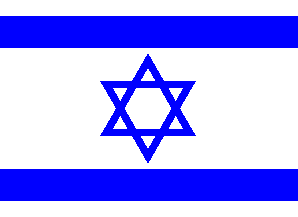
| At the ceremony of the Declaration of the Establishment of the State of Israel, the dais was decorated with a picture of Theodor Herzl, flanked on either side by the flag of the World Zionist Organization. This flag, adopted by the first Zionist Congress in Basle in 1897, had become accepted by Jewish communities throughout the world as the emblem of Zionism and it was thus natural to use it at the official proclamation of statehood. Five-and-half months earlier, on November 29, 1947 when the Jews of Eretz Israel had poured into the streets to celebrate the United Nations partition resolution, they too had hoisted the flag of the WZO and used it as a unifying symbol. In May, however, only a few days after the Zionist dream had become reality, the question was raised as to whether the Zionist banner should be the flag of the state or should be replaced. The dilemma continued for about six months till the final decision. |
|
|
The Provisional Council of State
Proclamation of the Flag of the State of Israel |
|
|
| This decision to adopt the Zionist flag to be the flag of the State of Israel reflects its power as a symbol of the spirit of the Zionist movement. In order to examine the reasons that led to this decision, let us look for the symbolism and consider the motives which prompted the members of the Provisional Council of State first to consider replacing it and then to decide against doing so. |
|
|
| Zionist tradition credits the design of the Zionist flag to David Wolffsohn. Legend even tells precisely when Wolffsohn had his brainstorm, namely, that during a meeting , Herzl raised the question of the Zionist flag. |
|
|
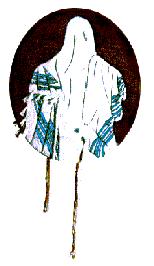
| Wolffsohn stood up and said: "Why do we have to search? Here is our national flag." Upon which he displayed his prayer shawl and showed everyone the national flag: a white field with blue stripes along the margin. |
|
|
| In our attempt to uncover the message conveyed by the Zionist flag, we should therefore address each of its components separately - the Magen David (Star of David), the blue stripes and the white background. |
|
|
| The Star of David |
|
|
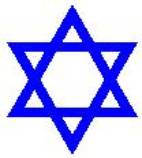
| One of the first Jewish uses of the Star of David was as part of a colophon, the special emblem printed on the title page of a book. |
|
|
| The motive for the widespread use of the Star of David was a wish to imitate Christianity. During the Emancipation, Jews needed a symbol of Judaism parallel to the cross, the universal symbol of Christianity. In particular, they wanted something to adorn the walls of the modern Jewish house of worship that would be symbolic like the cross. This is why the Star of David became prominent in the nineteenth century. |
|
|
|
 |
|
|
STAR OF DAVID |
|
|
|
|
| The Blue Stripes |
|
|
| The blue stripes on the Zionist flag were inspired by the stripes on the tallit (prayer shawl). The tallit has two separate symbolic aspects: the light blue hue and the stripes. Some say that the stripes are meant to recall the one dyed strand of the ritual fringes (tzitzit). This leads to the significance of the hue itself. According to the Torah, one strand in the tzitzit should be light blue. |
|
|
 |
|
TALLIT |
|
|
|
| White and blue, along with gold and purple, were the colors of the High Priest's raiment (Exodus 28: 4,43) and of the curtains of the Tabernacle (Exodus 26). They were considered to be the colors of purity symbolizing the spirituality of the Jewish people. |
|
|
| The first person in modern times who voiced the idea that blue and white are the national colors of the Jewish people, was the Austrian Jewish poet Ludwig August Frankl (1810-1894). More than three decades before the First Zionist Congress, Frankl published a poem entitled "Judah's Colors": |
|
|
When sublime feelings his heart fill,
He is mantled in the colors of his country
He stands in prayer, wrapped
In a sparkling robe of white. |
|
|
The hems of the white robe
Are crowned with broad stripes of blue;
Like the robe of the High Priest,
Adorned with bands of blue threads. |
|
|
These are the colors of the beloved country,
Blue and white are the borders of Judah;
White is the radiance of the priesthood,
And blue, the splendors of the firmament. |
|
|
| A. L. Frankl,Juda's Farben, in Ahnenbilder (Leipzig, 1864), p. 127 |
|
|
|
The blue stripes of the Zionist flag serve as a counterweight to the message of the Star of David. They give the flag the religious and ritual aspect totally absent from the latter. Whether the symbolic meaning of the blue stripes was perceived consciously or not, their origin in the tallit reminds onlookers of the Torah commandments. The Zionist flag uses the Star of David to express Jewish unity, which is in turn guided by the precepts of the Torah, as represented by the blue stripes and white background. |
|
|
|
Summary |
|
|
|
After nearly 50 years during which the flag served the Zionist movement worldwide, including the Jewish community in the Land of Israel, an ad-hoc committee of the Provisional Council of State in 1948 decided to "introduce a conspicuous difference - to the extent possible - between the flag of the State and the Zionist flag. Minister of Foreign Affairs Moshe Shertok (Sharett) explained that this was desirable. |
|
|
|
The Star of David is an outstanding example of the variable significance of symbols. The power of the message they convey stems less from the original use in history. At first the Star of David had no religious, political, or social connotations whatsoever. It gained a very powerful connotation precisely as a result of its terrible abuse by the Nazis. |
|
|
|
The blue and white stripes which symbolize a life of purity, guided by the precepts of the Torah, and the Star of David, which symbolizes rebirth and new life for the Jewish people, tie the State of Israel, through its flag, to the past, present and future. |
|
|
|
This is evidently why the Zionist flag prevailed over the political considerations that had prompted the leaders of the new state to propose substitutes for it. |
|
|
|
 |
|
|
|
THE ISRAELI FLAG |
|