Composers : Francisco Tarrega |
||||||
|
||||||
| No. | Song Name | No.of pages | Transcription by | MIDI |
| 1 | Adelita | 1 | Mario Abril | |
| 2 | Alborada | 2 | Mario Abril | |
| 3 | Andalusian Dance | 2 | Dirk Meineke | |
| 4 | Andante | 1 | Liona Boyd | |
| 5 | Cajita de Musica (Music Box) | 2 | Liona Boyd | |
| 6 | Capricho Arabe | 4 | Mario Abril | |
| 7 | Danza Mora | 2 | Mario Abril | |
| 8 | El Columpio | 2 | Eythor Thorlakssohn | |
| 9 | Endecha Oremus (Prelude in D minor) | 1 | Mario Abril | |
| 10 | Estudio de Velocidad | 2 | Eythor Thorlakssohn | |
| 11 | Estudio en Arpegios | 2 | Eythor Thorlakssohn | |
| 12 | Estudio en Forma de Minueto | 2 | Mario Abril | |
| 13 | Estudio en la mayor | 2 | Eythor Thorlakssohn | |
| 14 | Estudio I | 1 | ||
| 15 | Estudio in E | 3 | Liona Boyd | |
| 16 | Estudio Inspirado en J.B. Cramer | 2 | Eythor Thorlakssohn | |
| 17 | Estudio Sobre un Fragmento de Beethoven | 2 | Eythor Thorlakssohn | |
| 18 | Estudio Sobre un Tema de Alard | 4 | Eythor Thorlakssohn | |
| 19 | Etude No01 | 2 | Mario Abril | |
| 20 | Etude No02 | 1 | Mario Abril | |
| 21 | Etude No03 | 1 | Mario Abril | |
| 22 | Etude No04 | 1 | Mario Abril | |
| 23 | Etude No05 | 1 | Mario Abril | |
| 24 | Etude No06 | 1 | Mario Abril | |
| 25 | Etude No07 | 1 | Mario Abril | |
| 26 | Etude No08 | 1 | Mario Abril | |
| 27 | Etude No09 | 1 | Mario Abril | |
| 28 | Etude No10 | 1 | Mario Abril | |
| 29 | Etude No11 | 1 | Mario Abril | |
| 30 | Etude No12 | 1 | Mario Abril | |
| 31 | Etude No13 | 1 | Mario Abril | |
| 32 | Etude No14 | 1 | Mario Abril | |
| 33 | Etude No15 | 1 | Mario Abril | |
| 34 | Etude No16 | 1 | Mario Abril | |
| 35 | Etude No17 | 1 | Mario Abril | |
| 36 | Etude No18 | 1 | Mario Abril | |
| 37 | Etude No19 | 1 | Mario Abril | |
| 38 | Etude No20 | 1 | Mario Abril | |
| 39 | Etude No21 | 1 | Mario Abril | |
| 40 | Etude No22 | 1 | Mario Abril | |
| 41 | Etude No23 | 1 | Mario Abril | |
| 42 | Etude No24 | 2 | Mario Abril | |
| 43 | Etude No25 | 1 | Mario Abril | |
| 44 | Etude No26 Estudio en La | 1 | Mario Abril | |
| 45 | Etude No27 Estudio sobre un tema de Schumann | 2 | Mario Abril | |
| 46 | Etude No28 Estudio sobre un tema de Tannhauser de Wagner | 1 | Mario Abril | |
| 47 | Etude No29 | 1 | Mario Abril | |
| 48 | Etude No30 Estudio de JB Cramer | 2 | Mario Abril | |
| 49 | Etude No31 Estudio sobre un tema de Henselt | 2 | Mario Abril | |
| 50 | Etude No32 Estudio sobre un Giga de Bach | 3 | Mario Abril | |
| 51 | Etude No33 Estudio Brillante de Alard | 4 | Mario Abril | |
| 52 | Etude No34 Estudio de Prudent | 3 | Mario Abril | |
| 53 | Etude No35 Estudio de Concierto | 4 | Mario Abril | |
| 54 | Gran Jota Aragonesa | 8 | ||
| 55 | Gran Vals | 4 | Luc Gueugneau | |
| 56 | La Alborada | 2 | Eythor Thorlakssohn | |
| 57 | La Mariposa | 2 | Mario Abril | |
| 58 | La Grima | 1 | Mario Abril | |
| 59 | Las Dos Hermanitas | 4 | ||
| 60 | Lento | 1 | Liona Boyd | |
| 61 | Loure de Bach from Cello Suite No3 | 6 | ||
| 62 | Marcha Funebre de la Sonata No12 de Beethoven | 3 | Mario Abril | |
| 63 | Maria | 2 | Mario Abril | |
| 64 | Marieta | 2 | Mario Abril | |
| 65 | Mazurka | 2 | ||
| 66 | Menuet Beethoven | 2 | ||
| 67 | Minuetto | 2 | Mario Abril | |
| 68 | Pavana | 2 | Mario Abril | |
| 69 | Pavana | 3 | Liona Boyd | |
| 70 | Prelude in A | 1 | Mario Abril | |
| 71 | Prelude in A Major | 2 | ||
| 72 | Prelude in A Minor | 2 | ||
| 73 | Prelude in D | 1 | Mario Abril | |
| 74 | Prelude in D Minor | 2 | ||
| 75 | Prelude in E Major | 2 | ||
| 76 | Prelude in E Major | 2 | ||
| 77 | Prelude in G Major | 2 | ||
| 78 | Prelude Una Vision En La Torre De Diablo | 2 | ||
| 79 | Preludio No1 | 1 | Mario Abril | |
| 80 | Preludio No2 | 1 | Mario Abril | |
| 81 | Preludio No3 | 1 | Mario Abril | |
| 82 | Preludio No4 | 1 | Mario Abril | |
| 83 | Preludio No5 | 1 | Mario Abril | |
| 84 | Recuerdos de la Alhambra | 4 | Mario Abril | |
| 85 | Rosita | 1 | Mario Abril | |
| 86 | Sobre un fragmento de Mendelssohn | 2 | Eythor Thorlakssohn | |
| 87 | Studio | 1 | Miguel Abloniz | |
| 88 | Study No1 | 1 | Eythor Thorlakssohn | |
| 89 | Study No2 | 1 | Eythor Thorlakssohn | |
| 90 | Study No3 | 1 | Eythor Thorlakssohn | |
| 91 | Study on a Theme by Richard Wagner | 2 | ||
| 92 | Sueno | 5 | Mario Abril | |
| 93 | Sueno Mazurka | 2 | Jean Francois Delcamp | |
| 94 | Tango | 2 | Eythor Thorlakssohn | |
| 95 | Tango | 2 | ||
| 96 | Vals | 2 | Mario Abril | |
| 97 | Vals en la mayor | 2 | ||
| 98 | Vals en re mayor | 2 | ||
| 99 | Vals Tema de Strauss | 1 | ||
| 100 | Waltz Las Dos Hermanas | 4 |
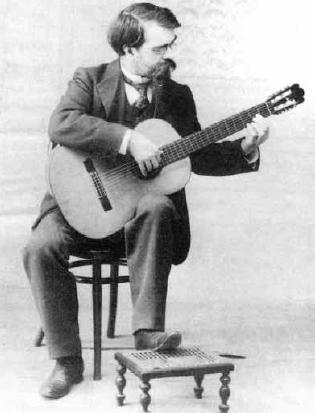
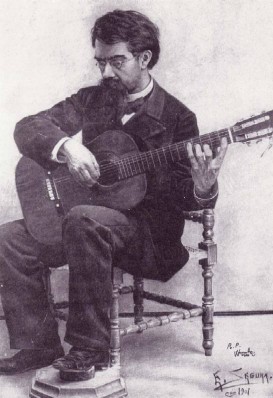
Francisco Tárrega (Francisco Tárrega y Eixea) (November 21, 1852 — December 15, 1909) was a Spanish composer, one of the most influential guitarists the world has ever known. He is considered the father of the modern classical guitar.
Francisco de Asís Tárrega Eixea was born on November 21, 1852, in Villarreal, Castellón, Spain. His father, Francisco Tárrega Tirado, was an usher, his mother, Antonia Eixea, died when Francisco was very young. He fell into an irrigation channel in his early childhood, permanently impairing his eyesight. Partially due to this accident, the family moved to Castellón and enrolled him in music classes. Both his first music teachers, Eugeni Ruiz and Manuel Gonzalez, were blind.
In 1862, concert guitarist Julián Arcas, on tour in Castellón, heard young Francisco play and advised Tárrega's father to allow Francisco to come to Barcelona to study with him. Tárrega's father agreed, but insisted that his son will take piano lessons as well. The guitar was viewed as an instrument to accompany singers, while the piano was all the rage throughout Europe. However, Tárrega had to stop his lessons shortly after when Arcas left for a concert tour abroad. Although Francisco Tárrega was only ten years old, he ran away and tried to start a musical career on his own along coffee houses and restaurants in Barcelona. He was found soon and brought back to his devoted father, who had to make great sacrifices to advance his son's musical education.
Three years later, in 1865, he ran away to Valencia where he joined a gang of gypsies, his father looked for him and brought him back home once again, he would ran away a third time, again to Valencia. By his early teens, Tárrega was proficient on both the piano and the guitar. For a time, he played with other musicians at local engagements to earn money, but eventually he returned home to help his family.
Tárrega entered the Madrid Conservatory in 1874, under the sponsorship of a wealthy merchant named Antonio Canesa. He had brought along with him a recently-purchased guitar, made in Seville by Antonio Torres. Its superior sonic qualities inspired him both in his playing and in his view of the instrument's compositional potential. At the conservatory, Tárrega studied composition under Emilio Arrieta who convinced him to focus on guitar and abandon the idea of a career with the piano.
By the end of the 1870s, Tárrega was teaching the guitar (Emilio Pujol and Miguel Llobet were pupils of his) and giving regular concerts. Tárrega received much acclaim for his playing and began traveling to other areas of Spain to perform. By this time he was composing his first works for guitar, in addition to those of other composers. During the winter of 1880, Tárrega replaced his friend Luis de Soria, in a concert in Novelda, Alicante, there, after the concert an important man in town asked the artist to listen to his daughter, María José Rizo, who was learning to play guitar. Soon they were engaged. In 1881,Tárrega premiered in the Opera Theatre in Lyon and then the Paris Odeon, in the Second Centennial of the death of Pedro Calderón de la Barca. He also played in London, but there he liked neither the language, nor the weather. There is a story about his visit to England. After a concert, some people saw that the maestro was a little sad. What is the matter, maestro? Do you miss home? Your family, perhaps? They advised him to capture that moment of sadness in his music. Then he conceived the theme of this work, called Lágrima. After playing in London he came back to Novelda for his wedding. On Christmas 1882 Tárrega married María José Rizo.
He soon began transcribing piano works of Beethoven, Chopin, Mendelssohn, and others to enlarge his guitar repertory, and, no doubt, to make use of his considerable knowledge of keyboard music. Tárrega and his wife moved to Madrid, gaining their living by teaching privately and playing concerts, but after the death of an infant daughter, Maria Josefa, they settled permanently in Barcelona in 1885. Among his friends in Barcelona were, Isaac Albéniz, Enrique Granados, Joaquín Turina and Pablo Casals.
On a concert tour in Valencia shortly afterward, Tárrega met a wealthy widow, Conxa Martinez, who became a valuable patron to him. She allowed him and his family use of a house in Barcelona, where he would write the bulk of his most popular works. Later she took him to Granada, where the guitarist conceived the theme for his famous Alhambra Remembrances, which he composed on his return and dedicated to his friend Alfred Cottin, a Frenchman who had arranged his Paris concerts. In 1900 Tárrega visited Argel, where he heard a repetitive rhythm played on an Arabian drum. The following morning he composed his famous Moorish dance (Danza Mora), based on that rhythm. From the latter 1880s up to 1903, Tárrega continued composing, but limited his concerts to Spain. In about 1902, he cut his fingernails and created a sound that would become typical of those guitarists associated with his school. The following year he went on tour in Italy, giving highly successful concerts in Rome, Naples, and Milan.
In January 1906, he was afflicted with paralysis on his right side, and though he would eventually return to the concert stage, he never completely recovered. He finished his last work, Oremus, on December 2, 1909. He died thirteen days later in Barcelona on December 15, 1909.
As a composer Tárrega was conservative, restricting his style to the general trend in the second half of the 19th century. A virtuoso on his instrument, he was known as the "Sarasate of the guitar". Tárrega is considered to have laid the foundations for 20th-century classical guitar and for increasing interest in the guitar as a recital instrument. The great Andrés Segovia used much of Tarrega's work on technique and many of his compositions to take the classical guitar into concert halls of Europe. Tárrega preferred small intimate performances over the concert stage. Some believe this was because he played without nails needed for volume. Others say this was related to his childhood trauma.
Francisco Tárrega music and style of guitar playing became strongly influential in the twentieth century. He was central to reviving the guitar as a solo instrument in recital and concerts. His output was modest, with just 78 original scores and 120 transcriptions - mostly for his own use - of the great classical compositions. Among his most popular works for the guitar are Alhambra Remembrances, Capricho Árabe and Moorish dance Danza Mora. Tárrega arranged pieces by others for the instrument, including works by Ludwig van Beethoven, Frédéric Chopin and Felix Mendelssohn.
He is also the composer of what has been claimed to be "probably the world's most heard tune": the Nokia ringtone Nokia tune or simply Nokia, also used in their advertising spots, is based on Tárrega's Gran Vals. His music also inspired Mike Oldfield, whose "Etude (The Killing Fields)" is based on Tárrega's piece for solo classical guitar "Recuerdos de la Alhambra" (Memories of the Alhambra).
As with several of his Spanish contemporaries, such as his friend Isaac Albéniz, he had an interest in combining the prevailing Romantic trend in classical music with Spanish folk elements, and transcribed several of Albéniz's piano pieces (notably the fiery "Asturias (Leyenda)") for guitar. The noted contemporary guitarist and composer Angelo Gilardino has written that Tárrega's 9 Preludios are "... the deepest musical thought of Tárrega in the most concentrated form."