Composers : Georges Bizet
|
||||||
|
||||||
| No. | Song Name | No.of pages | Transcription by | MIDI |
| 1 | Habanera from Carmen | 2 | Wojtek Binkowski |
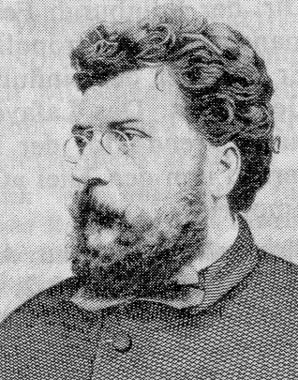
Georges Bizet (October 25, 1838 – June 3, 1875) was a French composer and pianist of the romantic era. He is best known for his opera Carmen.
Bizet was born in Paris. he was registered with the legal name Alexandre-César-Léopold Bizet, but was baptized Georges Bizet and was always known by the latter name. A child prodigy, he entered the prestigious Paris Conservatory of Music a fortnight before his tenth birthday.
In 1857 he shared a prize offered by Jacques Offenbach for a setting of the one-act operetta Le docteur Miracle and won the Prix de Rome, a competitive scholarship for promising artists and musicians. In accordance with the conditions of the scholarship, he studied in Rome for three years. There, his talent began to mature with such works as the opera Don Procopio. Besides this stay in Rome, Bizet lived in the Paris area for his entire life.
Following his stay in Rome, he returned to Paris where he dedicated himself to composition. Early into his return to Paris, Georges's mother died. In 1863 he composed the opera Les pêcheurs de perles (The Pearl Fishers) for the Theatre-Lyrique. During this period Bizet also wrote the opera La jolie fille de Perth, his well-known L'arlésienne (written as incidental music for a play), and the piano piece Jeux d'enfants (Children's games) He also wrote the romantic opera Djamileh, which is often seen as a precursor to Carmen. His first symphony, the Symphony in C Major, was written at the Paris Conservatory when he was only seventeen years old, evidently as a student assignment. It seems that Bizet completely forgot about it himself, and it was not discovered again until 1935, in the dusty archives of the Conservatory library. Upon its first performance, it was immediately hailed as a junior masterwork and a welcome addition to the early Romantic period repertoire. A delightful work (and a prodigious one, from a seventeen-year-old boy), the symphony is noteworthy for bearing an amazing stylistic resemblance to the music of Franz Schubert, whose work was virtually unknown in Paris at that time (with the possible exception of a few of his songs). A second symphony, "Roma" was not completed.
Bizet's best-known work is his 1875 opera, Carmen, which was based on an 1846 novel of the same name by Prosper Mérimée. Influenced by Giuseppe Verdi, he composed the title role in Carmen for a mezzo-soprano. Not an immediate success, Bizet became despondent over the perceived failure, but praise came from such luminaries as Saint-Saëns, Tchaikovsky, and Debussy, who recognized its greatness. Their views were prophetic, as the public eventually made Carmen one of the most popular works in operatic history.
Bizet's music has been used in the twentieth century as the basis for several important ballets. The Soviet-era "Carmen Suite" (1967) gave the fiery Bolshoi ballerina Maya Plisetskaya one of her signature roles; it was choreographed by Alberto Alonso and set to music drawn from Carmen by Plisetskaya's husband, the composer Rodion Schedrin. In the West the "l'Arlesienne" of Roland Petit is well-regarded, and the "Symphony in C" by George Balanchine is universally considered to be one of the great ballets of the twentieth century. It was first presented as "Le Palais de Crystal" by the Paris Opera Ballet in 1947, when Balanchine was guest choreographer there; under the name "Symphony in C" it concluded the first program of Balanchine's new New York City Ballet the following year and has been in the repertory there ever since. THe ballet has no story; it simply fits the music, as a Balenciaga gown might fit Audrey Hepburn. Each movement of the symphony has its own ballerina, cavalier, and corps de ballet, all of whom dance together in the brilliant finale, which as it were overflows with joy. Dancers call it simply "Bizet."
Although most known as a composer, Bizet was also an extraordinarily fine pianist, whose playing was praised by Franz Liszt himself. After Bizet sightread a complex piece flawlessly, Liszt said he considered Bizet one of the three finest pianists in Europe.
Bizet had long suffered from quinsy, a painful inflammation of the tonsils associated with angina and never got to enjoy Carmen's success. Just a few months after the opera's debut, he died on his sixth wedding anniversary at the early age of 37, the official cause of death being listed as a failed heart due to "acute articular rheumatism". He was interred in the Père Lachaise Cemetery, Paris.