|
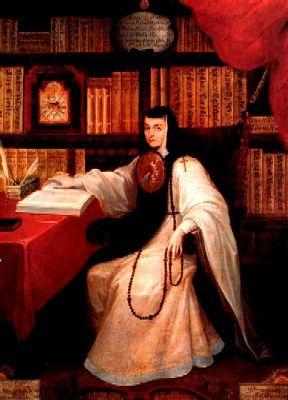
The life of Sor Juana Ines de la Cruz is not so very typical; she has a tremendous history of being a wonderful poet. Her status became about only because she was a female. If she would have been a male, she still would have been known as an accomplished writer and poet. But she was female, and struggle to be known makes her poetry and her other work much more important to history, especially during the 17th century. Because she was not white and was not a male, her life was much more difficult. Her impact on women during her time still leaves impacts on women of today�s modern world. She was in born in November 1648; she was born in the village of San Miguel Meplanta, which is located southeast of Mexico City. Her mother was Isabel Ramirez de Santillana. She ran the small farm on which they lived. Her father, Pedro Manuel de Asujae, was probably from Basque origin. He was mainly absent from her life. On December 2, 1648, she had been baptized and was named being a daughter of the church because her parents had not been married. Her godparents were Miguel Ramirez and Beatriz Ramirez; they were the brother and sister of Sir Juana�s mom. At the age of three she persuaded one of her sister�s teachers to allow her to go to school and teach her how to read. Within the next two years she learned how to write, and also learned embroidery, which according to customs of life during those times was something that a woman should have learned last. She didn�t like to eat cheese because she taught it inhibited her learning. She used to cut her hair as a punishment for not learning fast enough, she did this also because she didn�t think it was alright for her to have hair on her empty head. She begged and pleaded to her mother to be dressed in boy�s clothes in order to attend the University of Mexico City. It was uncommon for girls to go to Universities during those times. Because her mother didn�t allow this, she taught herself Latin within 20 lessons. When she was about 12, she met the viceroy, the marquis of Mancera, and his wife Don Antonia Sebastian de Toledo Molina and Do�a Leonor Carreto. Once they found out how intelligent she was, they had invited her to their court. Leonor took very special interest and her and she became a maid in waiting. She spent 5 years in the viceroy court. Leonard organized a special oral examination that tested her knowledge in front of forty scholars, philosophers, theologians, and other important people. This was sort of a graduation for her, people finally recognized a female intellectual, a rare phenomenon in a Hispanic society in the seventeenth century. If she had been a man, the exam would have not made such a huge impact on Hispanic society. This was just the beginning of difficult tasks that she had to face. While in the court she asked if she could write poetry for political and social events. She wrote by focusing on her knowledge of music, mathematics, logic, and theology. It was during this that time that Sor Juana gave new life to the Baroque style of poetry. On August 14, 1667, she gained entrance to the Convent of the Discalced Carmelites of Saint Joseph in Mexico City; this convent was too rigorous for her. About 1� year later she entered the Convent of the Order of Saint Jerome, where she got the name Sor Juana In�s de la Cruz, for the rest of her life. On April 17, 1695, she passed away as a result of a plague that hit her convent. She cared for the other nuns in the convent. "She surrendered her soul with 'serene acceptance' and 'without the slightest clouding of her understanding'" (Sabat-Rivers 90). �Sor Juana In�s de la Cruz is recognized as one of the most extraordinary people to come from the Spanish-American tradition. She is a major Baroque literary figure and had a strong desire to understand life around her. If Sor Juana were male, she indeed would have influenced Spanish-America. But because Sor Juana was female, she was forced to endure misogynistic behavior from others. This in turn made her a stronger person. This is shown throughout her writings and especially throughout her history. It is because of Sor Juana's strength, women understand that it is possible to be heard.� |
|