|
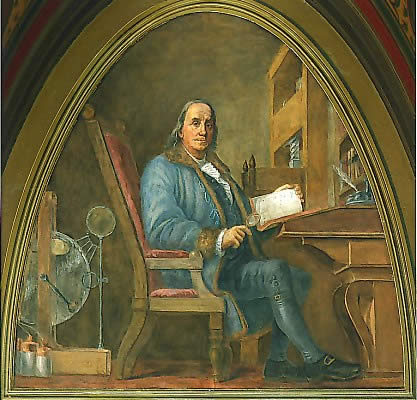
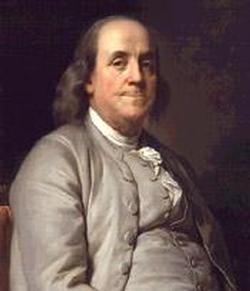
Franklin was born in Boston on January 17, 1706. He was the tenth son of a soap maker, Josiah Franklin, his mother was Abiah Folger, and she was the second wife of Josiah Franklin. With all of his wives he had 17 kids. Benjamin�s father intended for him to enter into the clergy business, however he could not afford to send out his son to school for the year need to be a clergymen. But young Ben loved to read, he had him be an apprentice to his brother James. His brother was a printer. After helping James out to compose pamphlets and set type which had been grueling work, at the age of 12 Ben would sell their products in the streets. When Benjamin Franklin was 15, his brother came up with The New England Courant which was the first newspaper invented in Boston. Even though there were two papers in the city before James�s Courant, they used to only reprint news from abroad. His paper carried articles, opinions pieces written by some of James�s friends, advertisements, and news of ship schedules. Benjamin wanted to write for the paper too, but he knew that James would never let him. After that Ben began writing letters to all night and signing them with the name of a fictional widow, Silence Dogood. Dogood was filed with advice and very critical of the world around her, particularly concerned the issue of how women were treated. He would sneak the letters under the print shop door at night so one knew who was writing the pieces. They became a huge success. Everyone wanted to know who was the real �Silence Dogood.� When he had written 16 letters he had confessed that he was the one writing all the letters. While James�s friends thought that Ben was quite precious and funny, James got mad at him and was very jealous of all the attention that everyone was giving him. Not long after the Franklins found themselves with odds with Boston�s powerful Puritan preachers, the Mathers. Smallpox was a deadly disease during their times, and the Mathers supported the inoculation. Ben�s family believed inoculation just made people even sicker, And while most of the Bostonians agreed with the Franklins, they did no like the way that James made fun of the clergy, during the debate. Ultimately, James was thrown in jail for his views, and Benjamin was left to run the paper for several issues. Once he was released from jail, James was not grateful to Benjamin Franklin for keeping the paper going. Instead he kept harassing his younger brother and administering beatings from time to time. Ben could no longer take it and decided to run away in 1723. In early America, running was Ben took a boat to New York where he hoped to find work and be a printer. He was unsuccessful and ended up going to New Jersey, finally arriving in Philadelphia in a boat ride. After that he used most of his money to buy some rolls. He was wet, disheveled, and messy when his future wife, Deborah Read, saw him on that day, October 6, 1723. She thought him odd looking, never dreaming that seven years later they would have gotten married. Ben found work as an apprentice printer, he was so good at his job that the governor of Pennsylvania promised him to set up his own business if he would just go to London to buy fonts and other printing equipment. He ended up going to London, but the governor broke his promise and Ben was forced to spend several months in England doing other print work. He had been living in the Read family and left for London, Deborah Read, who was the same girl who had seen Ben arrive in Philadelphia, started talking about marriage, with Ben. But he didn�t think he was ready to do that. While he was away she got married to a different man. When he returned to Philadelphia, Ben tried at running a shop, but soon went back to being some other printer�s helper. Ben was w a better printer than the man that he was working for, he borrowed money and set himself up in the printing business. Franklin seemed to be working all the time, and the citizens where he lived began to notice the young businessman. He later began a contract to do the government job and started thriving in the business. In 1728, Ben became father to a child named William, the mother of young William was not known. However in 1730, Ben married his childhood dream, Deborah Read. Her husband had run off, and now was able to remarry who ever she wanted. Besides running the print shop, the Franklins also ran their own store at this time, with his wife, Deborah, selling everything from soap to fabric. Ben also ran a book store, they were quite enterprising. In 1729, Benjamin Franklin bough a newspaper, the Pennsylvania Gazette, he did not only printed the paper, but often contributed pieces to the paper under aliases. His newspaper soon became the most successful in the colonies. The newspaper, among others, would print the very first political cartoon. Which was authored by Benjamin Franklin himself. During the 1720s and 1730s, the side of Franklin devoted to public good started to show itself. He organized the Junto, a young working-mans group dedicated to self and civic improvement. He then joined Masons. He was a socially busy man. But Ben thrived on work, in 1733 he started publishing Poor Richards Almanac, almanacs were printed annually and contained things like weather reports, predictions, and homilies. Ben published his first almanac under the guide of a man named Richard Saunders, a very poor man who desperately needed money to take care of his carping wife. Ben continued his civic contributions during 1730 and 1740; he helped out with projects to pave, clean and light Philadelphia streets. He started agitating for environmental clean up. Among chief accomplishments of Ben, this era was about helping to launch the Library Company in 1731. During these times books were very scarce and very expensive. He recognized that by pooling together resources, members could afford to buy books directly from England. This is first subscription library was created. In 1743, he helped to launch the American Philosophical Society, the first learned society which was in America. He realized that the city needed help in treating the sick better; Ben brought a group which formed the Pennsylvania Hospital in 1751. The Library Company, Philosophical Society, and the Pennsylvania Hospital are all in existence today. Fires were also a big problem that threatened the Philadelphians, so he sought out trying a cure for this problem. In 1736 he organized Philadelphia�s Union Fire Company, which was the very first in the city. His famous saying, "An ounce of prevention is worth a pound of cure," was actually fire-fighting advice. Bens printing business was soaring in the 1730s and 1740s, he also started to set up printing partnerships in other cities, By 1749 he was retired from business and began to study science, experiments, and inventions. This was nothing new to him. Because in 1743 he had invented a heat efficient stove which called the Franklin stove, which also helped warm houses efficiently. In the early 1750s he turned studying electricity, his observations, which included the kite experiment, verified the nature of electricity and lightning brought Franklin international fame. Franklin died on April 17, 1790 at the age of 84. 20,000 people attended the funeral of the man who was called, �the harmonious human multitude� His electric personality, however, still lights the world. |
|