Nichos and Shrines
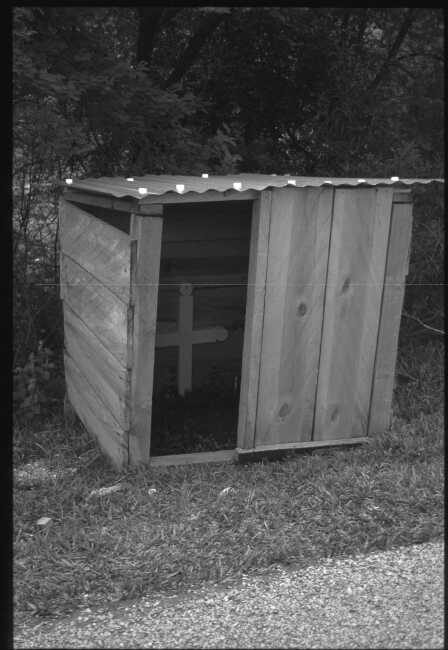
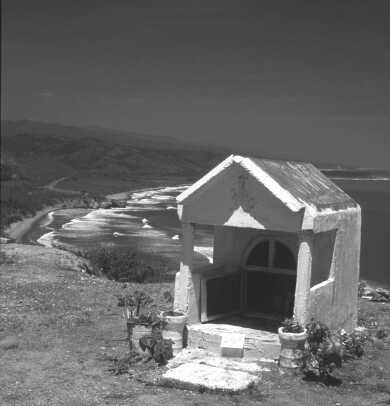
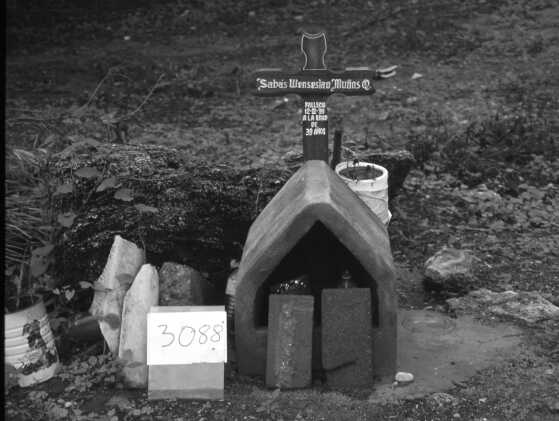
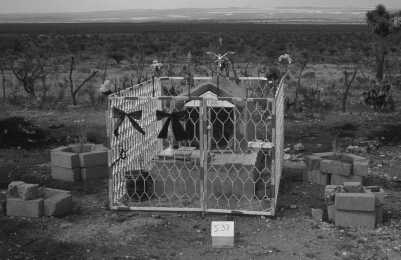
Nichos and shrines are, broadly defined, house-like structures which memorialize a highway fatality. The difference between the two is size; shrines are large enough for people to enter, nichos are not. There is considerable evidence that some crosses become integrated into or replaced by a nicho over time. Evidence that memorial shrines evolve into shrines of religiosity exists; but the apparent conditions, and therefore the evidence, is much more rare.
The key attribute of this category of memorials is their capacity to shelter and contain. This capacity provides the researcher with a wealth of artifacts and information upon which may be built a richly detailed ethnography of place. In addition to inscribed crosses and plaques one may find photos of the deceased, a variety of items which may be meaningful to the deceased- including favorite foods and beverages, and a broad array of religious articles such as: statues, framed prints, rosary beads, medals, scapulars, and votive candles. Many nicho/shrines exhibit arts and crafts items such as: embroidered altar cloths, decoupage plaques and picture frames, beadwork, metalwork, paintings, ceramics, and needlepoint. Often the nicho/shrine is padlocked, indicating its dual function as both a place of public display and private devotion- both to the deceased and the various heavenly personalities represented by the items mentioned above.
The first nicho image features a small bit of the highway pavement in the foreground, and the last shows a fence-line in the background. This location, between the pavement and the private property adjoining the right-of-way, is a 'nether place'; i.e. it is not intended to be used, rather it is held in reserve for future use. This phenomena, of creating a sacred place where no place is intended, is a defining characteristic of roadside memorials.
__________________________________________________________________________________________
Closing Notes
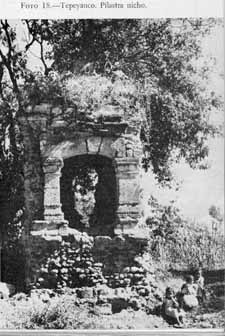
The image below, is a 16th century nicho from the state of Tlaxcla (Flores Marini 1966) and is situated near the junction of the Camino Real and a river; a likely place for a fatal accident; as stated earlier, this custom has a 500 year history in Mexico.
 Yet, the phenomena of roadside memorials, this public display of resistance to the
anonymity of death (and life?), seems especially suited to aspects of
postmodern social theory.
This leads one to wonder: what were the 16th century Mexicans experiencing that
resembles our post-modern condition? I hypothesize that social change is their
common bond and, in a certain sense, the world has always (but not everywhere)
experienced something like the current post modern condition of the Western
world.
Yet, the phenomena of roadside memorials, this public display of resistance to the
anonymity of death (and life?), seems especially suited to aspects of
postmodern social theory.
This leads one to wonder: what were the 16th century Mexicans experiencing that
resembles our post-modern condition? I hypothesize that social change is their
common bond and, in a certain sense, the world has always (but not everywhere)
experienced something like the current post modern condition of the Western
world.
By looking at contemporary Mexico, and at crucial historical epochs, we see that change is usually handled by blending the old with the new, and that the result of this mixing is a mestizo or hybrid culture. We never, the evidence on the landscape says, either totally accept the new or reject the old. They always co-exist simultaneously; sometimes peacefully, sometimes under duress.
A moment in my field work that I remember vividly was of a tiny, old woman walking along the roadside somewhere in southern
Mexico. With a tope band across her forehead, she was bent under a load of
firewood that seemed much bigger that her. Going home, no doubt, to make corn
tortillas and cook them on a wood fire; just like her mothers have done for
centuries, or even millennia. Only a few feet away from her, making a draft that
almost blew her over, was a brand new Mercedes Benz truck with a double trailer,
blasting by at 65MPH; hurrying north to meet some deadline.
NAFTA, globalization, the internet, and cyber-cafes co-exist with ghosts, the sanctity of madre, purgatory, and community; within one culture and, sometimes, within a single person. This is usually part of the 'taken for granted world' in Mexico, but sometimes; when emotions are at a breaking point and life doesn't seem to make any sense, it comes to the foreground for all to see. It is there, just off to the side of the road, that someone is saying: "This is no place to die."
___________________________________________________________________________________________
About the Author
The author of these pages, Daniel R. Weir, a native of Mt. Vernon, Ohio, is a
geographer and world traveler.
When not engaged in academic affairs Dan's favorite activities are backpacking,
camping, cycling, running, and scuba diving. He and his wife Cynthia Briggs
Weir, a native of Waterford, PA; live in Baton Rouge, Louisiana. Visitors wishing to view more images stored elsewhere, or to provide comments, may contact me at: [email protected].
CURRICULUM VITAE
Daniel
R. Weir
EDUCATION:
A.B.D. Geography, with a minor in Anthropology ,
Louisiana State University, 2000.
Dissertation Title: No Place to Die: The Poetics of Roadside
Sacred Places in Mexico
Chair: Miles Richardson
M.A. Geography, San Diego State University, 1997.
Thesis title: Land Use Changes by the Tohono O’odham at
Quitovac Oasis, Sonora, Mexico
Chair: Janet Franklin, co-chair: Irisita Azary
B.A. Geography, San Diego State University, 1995.
Emphasis in Natural Resource and Environmental
Geography—Policy Track; with Distinction in Geography.
REFEREED
PUBLICATIONS:
Weir, Daniel R. 2000. Review of “Indian Reservations in the United States: Territory, Sovereignty, and Socioeconomic Change” by Klaus Franz. The Professional Geographer. 52(4):765-6.
Weir, Daniel R. and Irisita Azary. Forthcoming.
Quitovac Oasis: A Sense of Home Place and
the Development of Water Resources. The
Professional Geographer 53(1):45-55.
INVITED PAPERS
May 2, 2000, California State University-Long Beach,
College of Liberal Arts. “The Virgin
of Guadalupe, the Everyday World, and Death on the Highway: A Poetics of Place
in Mexico”
May 2, 2000, California State University-Long Beach,
Geography Department. “Seminar on
Graduate School Strategies and Success”
PROFESSIONAL
PAPER PRESENTATIONS:
May 2000, San Diego. California Geographical Society
Annual Meeting. “Blurring Boundaries
and Creating Borders: Geopoetics and Sacred Place in Mexico”
April 2000, Pittsburgh. Association of American
Geographers Annual Meeting.
“Wink(e)ing Back at the Virgin: Reading the Poetics of Mexico’s Spiritual
‘Roadscape.’”
October 1998, Baton Rouge. Southwestern Association of American Geographers Annual Meeting. “No Place to Die: Roadside Death Markers in the Borderlands of Sonora, Mexico
March 1998, Boston. Association of American
Geographers Annual Meeting. “The Lost
Treasure of Quitovac”
April 1997, Ft. Worth. Association of American
Geographers Annual Meeting.
“Quitovac Oasis: Indigenous Knowledge and Unsustainable Land Use, an Unseemly
Compatibility”
April 1997, Ft. Worth. Association of American
Geographers Annual Meeting.
“Water and Justice” Panel,
“Intergenerational Equity and Unsustainable Development, Where is the
Justice?”
February 1997, San Diego. Pacific Coast Council of
Latin American Studies. “Quitovac
Oasis: Politics, Policy, Economics, and Land Use Change”
December 1996, San Diego State University Student
Water Conference, Session
speaker, “Quitovac Oasis: A Lesson in Arid Lands Hydrology and
Geomorphology”
TEACHING
EXPERIENCE:
Teaching Assistant, Physical Geography: The
Atmosphere (GEOG 2051). Fall 1998,
Louisiana State University.
Substitute Lecturer, Introduction to Cultural &
Social Anthropology, (ANTH 1003). Summer
Intersession 1998, Louisiana State University.
Instructor, Physical Geography Lab (GEOG 101L). Fall
& Spring 1997, San Diego State University.
Substitute Lecturer,
Environmental and Resource Geography (GEOG 370). Fall 1996, San
Diego State University.
Substitute Lecturer, Culture Worlds (Geography 312).
Fall 1996, San Diego State University.
TA and Tutor, Water Resources (GEOG 574). Spring
1997, San Diego State University.
Teacher, Social Studies (6th grade),
Sociology, and English Literature (12th grade). Fall
1984, Colegio Lincoln, San José, Costa Rica.
Teacher, English (as a foreign language), April - December,1984, Instituto Universal de Idiomas, San José, Costa Rica
Teacher, English (for adult Spanish-speakers), 1982,
Walker, Ekede y Lopez Idiomas, Mexico
City.
RESEARCH
AND RELATED ACADEMIC EXPERIENCE:
Independent Field Research: 1999-2000.
Designed and implemented field research of Mexico’s
sacred roadside landscape. Located and described approximately 7000 roadside
sacred places (an estimated 10,000 artifacts) along sixteen transects totaling
14,000 miles. This research and analysis will result in a doctoral dissertation
centered on the poetics of death and religion in a culturally produced
landscape.
Graduate
Student Assistant: Spring, 1998.
Editor’s Assistant for Representations of Blackness and the Performance of
Identities, Jean Muteba Rahier, ed. 1999, Greenwood Press. Responsible for
implementing all aspects leading to the final edit; especially to assure that
the essays, or translations, of the five non-Anglophone authors adhered to
proper sentence structure, word selection and grammatical rules, without losing
their intended meaning, and to pose questions for editor/author clarification.
Independent Field Research: 1995-97.
Designed, developed, and implemented a field research of the
hydrology, arid lands geomorphology, land use, and cultural ecology of an
indigenous oasis community in rural northwestern Sonora, Mexico. Field work
intermittently supervised by Irisita Azary, (currently) Assistant Professor of
Geography, CSU Long Beach, and Philip Greenfeld, Professor of Anthropology, San
Diego State University. This project resulted in a M.A. thesis.
Field Research: 1996-1997.
On-site verification of land-use/land-cover types for:
“Changing Land Use Patterns Along the United States-Mexican Border: Effects on
Ecosystem Structure and Climate Feedbacks,” sponsored by US-EPA and Southwest
Center for Environmental Research and Policy (SCERP), (Principle Investigators:
J. Franklin; San Diego State University, R. Balling, A. Brazel, J. Klopatek;
Arizona State University).
Research Assistant: Center for Earth Systems
Analysis, SDSU, Fall 1995.
Performed remote sensing and GIS assisted vegetation mapping,
and field verification of vegetation types on “Tijuana River Watershed GIS
Project.” John O’Leary, Professor of Geography, supervisor.
HONORS AND
AWARDS:
Inducted as an Associate Member into Sigma Xi the
Scientific Research Society, April,
2000.
1999 Ellinor H. Behre Award for Scientific Writing,
from the L.S.U. Chapter of Sigma
Xi the Scientific Research Society, April, 1999.
Robert C. West Graduate Student Field Research Award,
Russell Fund, LSU, Spring 1998.
Graduate Assistantship, Department of Geography and
Anthropology, LSU, 1997-99
Graduate Student Teaching Assistant, Department of
Geography, SDSU, 1996-97
B.A. Degree, conferred with Distinction in Geography,
SDSU, 1995
Dean’s List, SDSU, 1993-95
Elected to Alpha Gamma Sigma Academic Honor Society,
Alpha Nu Chapter of Palomar College,
1992.
Byron Gibbs Scholarship Award for Outstanding
Leadership, Alpha Nu Chapter of Alpha Gamma
Sigma, Palomar College1992-1993.
ORGANIZATIONAL
AFFILIATIONS:
Association of American Geographers
Cultural Ecology Specialty Group
Cultural Geography Specialty Group
Geography of Religions and Belief Systems
Specialty Group
Values, Ethics and Justice Specialty Group
Qualitative Methods Specialty Group
Conference of Latin Americanist Geographers
Southwestern Association of American Geographers
California Geographical Society
American Anthropological Association
Anthropology of Religion Group
Society for Cultural Anthropology
Society for Visual Anthropology