The Mir space station was launched in January 1986. It has been the most succesful space station ever launched (despite what you may hear in TV nowadays!).
IS THE MIR OLD?: that's the big question. According to the TV news, Mir is a piece of dangerous trash flying over us.
But that's not exactly true. Mir is made of seven modules. The central module
is old indeed (it was launched in 1986), but there are modules launched in 1995 and 1996: Priroda and Spektr.
The latter was damaged by a collision in august 1997, but neither the colliding craft (a Progress M cargo ship, launched some months before), nor the Spektr, were old. There was a fire onboard in April 1997, but it was caused
by a new carbon dioxide scrubber cartridge. Mir layout.
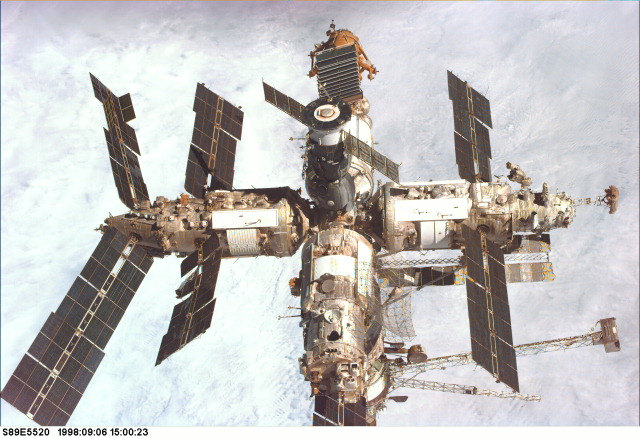
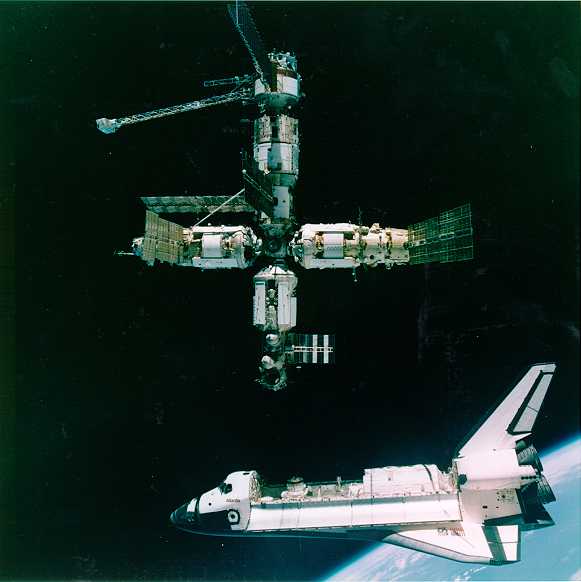
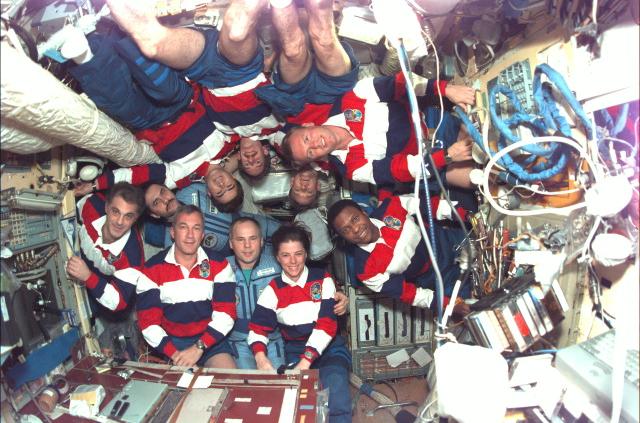
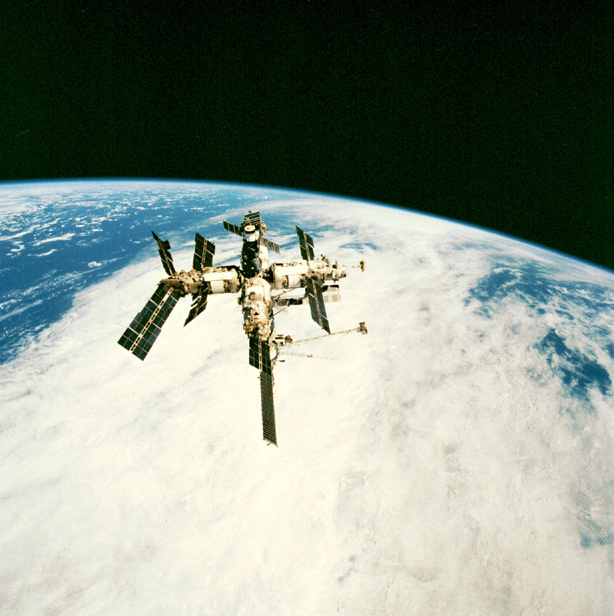
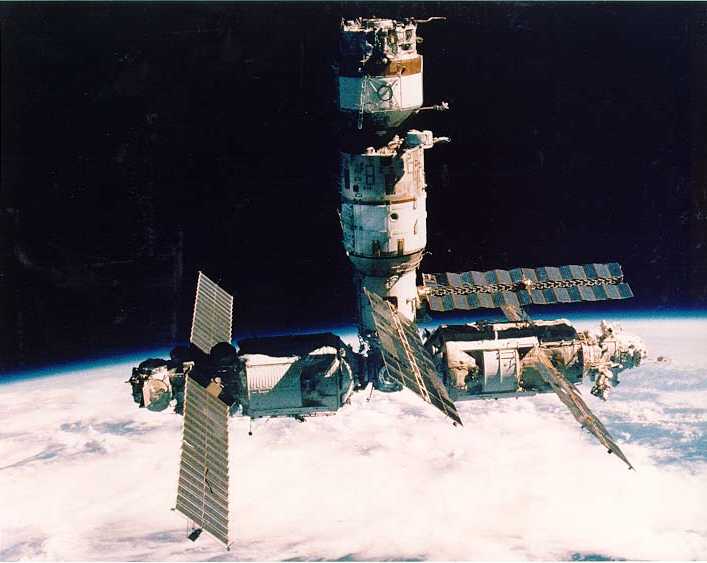
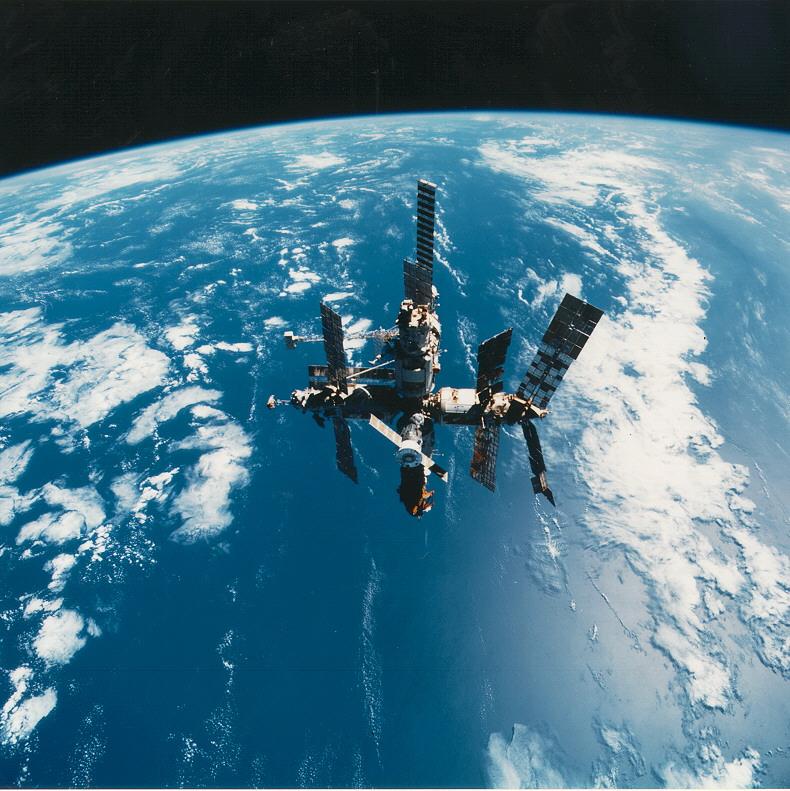
Mir during the STS-89 mission (January 1998). Mir during the first shuttle docking mission (STS 71, 1995). The Kristall module was relocated for this mission. The photos were taken from the Soyuz TM spacecraft. Mir 24 and STS 89 crews in Mir base module (January 1998). Space station Mir as seen from the space shuttle during STS 89 mission.
The Mir space station from a Soyuz TM spacecraft. When this picture was taken, the Spektr and Priroda modules were not docked yet.
Click here to know more about Mir.
Many spacecraft have docked with it: dozens of Soyuz TM, Progress, Progress M and even the american space shuttle.
It was the first modular space station, formed by 7 permanent modules, and the first to be manned on a permanent basis. Cosmonauts aboard Mir spent on it routinely up to 6 months.
Valery Poliakov holds the world record, with 14 months in space (1995).
Before him there were more records: Musa Manarov and Vladimir Titov expent one year in 1987-1988, and Yuri Romanenko in 1987:see space records
The american record in space, was also set onboard Mir by Shannon Lucid (1996), who spent nearly six months on it.
Mir is an international space station: besides american astronauts (there was an american from 1996 to 1998)
many countries or organizations
have sent cosmonauts to Mir: France(5), Germany(4), Bulgaria, United Kingdom, Syria, Afganistan, Japan, Austria, Kazakhstan and Canada (with the Shuttle).
Of course, there are problems due to Mir's age: leaks of cooling fluid, computer malfunctions, etc...
But the worst accidents have had nothing to do with that.
We have to keep in mind that space is a very hazardous environment, and things usually break down. Even the Shuttle, which before every flight is checked and repaired by an army of technicians, has some problems
during its two-week-long missions.

Mir Statistics