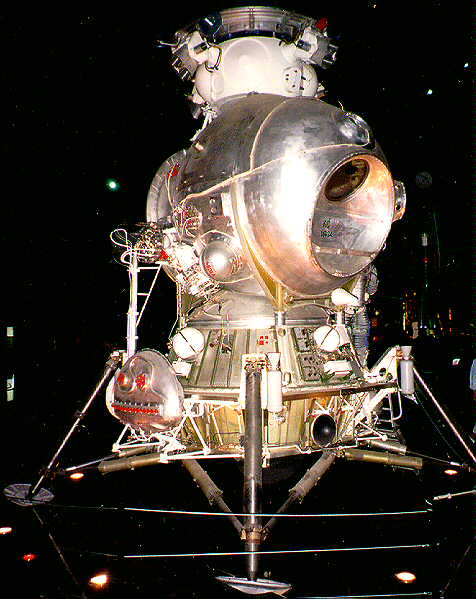
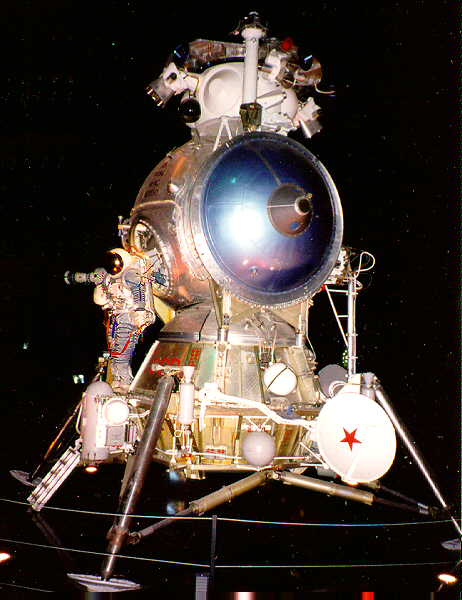
LK Soviet manned lunar lander
|
||||
|
The Soviets planned to use the LK lunar lander to put a man on the Moon. These were the planned events:
The LK spcecraft was based on the Soyuz orbital module, searching for simplicity. Although there were several test flights in low Earth orbit (under the LK-T2K configuration, without the landing gear), the final configuration never flew.
LK missions:
11/24/70: Cosmos 379
02/26/71: Cosmos 398
08/12/71: Cosmos 434
This lunar landing configuration was called L3. There were several other configurations proposed.
Photos:Michel Koivisto
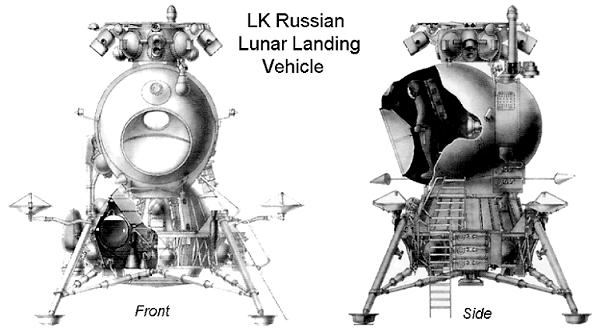
LK cutaway.
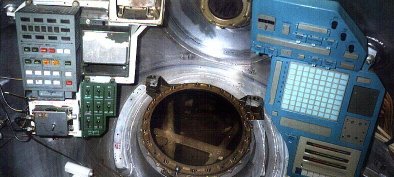
LK cockpit: on the left environmental, cabin depressurization and radio controls. At the center is the large window for landing. Above, it is the smaller porthole for rendezvous and docking maneuvers. On the right, maneuver controls.
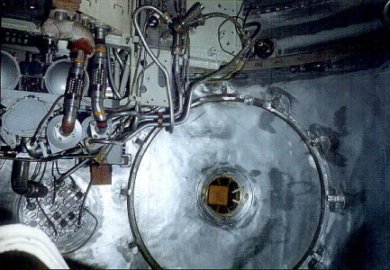
View of the LK behind the cosmonaut. Cooling loops and electrical cables are visible. The round piece of metal connects the LK cabin with an instrumental section mounted outside the LK.
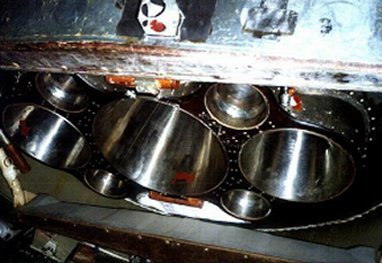
LK engines. At the center is the main engine RD-858 nozzle. Besides, the two RD-859 back-up engine nozzles are visible.
Design Life: 3 days. Orbital Storage: 30.00 days.
Total Length: 5.5 m. Maximum Diameter: 4.5 m.
Total Habitable Volume: 5.00 m3. Total Mass: 5,560 kg. Total Propellants: 2,400 kg. Total RCS Impulse: 25,000.00 kgf-sec. Primary Engine Thrust: 2,050 kgf. Main Engine
Propellants: N2O4/UDMH. Main Engine Isp: 315 sec. Total spacecraft delta v: 2,300 m/s. Electric system: 0.50 total
average kW. Electric System: 30.00 total kWh. Electrical System: Batteries.
|
 Back
Back
 Get your ownFree Home Page