Chapter 3 : A suggested approach to ICTs in development and some issues in the measurement of the impact of information.
Some basic problems to be addressed |
21 |
|
22 |
|
|
23 |
|
The role of apex organisations |
23 |
|
25 |
|
|
25 |
|
|
|
|
|
27 |
|
|
31 |
|
Appendix 1: World Bank national income categories |
33 |
Appendix 2: Potential actors within the model suggested |
34 |
|
|
Some basic problems to be addressed.
The proliferation of organisations claiming to be either practising development, or supporting others in doing so, raises questions like "do we really need all these organisations, or are they just soaking up scarce funds?" Such questions have been asked in relation to non governmental organisations (NGOs) and their support organisations ( see Jolly, 1999.) They have received such scrutiny partly because they are widely recognised as a sector engaged in development. This discussion has also highlighted the dangers of NGOs seeing themselves as the only Civil Society groups engaged in development and ignoring other actors, often leading to mutual disadvantage (BOND, 1997). This is not just limited to ignoring other Civil Society groups: Dreze and Sen describe how Oxfam was completely unaware of relief efforts of a gigantic scale carried out by the State government in Maharashtra during the famine in the early 1970's, at the same time as their own activities actually worked somewhat at cross-purposes to them (1989).
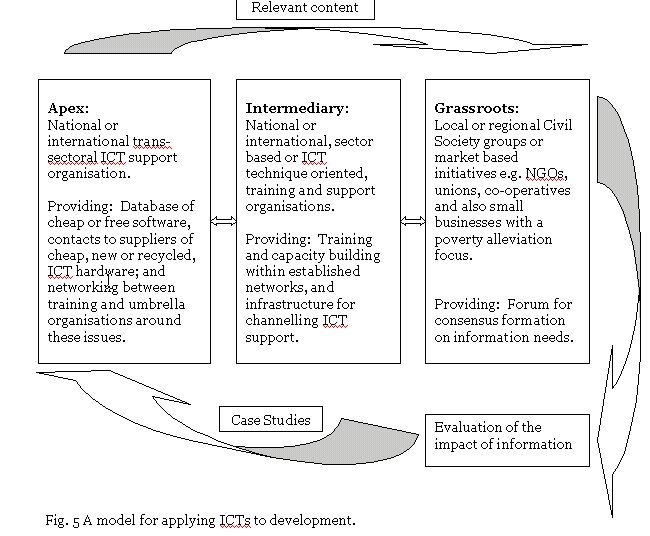
I will attempt to justify the need for the three separate components in the model proposed, and then attempt to outline the categories I have set up in an inclusive manner, taking into account the variety of actors who might be interested in ICT support, and who might have valuable information to share with one another. The political problem of "will actors actually be interested in such collaborative efforts" is also important, but not one that I have space to deal with in detail here. The case studies I have outlined have gone some way towards showing that low-cost ICT projects tailored closely to needs tend to be taken up more enthusiastically, as people perceive the necessity for relevant information and political consensus all too keenly and are able to perform their own cost-benefit assessments. What these case studies have not addressed is how particular the conditions that gave rise to these success stories are. Superficially "participatory communication" seems key, but what other factors contributed to these successes, and what was absent in the failures that remain undiscussed?
Why are the components of this model necessary?
Why the three tier structure? Why all that paperwork and administration? I propose a three tier structure in order to meet three needs:
This means that existing actors, fulfilling functions relating to these needs to some extent, need to be found. I have dedicating appendix 2 to listing actors that might be appropriate for working in these three areas, although my lists are bound to only represent a small proportion of potential actors.
The notion of taking an approach supportive to the development of existing "grass roots" information handling activities rather than a more top-down modernisation-through-technology-transfer approach finds some support in Macro Level studies on ICTs as a national development issue. This is despite a general consensus that centres on IT provision, mainly through Tele-centres (see Chapter 2.) Stephen Corea, in his article Cultivating Technological Innovation for Development argues for the support and development of social practices that are conducive to profound social reorganisation. He argues that they represent the wellspring of innovation within a society, which translates into economic benefit. He argues that the introduction of ICTs is unlikely to benefit productive innovation levels unless these deeper processes are addressed directly (2000). Since ICT applications of a participatory nature are so intimately linked to consensus formation processes, they seem likely candidates for his category of "innovation inducing social practices" (2000).
What the actors in the model should provide.
The provision within this model is aimed at facilitating existing information handling and ICT use, and so the case studies in chapter 2 are used as a departure point for framing the support required. One major issue that arose, especially in the case of IT usage, was that of the cost of equipment and connectivity making the financial sustainability of projects questionable. Connectivity in developing countries is a difficult issue, being addressed both by governments and by some Civil Society and market actors (for an example from Civil Society see the Network Start-up Resource Centre in general web references). Apex organisations have a potential role in making ICT related hardware and software available on a least cost basis.
The role of apex organisations
Organisations such as the World Computer Exchange in the US and Computeraid in the UK work to provide recycled IT equipment to the developing world, with the major costs of such activities associated with shipping fees (see general web references). These organisations do not address the issue of software provision, with recipients expected to source these themselves. With the growing emphasis on intellectual property rights in international relations (Ringo, 1994), the importance of open source software as an alternative to the common practise of software piracy seems to be increasing. In addition, these organisations are not addressing the availability of non-IT ICT equipment. The discussions around the case studies explored how equipment for handling visual and audio data is key to meeting needs via ICT, and the potential for recycling video and audio equipment must be quite large, since these types of equipment are widely used, and they display obsolescence cycles similar, if not quite so rapid, to those seen within IT ( see Dicken, 1992 : 110). Early digital equipment should soon be entering into obsolescence phases, and the desirability of recycling such equipment, which is compatible with an integrated ICT strategy, seems great.
Other technological problems that need addressing are those related to outreach and literacy. The idea of using radio modems is being explored in order to overcome the limitations placed by the extent of phone networks (see Pan Asia Networking in general web references.) A case study of their use is listed under Village Knowledge Centres in Dagron's book (2001.) Other areas of interest are around overcoming literacy problems. Northlight resource house is one technical approach to this, based on speech recognition software (general web references.) "The hole in the wall" project is another, based on touch-screen technology (Dagron, 2001 : 29, see under general web references)
Open source and freely available MSDOS based software is an important avenue for ICT approaches, especially where international funding may be contingent on the legality of the software used by an initiative, under an increasingly stringent international regime. Web-sites such as CNET make freeware applications available for download, including many titles written under MSDOS (see General Web references). Operating systems such as Linux, free BSD and pico BSD offer free platforms (see under general web references), with a broad range of applications based on these operating systems available for download. These operating systems are surrounded by a certain technical mystique, and projects aimed at making them accessible to grassroots actors should consider local language tutorial systems and the bundling together of relevant software applications into tailored user-friendly packages. Whilst the variety of hardware available makes "turn-key" packages, which set themselves up from scratch, hard to produce, such avenues should be explored within the specific constraints of ICT empowerment.
The particular information handling requirements of participatory ICT approaches need to be addressed. Freely available video and audio editing software is one area that needs addressing, as is freely available integrated ICT archiving software, able to handle both audio, video and text based files (for one example of the current state of the art in open source text data-basing software see SQL under General web references). Of course the traditional administrative needs of small organisations need to be met, but this is an information handling mode already well represented within software applications (for instance see Star Office under General web references for a free downloadable full feature office package.) It is important to show restraint before producing new software. A prior stage is to collate the software that is already available into a dedicated database relevant and accessible to grassroots ICT initiatives (my thanks to Vikas Nath for pointing this out to me.) With the problems associated with downloading large files being even more severe in areas with less sophisticated connectivity, the option of putting software onto CD ROMs, which can be sent by post, might be worth investigating. More and more obsolete IT hardware now includes CD ROM readers, and write-able CDs are now inexpensive to buy.
A huge amount of content is available via the internet, a small proportion of which is relevant to the meeting of basic needs. In terms of health there have been moves towards the direct provision of information via the internet (see "health information" in general web references.) In terms of livelihood and income, the provision of information relevant to agriculture has been a priority area (see under "agricultural information" in general web references) making the Food and Agricultural Organisation (FAO) the UN body most involved in working with ICTs, ahead of the United Nations Educational, Scientific and Cultural Organisation(UNESCO) (Dagron, 2001 : 21-22.) The internet has been envisioned by many as an educational resource, although relevance remains an issue even within this broader context (See "educational initiatives" under general web references").
The role of intermediaries in "capacity building"
Intermediary organisations should focus on providing the necessary "capacity building" required to support ICT usage, and should in turn have their "capacity built" in order that they may do so. "Capacity building" of course begs definition. Alan Fowler (1997) frames "Capacity Building" as the process by which an organisation reorganises itself in order to fulfil its goals more effectively. In order to do so the organisation needs to first define its goals clearly. Then it needs to define the role of each of its members in reaching its goals and then define how its external relations contribute to meeting its goals. This type of process is supposed to frame the consensus required for organisational change and development, and is somewhat related to the notions of empowerment employed within this discussion. Training efforts are then framed within this consensus in order to ensure that the new skills fit with the trajectory of the organisation.
Interestingly Fowler highlights the requirement of a catalyst for such change processes, due to a natural reluctance towards upheaval shown within organisational settings. Within developed countries ICTs, especially IT and the internet, have had a catalytic effect, prompting wide-spread reorganisation especially within market based organisations who have adopted them rapidly (Elliasson, 1990) Whilst I don't have literature to cite on ICTs and reorganisation within Civil Society, personal experience indicates that many small Civil Society organisations would not be viable without the information support provided by IT, and that ICTs in general are key to these organisations "getting their message across." As such there should be a base of IT, internet and possibly ICT training capacity to work from within intermediary level support or umbrella organisations, and ICTs represent an avenue by which existing organisations can rethink how they go about their work. This could either initiate capacity building and/or prompt organisations to build upon existing critical, learning and political capacities.
Some issues in the measurement of the impact of information
Grassroots level organisations will ideally provide the forum for consensus on how to meet their needs, either through information provision, ICT support or through other means. This rests on the assumption of a participatory approach being followed, with all the problems that accompanying this (For more in depth treatment of the problems surrounding participatory research see Pottier, 1995) . The ways in which the evaluation of ICT initiatives is carried out also becomes a crucial issue, especially since ICTs are a relatively new area. This is especially true when considering the level of interest it now receives due to the growth of IT and the internet. Case studies form the bulk of current knowledge in this area. Since training is a key element in this approach, the production of training materials from case studies is a priority requiring in-depth evaluation, preferably with some standardisation in place to allow for comparison between cases. This would involve close collaboration between apex and grassroots organisations, with some delicacy involved in balancing participatory evaluation objectives with the requirement for somewhat standardised detailed information as a basis for training materials and also as a basis for designing future support activities.
I have come across one text dedicated to the evaluation of the impact of information (McConnel, 1995.) Unfortunately it focuses almost exclusively on IT and the internet, so is of limited value to this discussion. One interesting article within the collection is entitled Measuring the effects of Information on Development by Warren Thorngate. He is a social psychologist, and he describes the view on information drawn from his area. He points out that information cannot be captured adequately within the narrow definitions found within information science, such as those around reducing uncertainty. He points to the social functions of information, in line with the approach taken here. He argues that one way of viewing information is as a trade off between time spent in terms of attention, and time saved through more efficient activity.
The importance of measuring the impact of information related projects cannot be underestimated both due to the intangiable nature of information and the fact that it is largely a means to an end and not an end in itself, when it comes to meeting needs such as income and health (but not education.) "Management by output" techniques, such as the construction of logical frames, in order to set up indicators of impact before a project is implemented are important when working in this area (see Gosling and Edwards, 1995 pp. 178-193 for more on this, and page 207 – 216 for an example of evaluating participation.) These indicators should be drawn up in a participatory manner: hopefully there would be a willingness to get involved in evaluation when it is clear that it will contribute to supporting other ICT initiatives through the production of training materials.
Since, as mentioned before, this is an area where capacity in the evaluation of a project may well be facilitated by the success of the project itself. If consensus formation processes are actually set in motion this type of approach may contribute to increased voice for grassroots actors in development debates. Certainly the dominance of voices from northern, rather than southern, Civil Society in international discussions raises ethical problems around who is really being represented (Jordan and Von Tuijl, 2000). Multilateral agencies are also in need of their evaluation processes occurring far more frequently at or near the grassroots (Pratt and Stone,1994).
Carolyne Dennis summed up these problems for me: "If these processes are not focussed around meeting needs, then they are just parasitic really, aren't they?" Whilst some work has been done on assessing the impact of information on needs (see "Tele-centre evaluations" and "Internet and IT evaluations" in General Web references) as mentioned earlier, there are major gaps, especially in the context of integrated "multi-media" approaches and empowerment. It seems that a lot of work still lies ahead.
References marked with a * are of general background interest and are not cited specifically within the discussion.
BOND(1997) Working Paper on Civil Societies and NGOs (Paraphrased in Jolly, 1999)
Brownlie, I. (1994) The Human Rights Committee: Its role in the development of the International Covenant on Civil and Political Rights (Opening Chapter) Oxford University Press: Oxford
Caire, Guy (1977) Freedom of association and Economic Development (Concluding Chapter) ILO: Geneva
Corea, Stephen (2000) Cultivating Technological Innovation for Development; EJISDC, 2, 2, pp 1-15 Web reference:
http://www.is.cityu.edu.hk/ejisdc/ejisdc.htm
Cottrell, Jill (1993) Third Generation Rights and Social Action Litigation in Adelman, S. and Paliwala, A. (eds) Law and Crisis in the Third World; Hans Zell Publishers: London
Croll, Elisabeth (1994) Chapter 5: Information Networked, Cardre, knowledge and agency; in From Heaven to Earth: Images and Experiences of Development in China, Routledge: London
Chambers, Robert (1983) Rural Development, putting the last first; Longman: London
Dahms, Mona & Benjamin, Peter (2000) Socialise the Modem of Production: the role of Telecentres in development IDRC Web reference:
http://www.idrc.ca/reports/read_article_english.cfm?article_num=552
Department for Intrnational Development (DFID) (2000) Eliminating World Poverty: Making Globalisation work for the poor, white paper on international development; Web reference:
http://www.globalisation.gov.uk/
Dicken, Peter (1992) Global Shift: The internationalisation of Economic Activity (2nd edn) Paul Chapman Publishing: London
Donnelly, Jack (1989) Repression and Development: The Political Contingency of Human Rights Trade – offs, in Forsyth, D. (ed.) Human Rights and Development: International Views; Macmillan: London
Dreze, Jean, Sen, Amartya (1989) "Famines and Social Response" in "Hunger and Public action"; Clarendon Press : Oxford
Elliasson, Gunnar (1990) The Knowledge Based Information Economy; (Industrial Institute for Economics and Social Research) Gotab: Stockholm
Fowler, Alan (1997); Improving Performance: Process and Method in Developing NGDO Capacity in Striking the Balance; Intrac: Oxford
Freire, Paulo (1970) Pedagogy of the Oppressed; London: Penguin
Furlong, Dominic (1996) The Conceptualisation of "Trust" in economic thought.; Institute of Development Studies : Brighton
Fukuyama, Francis (1995) Trust, the social virtues and the creation of prosperity, Hamish Hamilton: London
Gosling, Louisa & Edwards, Mike (1995) Toolkits: A practical Guide to Assessment, Monitoring, Review and Evaluation; Save The Children: London
Grillo, Ralph D. (1997) Discourses of Development: The view from Anthropology; (Introductory Chapter) Berg: Oxford
Howes, Mick (1999) IDS research report 36: NGOs and the Institutional Development of Membership Organisations; IDS: Sussex
*Hedebro, Göran (1982) Communication and social change in developing countries; Iowa State University Press: Iowa
Heller, Patrick (1996) Social Capital as a Product of Class Mobilisation and State Intervention: Industrial Workers in Kerala, India; World Development Vol.24, No. 6, pp. 1055 – 1071; Pergamon : London
Hobart, Mark (1993) An Anthropological Critique of Development: The growth of ignorance; (Introductory Chapter) London: Routledge
*Hornik, R.C. (1988) Development communication, information, agriculture and nutrition in the third world; Longman: New York
Jefkins, Frank & Ugboajah, Frank (1986) Communications in Industrialising countries; Macmillan: London
Jolly, Ruth (1999) INTRAC occasional papers series No. 28, NGO support organisations: Role and Function INTRAC: Oxford
Jordan, Lisa and Van Tuijl, Peter (2000) Political responsibility in Trans-national NGO Advocacy; World Development Vol. 28 No. 12 pp. 2051-2065; Pergamon Press: London
Leftwich, Adrian (1993) Democracy and Development in the Third World in Third World Quarterly, 14(3) pp. 605 – 624.
Leftwich, Adrian (1994) Governance, the State and the Politics of Development in Development and Change Vol.25 pp. 363 – 386; Blackwell: Oxford
McConnell, Paul (1995) Making a Difference, Measuring the impact of information on development, IDRC: Ottowa; see particular Thorngate, Warren, Measuring the Effects of Information on Development.
Morris, Matthew (1998) Social Capital and Poverty in India; Institute of Development Studies : Brighton
Mosse, David (1994) Gender, Power and Participation; in Development and Change Vol. 25 pp 497-526.'
Paul, J.C.N. & Dias, C.J. (1992) Alternative Development: A legal Prospectus, in Anthony Carthy (Ed.) Law and Development; Dartmouth Publishers: Aldershot
Pottier, Johan (1995) African Food Systems Under Stress; Food systems Under Stress Group: Brighton
Pottier, Johan (1999) Anthropology of Food: The Social Dynamics of Food Security; Polity Press : Cambridge
Pratt, Brian & Stone, Adrian (1994) Multilateral Agencies and NGOs: a position paper; INTRAC: Oxford
Rahnema, Majid (1992) Participation in Sachs, W. (ed.) The Development Dictionary, Zed Books: London
Ringo, Frederick S. (1994) The Trade-Related Aspects of Intellectual Property Rights Agreement in the GATT and legal implications for Sub-Saharan Africa: Prospective Policy Issues for the World Trade Organisation; Journal of World Trade Vol 28, No. 6 pp. 121 - 139
Schumacher, Ernst, F. (1973) Small is beautiful: A study of Economics as if people mattered; Blond & Briggs: London
Sengupta, Arjun (2000) Realising the right to development in Development and Change Vol. 31 pp. 553-578; Blackwell Publishers: Oxford
SIDA (2000) IT in Swedish Development Co-operation: Suggestions for ways of including the Low Income Countries; SIDA: Stockholm
Skidmore, David (2001) Civil Society, Social Capital and Economic Development; Global Society, Vol 15, No1, pp 53-72; Carfax Publishing : Canterbury.
Stonier, T ; Jayaweera, N.; Robertson, J. (1989) The New Economics of Information; New Economics Foundation: London
Tele-commons, (2000) Final report on Village Pay Phones. Web reference:
http://www.telecommons.com/villagephone/contents.html
Ugboajah, Frank (1980) Communication Policies in Nigeria; UNESCO: Paris
UNDP, (1996) Human Development Report, Oxford University Press: London
Young, Ridley and Ridley (2001) A preliminary evaluation of online access centres: Promoting Micro-business activity in small isolated communities; in the Electronic Journal of Information Systems in Developing Countries (EJISDC) 4 (1) pp. 1-16. Web reference:
http://www.is.cityu.edu.hk/ejisdc/ejisdc.htm
Yunis, Muhammad (1999) Banker to the poor: Micro-Lending and the battle against World Poverty, Public Affairs: New York
World Bank (1998) World Development Report; Oxford University Press: New York
Agricultural information (a few examples)
(Article on the FAO's Virtual Extension and Research Communication Network VERCON)
http://app-netaid.netlojix.com/WhatWorks/1.2.html?pillar_id=8&proj_id=114
(FAO Projects)
http://www.fao.org/sd/cddirect/cdpub/SDREpub.htm
http://www.fao.org/WAICENT/FAOINFO/ECONOMIC/esn/field/fieldpro.htm
(FAO Soil mapping)
http://geoweb.fao.org/GBR/GeoWEB.exe$ChooseCtry
(Costa Rica)
(Weather information)
http://nav.webring.yahoo.com/hub?ring=weather&list
Capacity building web-sites (A few examples):
(Oneworld)
http://www.oneworld.org/euforic/by_theme/120.htm
(INTRAC)
http://www.intrac.org/train-sc.htm
(Capacity.org)
CNET software download web-site:
http://download.cnet.com/downloads/0-10000-50-2070919.html
Computer Aid:
Credit Watch web-site:
http://www.prism.gatech.edu/~rc166/creditwatch_frames_new.htm
Digital Governance web-site:
http://www.cddc.vt.edu/digitalgov/gov-publications.html
Educational initiatives:
(Acrobat format report on the UNESCO Institute for Information Technologies in Education IITE)
(UNESCO World Information Report 1999/2000)
http://www.unesco.org/webworld/wcir/en/index.html
Global Knowledge Discussion Forum:
http://www.globalknowledge.org.my/index_main.htm
Health information (a couple of examples)
(Information for health managers)
(Satellife project)
Hole in the wall project: short report and photos
http://www.indiansunset.com/dispatches/dis_03.htm
Internet and IT Evaluations:
http://www.bsos.umd.edu/cidcm/wilson/xnasrep2.htm
http://www.bellanet.org/partners/ldia/introeval.html
Knownet Initiative:
Kothmale Radio web-site:
Labour News Production(LNP) web-site:
http://www.lnp89.org/english.html
For web-casts of LNP content:
http://mayday.nodong.net/2000/index_e.htm
Literacy.org
(report on literacy and the digital divide)
http://www.oecd.org/media/publish/pb00-17a.htm
Network Start-up Resource Centre:
Northlight resource house:
http://www.northlightsoft.com/prod_resourcehouse.html
Open Source web-sites:
(Africa)
http://www.aitecafrica.com/events2/linuxsa.html
(Pico BSD)
http://people.freebsd.org/~picobsd/
(Free BSD Webring)
http://nav.webring.yahoo.com/hub?ring=freebsdring&list
(Linux)
Pan Asia Networking: (wireless modems)
http://www.panasianetworking.org/
Satellife web-site:
SQL sites:
(Download)
http://www.mysql.com/downloads/index.html
(Documentation)
http://www.mysql.com/documentation/index.html
Star-office download site:
http://www.sun.co.uk/promotions/software/staroffice/get.html
Tele-centre evaluations:
(IDRC resource page)
(Electronic Journal of Information Systems in Developing Countries Vol. 4)
http://www.is.cityu.edu.hk/ejisdc/vol4.htm
TIME web-site:
http://www.time.stockholm.se/2001/show_page.asp?page_id=324&language=eng
TUC partnership institute research page:
http://www.tuc.org.uk/pi/research.htm
World Computer Exchange:
http://www.worldcomputerexchange.org/
World Bank national income categories
Figures quoted relate to GDP per capita:
Low income country (LIC): < US$470
Lower Middle Income Country (LMIC): US$ 470 –1190
Upper Middle Income Country (UMIC): US$ 1190 – 4650
High Income country (HIC): > US$ 4650
It should be noted that "income level" and "development" are not synonymous.
Appendix 2:
Potential actors within the model suggested.
Apex organisations
FAO
IDRC
Netaid
Oneworld
SNDP
Tele-commons Development Group
World-space foundation
Intermediary organisations
This list is only a small selection of organisations, mainly relevant for the UK . The organisations listed should be in contact with partner or parallel organisations in developing countries. Co-operatives, unions and the wide variety of other Civil Society actors should not be overlooked, despite under-representation in this list.
BOND
http://www.bond.org.uk/aboutus/index.html
BEARR Trust
Email:
[email protected]Co-operative movement:
(US)
http://www.ncba.org/(Internationally)
http://www.coop.org/welcome.htmCharities Aid Foundation (CAF)
http://www.cafonline.org/uk_default.cfm
INTRAC
TUC (Contact with unions overseas, see also National Education Centre.)
Grassroots organisations
Even listing support organisations is a somewhat futile task, never mind the unmeasured number of grassroots organisations. Most of the apex and all of the intermediary organisations listed should have their own list of contacts to draw from.
Again it should be stresses that unions, co-operatives and other groups outside of the formal NGO sector are under-represented. Even within the NGO sector there is a bias towards organisations based within high income countries.
See also:
Arias, Pedro & Eide, Deborah (1995) The Oxfam Handbook of Development and Relief Volume 3: Resources Directory for Development and Relief NGOs; Oxfam: Oxford
A search of the Development Search engine Eldis (
http://nt1.ids.ac.uk/eldis/eldsea.htm) using the keywords: "NGO directories" turned up this:Various agencies are creating databases on non-governmental
organizations (NGOs), including:
(a) Idealist / Action Without Borders: directory of some 16,000
organisations. http://www.idealist.org
(b) CharityNet: UK plus some international.
http://www.charitynet.org
(c) USAID: directories of USA and non-USA NGO's (international and
indigenous) registered with USAID.
http://intranet.dimen-intl.com/usaid/index.html
(a) United Nations Non-Governmental Liaison Service (NGLS): database
on developing countries NGOs with c.1600 entries. Information on
contact address and subject interest. NGLS is also working on
databases of NGOs accredited to the major UN conferences (lists of
these are also issued with the supporting documents for each
meeting); NGOs from the transition countries of East and Central
Europe; Women's organisations world-wide. WWW:
http://www.un.org/MoreInfo/ngolink/welcome.htm
(b) International Council of Voluntary Agencies (ICVA): Creating a
world-wide NGO database (possibly with support from NGLS on
developing countries): http://www.icva.ch/
(d) World Bank: Database of some 6,000 NGOs, may be out-of date.
Contact: John Clark, World Bank.
(e) IDIN institutions database: includes some of the more research
orientated NGOs (see separate entry)
(f) CRIES CDRom: includes database of research NGOs in Central
America and Caribbean (see separate entry)
(g) EDET database: organisations involved in environmental education
and training (see separate entry)
(h) UN Department of Humanitarian Affairs (DHA): directory of NGOs
providing humanitarian aid, emergency relief, food aid, refugee
support, etc. Available of Humanitarian Crisis Web, part of UNIENET
(see separate entry)
P
(i) OECD Development Centre: produced a general printed directory of
(1) development related NGOs in OECD countries in 1990, plus updated
sectoral directories on (2) the environment (1992), (3) human
rights, refugees and migrants (1993), (4) Population and Development
(1994: also available on CDROM), (5) Habitat and urban development
(1997). The information on European NGOs working on sustainable
development was [partly] updated in 1996 and issued on both print
and CDROM disc. These are not yet available online, but you can
request searches on the database by subject/country/organisation
etc. by contacting the External Cooperation Programme of the OECD
Development Centre. Fax: 33 1 45 24 79 43.
(j) NGO directory for Eastern and Central Europe: See separate
entry. Available via Cedar WWW
(k) Carter Centre WWW site has a listing of NGO's which they work
with in various countries (see separate entry)
(l) Housmans World Peace Directory (see separate entry)
(m) WHO has a directory of NGOs which are in liaison with WHO.
Available on their WWW server:
http://www.who.org/programmes/ina/ngo/1index.htm
(n) World Directory of Development Organizations and Programs: WWW
directory of NGOs, some entries include information on
countries/sectors in which they fund projects (see separate entry
for more details). WWW: http://www.energ.polimi.it/development/
(o) Interaction Directory of African NGO Networks, 1998:
http://www.ourdays.com/ngodir/infopage.htm
(p) NGO Exchange: host site or directory for a number of major
developing country NGOs. http://www.ecouncil.ac.cr/ngoexch/index.htm