Chapter 2 Existing applications of ICTs
|
|
|
The appropriateness of ICTs |
9 |
|
10 |
|
Gasaleka and Mamelodi Telecentres, South Africa |
11 |
|
13 |
|
|
16 |
|
|
18 |
|
|
19 |
|
The appropriateness of ICTs
This is a difficult issue. Since "appropriateness" in technology is supposed to measure among other things, how well a population can manage and reproduce a technology and its associated skills (which taken together I term as "technique") the capital intensity of the technology involved in ICTs raises problems (see Schumacher, 1973.) Some ICTs, such as video and radio equipment, might be produced within a country, but expertise for operating and repairing such equipment might be scarce. For computers these issues are even more crucial, due to the complicated nature of operating them, and their notorious capacity for developing faults in both software and hardware. Some of these issues are discussed within the case studies. Cost is a part of this issue, with higher technology equipment being more expensive, both initially and in terms of maintenance costs.
Another key issue is outreach. Newspapers are generally excluded from this discussion due to the major limitation that low literacy levels place on their outreach (Dagron, 2001 also see Literacy.org under general web references). This limitation also applies to the use of the internet, even when integrating the use of the internet with broadcast media such as radio. Broadcast media are in themselves limited by the presence of receivers, and this makes radio generally preferable to television, although this is dependent on who the audience is. With learning-capacity-building, perhaps radio, with its broad outreach is preferable. But with representational capacity, perhaps television (or video), with its visual impact and broad audience amongst better placed groups, has certain advantages. Video has found a place as a lower cost alternative to television, with new technology rendering this technique ever more controllable at a small scale.
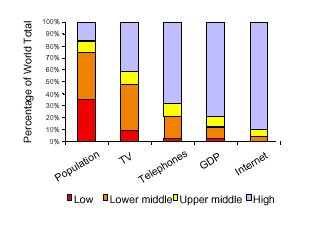
Access to infrastructure such as phone lines and electricity also place crucial limitations on ICT usage. A statistical snap-shot such as that provided in figure 1 goes some way to defining the scale of the outreach problem. The Village Pay Phone, solar techniques and wind-up radios are a range of responses to such problems, alongside the investigation of short to medium range two-way electromagnetic radiation based links (See chapter 3, the role of apex organisations.)
fig. 1 Comparing the analogue and digital divides, broken down by national income levels 1 (source: DOT force draft report, 2001)
I have selected case studies to represent the range of techniques available. I have tried to pick examples that illustrate the growing role of the internet alongside more familiar techniques. The case studies have been selected on the basis of them being examples of participatory communication. The Tele-centre examples are chosen due to the popularity of this approach within policy documents on this area (see SIDA, 2000 and World Bank, 1998.) These examples are mostly drawn from Alfonso G. Dagron's excellent book of case studies in this area, Making Waves, stories of Participatory Communication for Social Change (2001) with additional sources coming from the internet.
The Indian Satellite Instructional Television Experiment (SITE) is an early example of ICT use, where satellite technology was employed to deliver a mass literacy and health education campaign. However, the highly centralised, mass media nature of this approach places it far outside the notion of participation that this discussion is focussing on. Local level verbal communication networks (termed "oramedia" by Ugboajah) were used as part of the literacy education, but the development of a critical awareness is not mentioned as a feature of this State- led programme (Jefkins & Ugboajah, 1986).
Gasaleka & Mamelodi Tele-centres, South Africa.
Tele-centres have been taken up in South Africa as part of a national drive to provide IT training, supported by the World Bank and local NGOs. Gasaleka and Mamelodi Tele-centres are chosen because they are similarly equipped, each with nine computers, telephone lines, an email service, printers and fax machines. As such they are fairly representative of Tele-centre projects as envisioned by Donor agencies (for instance, see SIDA, 2000 pp 32-37). Gasaleka Tele-centre is situated in a Rural area containing 34 villages and around 30,000 inhabitants. Mamelodi Tele-centre is found near the centre of Mamelodi town, in an urban setting. In Mamelodi the centre is used mainly for reference, with people asking for directions to places and the addresses of people. As such, Mamelodi Telecentre has produced a directory of local services, and so is embarking on being an information production, as well as consumption, centre. According to the project director, Gasaleka suffers because "the people are not aware of what is happening in the Tele-centre." Seven agents are employed to go around and explain to the communities about the Tele-centre's facilities and the availability of information and training courses there. (ibid.)
The project director is attempting to overcome these problems by engaging in information production towards the needs of the community. A newsletter is planned. The newsletter will have to grapple with literacy problems, and depend on literate members of the community to pass on information to those who cannot read. "It is true that illiterate people don't come and use the Tele-centre" reports the project director, highlighting a key problem encountered when focussing mainly on internet connectivity. The newsletter aims to overcome the other key problem of finding information on the internet relevant to the needs of the rural poor in lower income countries (ibid.)
The uptake of training courses is slight, with the main users of the Tele-centre being business people who contact clients via email, use the internet, produce documents and carry out their financial administration. Others tend to use it for basic telephony and sending faxes. As such, these Tele-centres at present amount to expensive "communication shops" and so their income does not cover their overheads, making them unsustainable once external funding is withdrawn (ibid.). However it should be noted that lower cost tele-centre models have been springing up spontaneously in low income country contexts, in the form of internet cafes. This has mainly occured in urban areas.
These problems have been picked up in the general academic literature on the evaluation of Tele-centres. For instance, in Mona Dahms and Peter Benjamins "Socialise the modem of production: the role of Tele-centres in development" it is suggested that the form of Tele-centres should be approached far more flexibly, perhaps opting for lower cost set-ups. They also suggest that the design of them should be participatory in character, and implementation should be designed to foster community ownership. They also point to the need for fostering the social systems or "social capital" that surround computer usage, to lay the ground for the introduction of such equipment (Benjamin and Dahms, 2000.)
Grameen Village Phone, Bangladesh
 100 miles
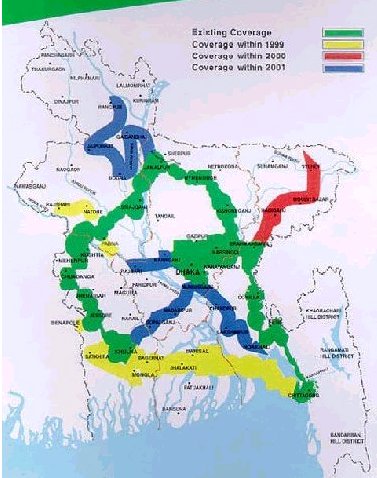
fig.2 Areas of Bangladesh currently or projected to be covered by Village Pay Phones.
(Source: Telecommons, 2000)
A good example of a highly decentralised low-cost project that is financially sustainable (it operates as a market-based initiative) is the Grameen Bank's Village Payphone Project (VPP) (see figure 2 for geographical coverage in 1998, with projections for 1999, 2000 and 2001.) Its relevance is illustrated by current uptake levels of in the region of 100,000 handset owners (Dagron, 2001.)
The Grameen Bank's approach to this project has grown out of its approach to Micro-credit. This involves using social capital and trust alongside encouraging community self-organisation as a means to reduce the cost of administrating and policing the many small loans involved in micro-credit schemes (Yunis, 1999). This has been a response, as mentioned earlier to problems of access to credit markets for poor people. Social capital is "levered into" the process by making loans to a group of people who know each other, with default by any one member damaging the credit record of the group as a whole. As such policing is carried out through "trust" within the group, and very high repayment rates are achieved with this minimal policing structure.
The Village Pay Phone scheme is an extension of this approach, whereby loans are made to members who already have an existing successful business under the scheme, in order that they can purchase a cellular phone in order to provide a communications service that people within the village will pay for. Since the cost of the handset is low, when compared to other approaches ($420 compared to tens of thousands of dollars for Tele-centres), the approach is, from the outset, more likely to be financially sustainable (Dagron, 2001).
There is a high level of demand for the communication service provided by the phone, also stemming largely from problems of market access for the rural poor. Since labour markets are often weak locally, it becomes necessary for family members, usually men, to migrate in search of work, or for whole families to migrate, even internationally. The VPP provides a channel whereby social ties can be maintained with migrants, and remittance incomes can be secured. In addition, in order to buy and sell goods, travel to markets in regional centres may be required. Relatives in town may be consulted on prices in the markets or the conditions on the roads, and as mentioned before, by breaking the information monopoly of traders operating between these regional and local markets, the risks of exploitation are reduced. These pressing needs, which are mostly related to income, make willingness to pay for these services high, with 54 percent of VPP users indicating they are willing to pay between 100 to 300 Taka (US$ 2 – 6 ) for a three minute phone call involving a financial matter with a family member overseas (Dagron, 2001).
The Village Pay Phone addresses the perceived needs of end users directly, and so has a high rate of uptake and sustainability. Solar technologies allow outreach beyond electricity grids, and the erection of bamboo poles of 3-5 metres with high gain antennas can extend the reach of Cellular phone coverage, which is already greater than that of landline connections. Literacy problems are overcome by the nature of the medium and by the relative simplicity of the technology. It is also reliable, as it has no moving parts. However, whilst providing a much needed channel of communication, the lack of any centralised consensus forming precludes the formation of critical, political or learning capacities. Although new ideas may filter through the phone links, it is not until they prompt discussion within a community that a consensus is formed. Perhaps by providing a focal point for information exchange the VPP may encourage this, but the approach does not actively encourage the forms of community empowerment I have outlined.
The approach does explicitly address gender empowerment, by targeting the ownership of phones towards women where possible. Besides giving women control of a productive asset, and also placing an important information source within the "female domain" of a community, the presence of a phone is also gendered, in that constraints on market access generally weigh more heavily on women. Due to restrictions on travel away from home, that are often placed on women in lower income (and some higher income) countries due to their reproductive responsibilities, it is most often men who are able to migrate for work. The ability to maintain contact with migrants should, on the face of it, reduce the likelihood of families being "abandoned" and losing contact with the migrant. This is a question worthy of further investigation. These restrictions on movement also apply to travel to markets for trade, especially where this means staying away from home overnight. This may mean women need to send male relatives to market to sell their produce, and so accurate information about prices may, in principle, reduce the risk of exploitation, although in practise this is dependent on the relative bargaining positions of the individuals in question (Pottier, 1999).
Kothmale Community Radio, Sri Lanka
Community radio has a long history, especially in South America, where its application has often involved a high level of community participation (Dagron, 2001). It also has been applied in Africa, where it has been used to reach out to populations across huge geographical distances, where little or no infrastructure is available (Ugboajah, 1980). Since wind-up or solar powered radios are available for a relatively low cost ($26 is one price quoted in Dagron 2001 : 281) and literacy problems are avoided with this medium, and since the broadcast equipment is also relatively inexpensive compared to television, this medium has been one of choice in developing country settings. The complementarities between the outreach available through radio, and the research and data-basing opportunities available via IT and internet have been utilised in a number of community radio projects, of which Kothmale Radio is a notable example (see Dagron 2001 for case studies.)
Kothmale Community Radio Internet Project (KCRIP) in Sri Lanka aims to assess the potential benefits of new communications technologies to rural areas. Kothmale Community Radio (KCR) serves an area with a radius of around 25 km with an estimated population of more than 350,000 people. Anecdotal evidence from Tanya Nutley, a volunteer on the project suggests that KCR is well known and well regarded within this area ( see Dagron, 2001 : 127) Letters to the station average 50 per day, including poetry, drama, history, songs and local events information. KCR was provided with computer equipment for the KCRIP by UNESCO. The Sri-Lankan government provided the internet connectivity through a dedicated 64 kilobyte line (which is a low capacity trunk connection by current high income country standards, although still faster than what most home users rely on. )
Three computer access points have been established in community centres in the area, with two way microwave links being employed where landline connectivity is lacking. The government is absorbing the connectivity costs of the KCRIP for two years, after which the KCR will need to find US$1000 per month to cover these extra costs. The KCRIP has, with help from the Institute of Computer Technology, incorporated web design training into its activities. KCR broadcasts a daily one hour programme based on queries from listeners that are answered by broadcasters with the help of the internet. A database of frequently requested information has been built up from this. The community internet access points are used as a portal for live broadcasts from within the community (Dagron, 2001).
Much needed health and income related information is drawn from the internet by the community. The formation of a community identity and consensus via community programming is contributing to a sense of empowerment and a level of critical capacity, in the form of an awareness of social problems in the area. The presence of Kothmale radio broadcast content on the internet, as part of a web-site written in three languages, (see Kothmale community radio web-site under general web references) has improved the political visibility of the community, and acts as a support for community radio within the region. The database of frequently requested information represents progress in the learning capacity of the community, and is also a resource contributing to the more general discussion of information needs and the provision of relevant content on the internet (see chapter 3 for more on this.)
The addition of internet connectivity to the station provides a channel for health and income related information, and educational opportunities, that is actually utilised by a community already empowered within a participatory communication process. However it is not certain that it will be financially sustainable: the initial investment of around $50,000 dollars alongside ongoing costs of around $1000 dollars per month may prove hard to bear, even for what is an example of a healthy community radio project, with 75% of its income derived from commercial programming. In addition the internet component is still mainly beneficial to those that own a phone line and can call in, are literate and can write in, or those that speak English and can browse the web for themselves (Dagron, 2001.) This suggests that telephone connectivity, postal service coverage and reliability, and literacy levels are a limit on the outreach of such a scheme, and that English language education or web content in local languages is required. Direct access to the internet still requires literacy amongst end-users. As such the development of software that can overcome literacy barriers in IT use remains a priority, even where such integrated ICT approaches are taken (for more on this see chapter 3.)
Labour News Production, South Korea

Fig 3. Screen capture: ( see Labour News Production in general web references.)
"Labour news production's main goal is to strengthen the democratic and progressive labour movement in Korea and world-wide and to play an important role in making the situation of media in the country more democratic." (Dagron, 2001 : 152)
Globalisation, in South Korea as in other countries, is causing serious problems for workers faced with harsh economic realities. The labour movement has a key role to play in such situations, but unfortunately many trade union organisations are not effective within current rapidly changing conditions. Labour News Production (LNP) approaches the social problems faced in Korea, especially in the wake of recent economic troubles, by focussing on a "social democratic" vision of democratic political processes coupled with decent living standards for working people. LNP wishes to be the driving force for using media in strengthening the progressive labour movement and also wants to make this movement internally participatory and democratic (Ibid.)
LNP has produced more than fifty video programmes of an educational and historical/documentary character. They have also built up more than 3000 hours of archive material. Since 1991 LNP has trained workers and citizens in video production and in the critical understanding of the mainstream media. This has led, amongst other things, to the production of six videos by workers collectives trained by LNP, so contributing to the build up of a network of information producers. Participation in the setting-up of international conferences such as Labour-Media 97 and Labour-Media 98 have broadened this networking activity (Ibid.)
LNP has used video as a low cost, but high visibility, alternative to television, in order to build political capacity within the Korean labour movement. This political visibility has been enhanced through the use of the internet, with the creation of a web-site in English (see fig 3.) and the video streaming of LNP content over the internet (see General Web References). LNP has also involved the building up of a "communal narrative" (both within the video archive and the participatory discussion processes that are said to surround video production,) which is explicitly aimed at promoting critical capacity within the union movement. The training and education programmes have been aimed at promoting these video techniques. The awareness of the need for these techniques within labour movement probably arose from ongoing discussions within the union movement that framed the need for promoting such skills, facilitating the emergence of this learning capacity (Ibid.)
The project is largely self-sustaining; with 80% of revenues deriving from tape sales, production fees from co-production projects with trade unions and NGOs, and training fees from the training programme. Fifteen percent comes from public and international funding, which is rarely available, possibly due to the political sensitivity of the project. Five percent of revenues are derived from individual supporters. Since the project has emerged from an existing popular movement and is structured around the critical discussion of people's needs, it seems to have found the support it needs to render it sustainable, even through the political turmoil during the 1990s in Korea (Ibid.)
ICTs, Civil Society, Social Capital and the State.
The information above should of course be framed as a possibly idealised view, since I have drawn only from Dagron on this topic, and he drew mainly from the leader of the movement, Myoung Joon Kim. However there is academic literature to support the view that a broadly based union movement can lead to democratisation coupled with improved standard of living. Patrick Heller in his article Social Capital as a product of Class Mobilisation and State intervention: Industrial Workers in Kerala, India points to the broadly based nature of union movements in Kerala. Organised along inclusive class interest lines, rather than smaller exclusive factions, they were key in leading to an effective movement for improved living standards, able to bargain collectively and also make economically necessary compromises with employers in order to improve productivity(1996). As mentioned earlier, Skidmore (2001) frames discourses on "social capital" within the framework of the debates on the value of Civil Society as a source of agency in National Development. Of interest to such discussions is an OECD study showing productivity being positively related to rates of unionisation, within a western European context (see Fig. 4.)
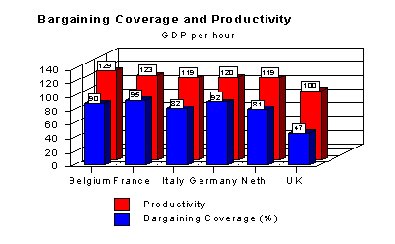
Fig. 4 Unionisation rates and productivity within Western Europe (Source: OECD in TUC partnership institute research page, General web references.)
This "social capital" expressed as the capacity for collective action is attributed to a long history of inclusive associational activity within Kerala. As mentioned before one major indicator of such associational capacity, employed in a study of social capital levels across Indian States (Morris, 1998,) is the number of periodical local language publications found within the State. Kerala scored highly in this, with its large number of publications seen as being indicative of its strong "civic culture." It should however be noted that media can be used divisively, as in the case of community radio projects controlled by evangelical religious sects (see Dagron, 2001 : 36).
These discussions seem to implicate the role of media in creating broad based movements for social change, and unions as being well placed to improve the living standards of workers, making Myoung Joon Kim's claims seem somewhat credible. This is part of a broader human rights and development debate around the possibilities for meeting economic, social and cultural rights through the exercise of civil and political Rights (for more on this topic see: Brownlie, 1994 and Sengupta, 2000) Other discussions within this category include that on public interest litigation (see Cottrell, 1993) and more general debates on the suitability of introducing formal democratic procedures and the observance of human rights as a part of "good governance" (see DFID, 2000 for a developed country government's recent treatment of these topics) in national development strategies (see Leftwich, 1993 and 1994 and also Donnely, 1989.) Dreze and Sen have also contributed to this debate in their comparisons of famine response in India and China (for one example see 1989.) One key rights area highly relevant to Civil Society as a whole is freedom of association (for more on this see Caire, 1977 and Paul & Dias, 1992.) The role of the media and its relationships with Civil Society are implicated in all of these discussions. Certainly ICT approaches within Civil Society, often involving the use of video, have been used in checking the excesses of government, with Civil Society groups working to increase transparency. The case study of the Chiapas Media project, involving the extensive use of video, found in Dagron's (2001) book, is one example. The case studies found in Vikas Nath's website on digital governance focus on the role of the internet in increasing "transparency" especially in relation to the sometimes corrupt activities of the State (see under general web references.)
The availability of portable and affordable video production facilities due to advances in digital technology have encouraged, and will continue to encourage, ICT usage where such techniques become more accessible. Certainly IT has a role to play as a support technique for the information processing involved in both radio and video based work. However, cost remains an issue and the provision of low–cost hardware and the production of affordable or free software of a truly "multi-media" nature seems a priority, if production and training projects such as LNP and Kothmale radio are to be supported internationally.
1
Income categories are in line with World Bank definitions (see appendix 1.)