 |
|
|
|
|
|
|
|
|
|
|
|
|
|
|
|
|
|
|
|
Solving Schrondinger |
|
|
|
by |
|
|
|
Daniel McCreary |
|
|
|
(c) 2006 by Daniel McCreary |
|
|
| Have you possibly been looking at quantum measurement from the wrong point of view? |
|
|
| The answers to most problems can be found by asking the right question or looking at something from the right angle. Sometimes a person with a fresh viewpoint (like looking at the backside of something, reading the directions, etc.) can solve a problem that has baffled others. |
|
|
| The quantum measurement problem has been plaguing physics for a long time. Without the proper viewpoint change, some things will never be solved. |
|
|
| The quantum measurement problem can be solved by considering the "isolation" of the quantum particle. It may be no more isolated than a boulder is isolated from the dirt that it is half buried in. The quantum particle is embedded in the spacetime field, like a fish is embedded in the water through which it so freely moves. |
|
|
| When a quantum particle is "isolated," it may not be isolated at all. The quantum particle's "isolation" can be regarded as physical involvement with the universe as a whole, like the boulder above is physically involved with a whole lot of dirt. This involvement of the quantum particle would explain Schrondinger's wavefunction being spread across spacetime. We can still speak of an isolated quantum particle, just as we can speak of an isolated boulder sticking up out of the ground. |
|
|
| With this consideration, we can see that the wavefunction's extent may be limited, moment-by-moment, by whatever physical system that the quantum particle is involved with, through the physical forces acting upon it. The movement of the above-mentioned fish is certainly going to be limited by whatever fisherman's belly it winds up in. When the particle stops following the spacetime field curve and becomes involved with a smaller physical system than the universe as a whole, we can suppose that its wavefunction will be effected by that system and at least some of that system's characteristics. Gasoline is effected when it gets involved with your car's engine. |
|
|
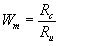
| The particle's involvement, caused, for example, by an experimenter working with it and taking measurements on it, would only be for the duration of that time frame. The quantum particle then is physically linked (through the forces employed by the experimenter) with a smaller physical system than the whole universe, even if it is just for the duration of the measuring event. This event imposes a radius of constraint upon the particle. Within that radius it is as free to move as it always has been, like a fish placed into an aquarium instead of a fisherman's belly. The more tightly restrained the measurement (by way of precision), the tighter the radius of constraint will be to the particle's measurement. This is mathematically expressible. |
|
|
 |
|
|
 |
|
|
 |
|
|
 |
|
|
| Wm gives us a very natural way to handle Schrondinger's wavefunction. As Rc approaches zero, as a practical limit (like you approaching a wall you cannot walk through), Wm approaches zero and the wavefunction collapses into the radius of constraint. |
|
|
| When Rc=Ru, Wm=1 and Schrondinger's equation is unchanged. |
|
|
| More generally: |
|
|
 |
|
|
| Admittedly, I may not have placed Wm quite correctly into Schrondinger's equation above, but you can see how it would work. |
|
|
| Experiments can show what involvement is required for the wavefunction collapse to occur, by use of wave interference patterns. |
|
|
| We know that electrons show the pattern; what about larger bodies, such as hydrogen atoms or alpha particles? Has anyone ever checked out cosmic rays and their interference patterns? Ions suggest themselves for interference pattern experiments, as well as the testing of small, charged molecules. |
|
|
| All of these suggested experiments (if they have not already been done) could throw new light on quantum mechanics. |
|
|
| In any event, I think Schrondinger has been solved. |
|