The
perfect Palm PDA
An Idea By Dan Bruner 08/09/03
([email protected])
I've been thinking about this little project for some time now... How would I design
the "perfect" handheld palm device? Okay. Let me take that back and not say
"perfect". What I mean to say is, How would I design a device that works best
for the most people. What features are essential, and which ones are more flexible. What
features can I borrow from both Sony and Palm that I would most like to see on the same
device...
As you get further into this, you'll see that I borrowed heavily from both Sony and
Palm designs. In fact, my design is basically a copy of Palm’s Tungsten model with
added features from Sony’s models and a few of my own ideas.
I'll start by listing off the features that I feel are important or not important in
today’s various models. First, I see more and more devices coming out with the
built-in mini keyboards. Personally, I find them to be inadequate compared to graffiti.
They also take up valuable space on the device that could be better used in other ways.
Still, I know that there are people out there who live and die by the mini keyboard. So if
you need one, I would provided it in the form of a peripheral device. It's a copy of
Sony's keyboard, with the exception that the keyboard plugs and snaps directly into the
device’s cradle port. Again, just like Sony, I would also provide a type of game
controller, but with the added feature of "direct" connection and attachment to
the device’s cradle port by means of a "locking" clip. This
"locking" clip concept is also used on the memory/module slot on top of the
device.
I'm puzzled by why manufacturers are leaning more and more towards "built-in"
rechargeable batteries. There must be thousands of people out there who have lost
everything on their device because they ran out of power while on a business trip without
access to a charger. I therefore believe that standard removable batteries should be
mandatory. For this design, I chose the widely available AAA battery. If I'm 500 miles
away from my charging cradle, I want to be able to go into the nearest mini market and buy
some AAA batteries to keep the thing going till I can get back home. This is the reason
that I currently use a Sony SL10... It was the only device that I liked that also had the
removable battery feature.

Image-01
As you can see in the first drawing (Image-01), the form factor is based on Palm's
Tungsten design. The only difference in this particular view is that I have located the
microphone in the lower right side and an indicator light in the lower left side. The
reason for moving the microphone is for the use of a cell phone module that will be
explained later.

Image-02
The second drawing (Image-02) shows all the peripheral items that can be used with
the device. I’ve already explained the keyboard and game controller. So I’ll
start here by explaining the memory and module slots. I decided on using the
"SD/MM" memory card as a basis for this design because of its relatively small
size and because it’s not a proprietary medium like Sony’s Memory Stick. There
are two "slots" available for memory located on the top and the right side of
the device. The top slot can be used for either a memory card or a module. A module would
be a peripheral device that you would purchase separately. Modules would cover a wide
variety of features that I think should not be built into the device itself (mainly for
purposes of keeping costs down). Some examples of these modules would be things like a GPS
module, a cell phone module, a camera module, or a wireless module (ex: bluetooth or
WiFi). The other important feature of having an extra memory slot is that if you have
something like a GPS module plugged in, you’ll still have another available memory
slot to store things like your map files. Please remember here that I’m trying to
design a PDA that will suit the majority of people out there. Not everyone needs or wants
things like cameras or built-in wireless capabilities. Why pay for them if you don’t
need them.
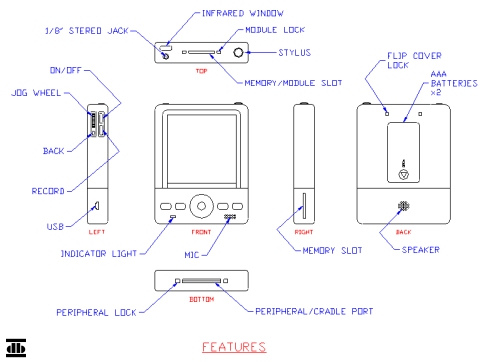
Image-03
The third drawing (Image-03) shows all the different views of the device.
It’s pretty Self-explanatory, but I’d like to point out a few things. On the
left side is a USB port for those of us who do not want to use a cradle. Again, this could
keep the cost down. If you do not need a cradle, you would not have to purchase one. Next,
on the same side, you’ll see Sony’s "jog dial" feature. I feel that
this is an important feature that should be made available to everyone. It makes
one-handed use possible where it would otherwise not be. On the back, you’ll see two
small holes located towards the top. These are for a flip type of cover that can be
attached or removed depending on your needs. I am basing this idea on the flip cover that
came with my Sony SL10. It’s a very basic cover, but I feel that it is really all
that anyone needs (Image-04). I think everything else on this drawing speaks for
itself or has already been explained.

Image-04
Lastly, I want to point out a few things that aren’t shown on the drawings. The
device’s screen is to be full color. There are so many programs out there that
utilize color now that I think it should be considered standard. The amount of built-in
memory should be as high as possible within reason of keeping the cost down. The processor
should also be the strongest available, but, again, within reason of keeping costs down.
The operating system should be fully upgradeable. The body, the digitizer, and the
built-in temporary battery (this is the battery that saves the when changing the main
batteries) would be BUILT TO LAST! I would expect no less than 5 years’ usage before
needing repairs or replacements. All this for a starting price of around $200, I think
would be appropriate. Oh yes, and for the stylus, the device’s Stylus is based on the
Palm Tungsten version. My stylus, however, would have a built-in ink pen and no reset pin.
Why no reset pin? The "perfect" Palm OS device would never need to be
reset… |