 |
| BUILDING THE CLOCK |
| The insides of my clock. |
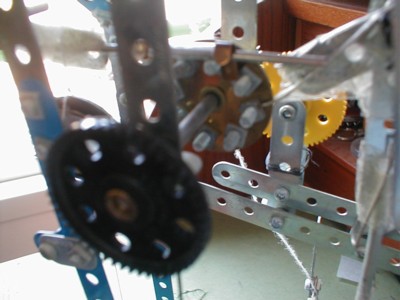
| The clock that you build is very simaler to the diagram on the last page. First of all you have to build a strong frame that will hold all of the parts. It should be at least 5 inches longer than the pendulum you want to use. Then you hahe to get a "pin wheel". I used the brass wheel of an Erector set and filled with screws(see picture). put it on an axis and position it close to the top of the frame. Then you have to connect another cog or wheel (the black one in the picture)to one end of the axis, wrap a string around it, and connect a weight to the loose end. when released, the string should unravel and the pin wheel should spin. |
| Step1: - Frame and pin wheel |
| Step2: - "finger" |
| make sure to have read the first clock page! |
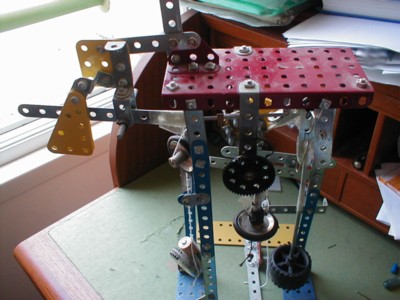
| This is one of the hardest parts to build. It is important that it is strong - If it shakes then the clock wont tick. You can see the support of the finger on my clock on the bottom picture - it is the part with the yellow triangle. on the tip of the finger you have to put something strong, but thin enough to fit in between the pins of the wheel, after that peice there should still be some metel sticking out (see top picture for detail). The fin ger should be able to move up and down freely and should have a little weight to it. When released it should stop the pin wheel from spinning. |
 |
| Step 3: - the pendulum |
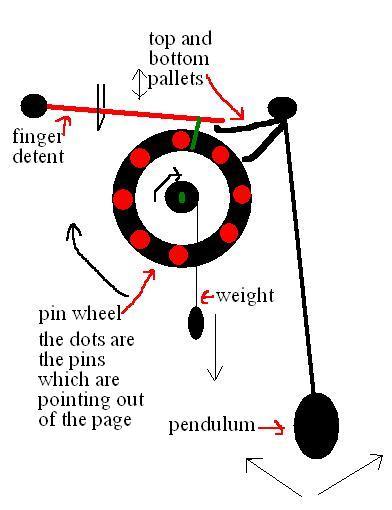
| The pendulum should be long and hard. One end should have a heavy weight and the other should be connected to a hinge that is a little higher than the pin wheel. To the top of the pendulum at the hinge connect the two pallets (see the last page). The top one should be wide enough to catch the finger, and the bottom one should be thin enough to fit in between the pins. To see their respective lengths, look at the bottom picture. As the pendulum swings left, the top pallet should pick up the finger and release the pin wheel. Almost immidiatly after that the bottom pallet should mesh with the wheel and cause it to stop. The force of the pin wheel on the bottom pallet should push the pendulum back to the left. If this happened than your pendulum should keep on going untill the weight on the pin wheel reaches the ground! |
 |
| Problems: |
| If you want this clock to actually tell time then you have to get a "clockwork gear box" and connect it to the rotating axis of the pin wheel. You'll see what I mean after you've completed the clock. |
| If your clock dosn't than try adjusting the weights and length of the pendulum. if that dosn't work than write to me at: |