Representations of Fascism
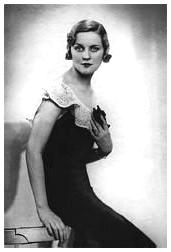
Left: Diana, Lady Mosley (1910-), Editor of The European Journal
Purifying the Nation: British Neo-Fascist Ideas on Representations of Culture
Steven Woodbridge, Kingston University
Although Fascism and Neo-Fascism have emphasised 'action' in politics, we should not underestimate the extent to which Far Right ideologues have sought to engage in the 'intellectual' arena. This paper investigates the ideas, attitudes and discourse of the post-1945 British Far Right towards representations of culture. It will argue that the texts of the Far Right show a recurrent concern with the need for the 'purification' of national culture. There is a belief that 'liberal' cultural forms have resulted in national decadence, showing the nation is in serious decline. Consequently, there has been a call for the 'regeneration' of the nation, together with a conviction that national culture requires 'cleansing' as part of this project. Far Right texts have put forward a number of distinctive views on what constitute 'true', legitimate and authentically 'British' cultural representations. They express views on how cultural representations reflect either 'decadent' or 'healthy' national identities. Indeed, in their desire to define the 'healthy' version of culture, the texts of the Far Right during the post-war period have been replete with (sometimes rival) concepts of identity. A survey of these definitions and debates on culture can capture both the common ideas and the moments of tension in these texts, helping us to better understand the interplay between Neo-Fascist texts and potential audience. The Far Right's prescription for cultural and political renewal is illustrated through a brief exploration of the texts of the 'Union Movement', the National Front', and the 'British National Party'.
Imagining Fascism in Knut Hamsun
Peter Jackson, University of Sussex
"We'll never be finished with him - Hamsun returns. And now this wonderland is being opened for a new generation". Thus reads an article greeting the re-publication of Knut Hamsun's Collected Works in 1954. Knut Hamsun's career is both intimately bound to the construction of Norway's national imaginary and profoundly disruptive of it. Hamsun's name which is right at the centre of the Norwegian literary canon is also associated with "the Nazi affairs", calling forth memories of the German Occupation of Norway
1940-1945. Focusing on the recent film Hamsun (dir. Jan Troell, 1996), this paper will investigate the ever-recurring debate on Hamsun's political allegiance with Nazi-Germany during the Second World War, the film's inscription in that repetitive debate and how "Fascism" is imagined (though not necessarily addressed) therein.
Representing Whom? The European: Independent Journal or Neo-Fascist Tract?
Andrew Harvey, University of Sussex
This paper concerns The European journal edited between 1953 and 1959 by Diana, Lady Mosley, the wife of Sir Oswald, the interwar leader of the British Union of Fascists, and postwar leader of Union Movement (UM). It argues that The European was an organ of UM, despite assertions to the contrary from the surviving protagonists. Apparent uncertainty amongst the handful of historians who touch upon on this has required new analyses to be drawn, based on sensible logic. Thus, The European was established simply for Mosley to promote his political ideology. Therefore, if one accepts the observation from a former UM member that 'OM is UM, and UM is OM,' it can be asserted that the journal was, intellectually, if not institutionally, a UM journal. However, even Mosley's comments in his autobiography, My Life (1968), suggest that he was clouded on its true accountability. But, if the assertion of synonymy is accepted, it is possible, for further conclusions to be drawn from The European's financial ownership and control. The paper logically suggests that it can be see as little other than a UM organ for five reasons: a) The European's editor was the wife of UMs leader; b) its editorial address was UMs offices; c) it espoused the same (European) ideology; d) it desired an intellectual audience, which can be equated to Mosley desire for Goethean 'thought-deed men;' and, e) it was financed by the man who was the embodiment of UM. The paper will conclude with brief comment on The European's content and physical production.