5-SPECIAL ADAPTATIONS:
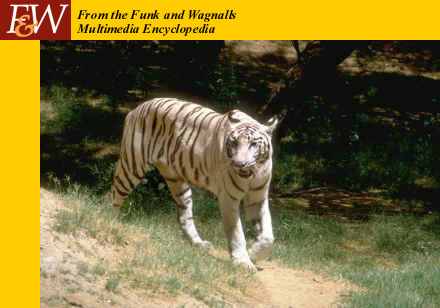
The white ear spots may enable mothers and cubs to keep track of each other in the dim forests at night. Unlike conspecific leopards, tigers take advantage of human-made rails and roads. They are excellent swimmers.
6-INTERPRETIVE INFORMATION:The male regularly patrols his territory, scent-marking and scraping tree trunks. The stiff whiskers enable a tiger to move through thick cover at night. If the whiskers fit, the whole body can follow. Notice how little interaction there is between our pair. They get along fine but do not seek close proximity.
7-STATUS IN WILD:
Endangered. They have been hunted heavily by man for sport, skins, and as a source of traditional medical products. Superstition has surrounded tigers for centuries; necklets of claws are thought to protect a child from "the evil eye", whiskers have been considered either a dreadful poison (Malaysia), a powerful aphrodisiac (Indonesia), or an aid to childbirth (India and Pakistan) and the bones, fat, liver and penis are prized as aphrodisiacs or medicines. The main tiger population of the Indian subcontinent has suffered a serious decline in the last 50 years. It is estimated that some 200 tigers yet survive in Nepal, and perhaps 4000 in India, up from a low of 2000 in the 1970s. A government program, called Project Tiger, established nine sanctuaries designed to provide ample habitat and prey. However, small isolated parks may promote inbreeding and the future of the Bengal tiger is still in question. In the 90s, there has been a resurgence of poaching for the escalating Chinese and Korean markets, in spite of a Chinese ban on tiger products in 1993 and South Korea's joining of CITES.
