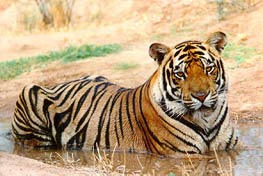
        			ORDER: Carnivora
        			FAMILY: Felidae
        			GENUS: Panthera
        			SPECIES: tigris
1- DESCRIPTION:
Head/body length: 5 feet 10 inches- 9 feet 1 inch; tail length: 36 inches; weight: 350-550 pounds; shoulder height three feet or less. Eyes are large with excellent vision. Hearing is good with well developed ear flaps. They have large canine teeth and strong, powerful jaws. Paws are heavily padded; claws are retractable. Coloration is bright fawn to reddish tan, shading to white underneath, and sharply marked with uneven black stripes: a unique pattern for each individual. Fur is short and thick. Whiskers (vibrissae) are long with thick individual hairs.
2-GEOGRAPHICAL RANGE AND HABITAT:
Found throughout India from the Himalayas to Cape Comorin, except in the deserts. (Other races are found in Burma, Malay Peninsula, Sumatra, Java, and Bali.) Prefered habitats include dense thickets, long grass, or tamarisk shrubs along river banks. Some seem to have special fondness for cover in old ruins.
3-DIET:
Carnivorous. Diet varies according to locality. Prefers deer, wild pigs, young buffalo, young elephants and cattle in general, any prey over 100 pounds in weight. But when driven by hunger will eat almost anything: fowl, fish, lizards, frogs, crocodiles, carrion, or even humans, on occasion. Hunting method is a slow patient stalk through cover until close enough for the final spring. For prey less than half a tiger 's weight, the killing bite is delivered to the nape of the neck. For larger prey, a throat bite is prefered. Tigers are heavier predators than lions, and average about 50 deer each, per year. Only one hunt in 20 is successful. Man-eating and cattle-killing are usually attributed to older tigers, injured tigers, or young adults unable to leave an over-crowded territory. Oakland Zoo feeds Feline Diet (beef fortified with ground bone, vitamins and minerals) and occasionally whole carcasses.
4- LIFE CYCLE/SOCIAL STRUCTURE:
Usually solitary, but occasionally travels in parties of 3 or 4 (probably mother with sub-adult children or an estrous female and suitors). Both sexes mark territories but a male's territory will overlap several females' territories. Tigers are polyestrous but most commonly conceive after the monsoon rains; the majority of cubs are born between February and May after a gestation of three and a half months. Cubs weigh under three pounds at birth and are striped. Eyes open in 15-16 days. Litter consists of 1-4 cubs, occasionally up to 6, but it is unusual for more than two or three to survive. Cubs are weaned at 4-6 months but depend on their mother for food and protection for another two years. Females bear single litters every 2-3 years. New males entering a female's territory may eat cubs. There is some evidence that females permit their daughters to take over their home ranges and there have been verified reports of rather large groups of tigers (up to 9) feeding at a single kill. In one case, the additional tigers were offspring from several litters of the one who had made the kill. Maximum longevity is about 26 years.