                       ORDER: Carnivora
        	           FAMILY: Felidae
        	           GENUS: Panthera
        	           SPECIES: leo


1-description:
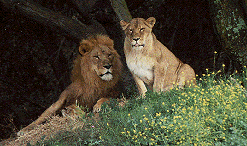
Typically a mature male stands 4 feet at the shoulder and is 8 .5 feet long,
plus tail.He'll average 450 pounds. Females are considerable smaller, weighing less
than 300 pounds.Adult lions usually have a plain unspotted coat, light brown to dark
ochre in color.Cubs are marked with spots which   sometimes persist on the legs and
belly until they are fully grown. Male lions have a brown mane, which tends to grow
darker and fuller as the animal ages. The tail has  a  black tuft at the end. White"
lions occasionally occur in the Transvaal region of southern Africa, but these are
not true albinos.


2-GEOGRAPHICAL RANGE AND HABITAT:

Thousands of years ago, lions were common throughout southern Europe, southern
Asia, eastern and central India and over the whole of  the   African continent. Today,
with the exception of some 300 highly  protected animals in  the Gir National Park of
India, the only naturally-occuring lions are found in Africa. (But even in Africa lions
have been wiped out in the north; the last Numidian male was shot as a trophy in the
1930s.) Lions do not live in heavy forests and jungles and they do not inhabit desert
areas due to a scarcity of game.

3-DIET:
Lions feed on a variety of large and medium-size prey. They prefer wildebeast (or
gnu) to all others when the annual migration brings the vast herds through the  pride's
range. Otherwise they eat buffalo, zebra, antelope, giraffe, and warthogs. They also steal
kills and carrion from other predators.
4-LIFE CYCLE/SOCIAL STRUCTURE:
Lions are the only cats that live in large family groups. Each pride differs in size
and formation, but a typical pride consists of two males and seven females and a variable
number of cubs. Females are usually sisters and/or cousins that have grown up together.
When the pride hunts as a group they employ an ambush that forces large prey into the
waiting paws of the males. Females have the speed but lack the body weight to knock down
large "family size" prey such as the wildebeast. Despite their tremendous power and adaptive
efficiency, lions are more likely to fail than succeed in their attempts to kill.
Subadult males are driven out at 2-1/2 to 3 years of age and may go in a group with other
 males. Females mature in about two years, males a few years later. All big cats are induced
 ovulators, i.e. release of the ovum is brought about by the act of mating, which explains
the spitting, hitting, and roaring contest during courtship. The period of gestation for the
 lioness is between 105 and 118 days and usually three or four cubs will be born. Only one in
 five will survive the first year. When game is scarce the dominance hierarchy based on size
and age quickly becomes apparent. The youngest die first.

NEXT