5-SPECIAL ADAPTATIONS:
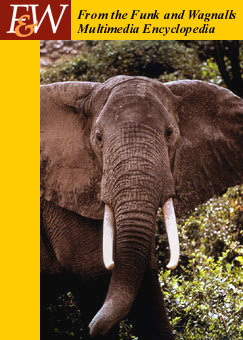
The majority of the skull is honeycombed with sinuses to minimize weight. Tusks are elongated second upper incisors and grow throughout the lifetime. They are used for food gathering and carrying, as well as weapons. Molars make up other dental equipment; six consecutive sets of two upper and two lower molars are produced throughout life. The first set has three enamel layers, increasing to ten layers in the sixth set. The trunk is an elongation of the nose and upper lip; in adults it contains 40,000 to 100,000 muscles. Literally the animal's lifeline, it is used for eating, drinking, dust and water bathing, as well as communication. The sense of smell is highly sophisticated; they are believed to locate underground water by smelling the earth above. Vision is poor. Long lashes and nictitating lids protect the eyes from dust. Hearing is acute. Recent studies establish the use of infrasound (tones lower than humans can hear) for long-range communication. Ears are also used to control body temperature; blood circulating through the large vessels in the ears is cooled by flapping.
6-INTERPRETIVE INFORMATION:Skin is extremely sensitive to sunburn and insect bites; they roll in dust and mud and throw dust on their backs to help protect their skin. Elephants have the largest brain size versus body weight other than man. New intelligence data: most mammals, excluding primates, are born with a brain weight of 90% of adult weight. A human brain at birth is 26% of adult weight, and the elephant's is 35% of adult weight. These statistics are used to distinguish instinctive from learned behavior, and are examples of higher intelligence.
7-STATUS IN WILD:
Endangered because of loss of habitat and because of poaching for ivory.