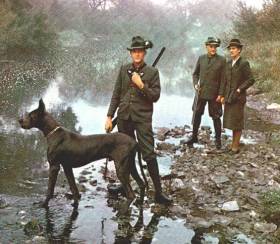
German
Hunting Party
Many scientists
believe that the highland of Tibet was the original country of
all Dane-like dogs. Assyrians were an extremely cultured
people, and marched or sailed along great trade routes where they
sold their manufactured goods of silver, gold and other metals,
ivory and carpets. It is certainly not unlikely, that with
them went some of the great dogs which had already been known and
bred for centuries before in their kingdoms. Evidence of this is
the fact that these very large dogs, next seemed to spring up in
those trade routes first used by Assyrian businessmen.
On the other hand, dogs with Dane-like figures, independently of others, existed in the middle of Russia, Poland, and middle Germany. This has been proven by excavations of big, heavy dog skulls. Dogs with heavily built bodies lived in those regions where the natural conditions and the necessity of fighting wild animals made life hard to bear.
It is also probable that the cultured Romans with their high standards of living were interested in raising purebred dogs for fighting, and also the more slimly built hunting dogs. For these purposes they imported British dogs who were very famous in that day. It is reported that these imported dogs were able to break the neck of an ox. Their ancestry went back to the Mollasian dogs which the Phoenicians had taken to Britain in the 6th century AD, and, as a result, of their descendants being crossed with the native dogs, the breed became very famous. They were taken by the Romans to fight in the circus, and in order to procure the best specimens the Roman emperor had a special official called the “Procurator Cynogie” who lived at Winchester. It was his duty to select both the heavy and more slightly built dogs which were to be exported to Rome. The broad-jawed dogs who became victors in the Roman circus against the Molossers are mentioned for the 1st time in AD200 by Gratius Faliscus.
During the Middle Ages they were crossed with the Great Dogs of Ireland, sometimes called Irish Greyhounds, and this cross brought about hunting dogs whose fame spread the world over in short order. Immensely favored at Court, these animals were often offered as gifts to visiting Kings and Queens, so great was their worth because they had such beautiful figures. To kill one meant immediate death for the peasant who would dare to be so foolish. About AD100 the Cimbern also had broad-jawed dogs for use in war and hunting, and to kill one of them would bring about severe punishment as well.
For thousands of years now, these large, sturdy, strong jawed
dogs, had been widely known and were renowned for their courage,
stamina and hunting prowess. However, they had out-lived their
usefulness in many areas as war dogs and were now being bred to
serve other 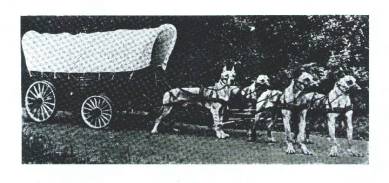 purposes. For
example, we now see their strength and stamina becoming useful as
draft animals and put to harness in small carts and yet again,
working for their living. Most notably in many
Mediterranean countries where still today, large dogs are used to
pull milk wagons and other small carts for their owners.
purposes. For
example, we now see their strength and stamina becoming useful as
draft animals and put to harness in small carts and yet again,
working for their living. Most notably in many
Mediterranean countries where still today, large dogs are used to
pull milk wagons and other small carts for their owners.
The breed became very popular , but during WWI it all but died out. After the war, Great Danes were again imported, and in 1938 it was stated that the Great Dane was “the most popular large breed in England because if its short coat, protective strength, obedient disposition, and its fondness for children.” Apart from the exhibitor and breeder owners of Danes in England, there are countless numbers of people who love the breed purely as pets and companions, for true the world over is the old saying that if you once had a Dane, you never want any other kind of dog.