This list is here so that when you talk to breeders you can ask questions about your dog's family's health history. These are aliments common to all breeds, not just Danes.
Acral lick dermatitis: a skin disease caused by an animal licking a localized area excessively, specially on the legs and paws.
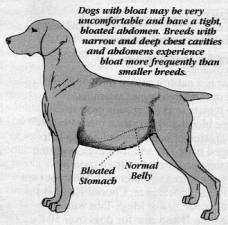
Bloat: a condition where a dog’s stomach
produces excessive gas and enlarges severely enough to cause
death without immediate treatment. Usually associated with
gastric torsion. (See Gastric torsion.) Bloat (Gastric
Dilatation-Volvulus) Bloat is a serious and often
fatal condition affecting Great Danes. Great Danes run 40 times
the risk of bloat compared to mixed-breed dogs. They have
the highest bloat incidence of all dog breeds. When a dog
“bloats,” gas is allowed to accumulate in the stomach
and cannot pass back out via the esophagus or small intestine.
Because of the shape and placement of the canine stomach, the
stomach sometimes twists, causing a surgical emergency called
gastric dilatation volvulus, or GDV. This can be fatal.
For this reason, if you suspect your dog has bloat, time is of
the essence. Some symptoms are: retching, trying to vomit
but not being able to, pacing, restlessness, and a hard distended
stomach. If you suspect bloat see your veterinarian
IMMEDIATELY.
Bloat remains somewhat of a mystery, with a wide variety of suggested causes. Some of these are:
Calcinosis circumscripta: the development of lumps of hard calcium deposits in the skin.
Cancer: it should not be surprising that bone cancers are the most common type of cancer found in Great Danes.
Cardiomyopathy: a disease of weakened heart muscles.
Cataract: as in humans, a change in structure of the lens of the eye leading to cloudiness and usually to blindness.
Cerebellar hypoplasia: a condition where the cerebellum, a part of the brain, is poorly formed (too small or absent) and doesn’t function properly or at all.
Cervical disc disease: a degeneration or malformation of the cushioning discs between the spinal column bones (vertebrae) in the neck. (Also see Wobblers)
Cervical vertebral malformation or instability: a malformation of the vertebrae in the neck usually leading to nerve damage.
Color mutant alpaca: a condition where certain colored areas of a dog’s skin grow less or no fur.
Combined immunodeficiency: a severe combined deficiency of cell-mediated immunity (T-cell function) and low concentrations of serum immunoglobulins (IgA, IgG, and variably IgM). Affected puppies usually die from viral infections by 12-16 weeks of age.
Complement deficiency: a deficiency in serum concentrations of the third component of complement that impairs neutrophil function and causes recurrent infections.
Cystinuria: an abnormal excretion of a substance (cystine) in the urine.
Deafness: an inability to hear, due to many different causes. (Usually related to color) BAER Test
Demodicosis: a kind of skin disease (mange) caused by microscopic Demodex canis mites living within the skin layers and producing an immunodeficiency syndrome.
Dermoid cyst: a small growth composed of skin-like structures.
Distichiasis: abnormally growing eyelashes.
Ectropion: an abnormal rolling outward of the eyelids.
Entropion: an abnormal rolling inward of the eyelid.
Eversion of nictitating membrane: a condition where the third eyelid is protruding.
Gastric torsion: a condition where the stomach twists, thereby impeding input and output. (See Bloat.)
Glaucoma: abnormally high pressure in the eye. Test available
Hemeralopia: inability to see in daylight. Test available
Hip dysplasia: a developmental malformation or subluxation of the hip joints. It can be very painful and debilitating. It is very common among Great Danes, and you will probably have trouble finding a line which is completely free of the problem. Test available
Histiocytoma: a tumor composed of certain skin tissue cells (i.e., histiocytes).
Hygroma: a fluid-filled sac usually occurring on the elbows of large breed dogs such as the Great Dane.
Hypertrophic osteodystrophy (HOD): a condition of rapidly growing giant breeds where there is an abnormal inflammation of bones pain and development of excessive bony growths. Out of 4,000 cases of bone disorders studied in Great Danes, HOD accounted for more than half. The majority of these were attributed to nutrition, usually from an animal consuming more calories than needed.
Hypothyroidism: a common endocrine disease where the body produces an abnormally low amount of thyroid hormones. An autoimmune destruction of the thyroid gland that affects more than 50 dog breeds. (See . Lymphocytic thyroiditis, Thyroiditis.)Test available
Iris heterochromia: a condition where one iris is a different color from the other or has more than one color to it.
Lymphocytic thyroiditis: an autoimmune disease causing inflammation and destruction of the thyroid gland, which becomes infiltrated with lymphocytes (white blood cells) and leads to hypothyroidism. This is the most common endocrine disease of the dog and has an inherited predisposition.
Metabolic bone disease: any of a number of diseases affecting the bones due to an abnormality of metabolism.
Microphthalmia: a condition where one or both eyes are too small.
Missing teeth
Mitral valve defects: a group of abnormalities of the mitral valve of the heart.
Multiple epiphyseal dysplasia: a condition where many of the long bones develop abnormally due to changes in the growth plates.
Muscular dystrophy: a congenital and often inherited form of generalized muscle dysfunction which causes signs such as poor growth, weakness, abnormal gait, difficulty eating and swallowing, and muscle atrophy. Affected animals have serious health problems and may die or be euthanatized.
Necrotizing myelopathy: a condition where the spinal cord gradually dies.
Osteochondritis dissecans—OCD: a specific form of inflammation of the cartilage of certain joints that causes arthritis. It accounted for about an eighth of the cases out of 4,000 Great Danes studied for bone disorders. It can happen from an injury but the survey suggested the weakness may be caused originally from nutritional problems.
Osteochondrosis: a group of developmental diseases resulting in abnormal formulation of joint cartilage. Commonly involves the shoulder, stifle, hock or elbow.
Osteosarcoma: a cancer arising from the cells of the bones.
Persistent right aortic arch: a developmental abnormality where one of the fetal blood vessels near the heart does not atrophy, as it should.
Pododermatitis: a skin infection of the paws.
Progressive ataxia: a condition where the animal’s sense of coordination deteriorates. Test available
Progressive retinal atrophy: a disease where the retina slowly deteriorates, producing night blindness. Test available
Retinal dysplasia: a condition where the retina is malformed. Test available
Spondylolisthesis (Wobbler’s syndrome): also known as cervical vertebral instability (CVI)a condition where the vertebrae of the neck slip out of joint and are malformed causing progressive in coordination of the rear legs. It occurs in many large breeds involving the lower cervical vertebrae and results in varying degrees of spinal cord compression. The afflicted dog becomes wobbly in his hindquarters. In the later stages of the disease, the dog may not be able to support his weight.
Thyroiditis: an autoimmune inflammatory disease of the thyroid gland. Test available
Von Willebrand’s disease: a type of bleeding disorder caused by defective blood platelet function. An autosomal trait affecting both sexes. Test Available
Wobbler’s syndrome (see Spondylolisthesis)
I have had some success with hydrogen peroxide in treating mild skin troubles. Saturate a cotton pad with a mixture of 2 part 3% hydrogen peroxide to 1 part boiled water. Apply, but do not rub, to affected skin. Let dry naturally and when completely dry apply an antiseptic talcum powder like Johnson & Johnson’s Medicated Powder. When this treatment was suggested to my vet he confirmed that he had success with it. If the skin irritation is not noticeably better after 2 of these treatments, once daily, the case should be referred to a vet. (Specifically for Eczema-the most common ailment in dogs. “Hot Spots,” “fungitch” etc. The warm moist days of summer seem to promote the growth and development of both fleas and fungi. When the fleas bite the dog, the dog scratches or bites to alleviate the itch. The area thus becomes moist and makes a perfect place for fungi spores to propagate.)