


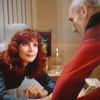
WOULD YOU?
by Pat Greiner
(Part 1 of 4)
Hmmm. It wasn�t at all like Jean-Luc to suggest a romantic interlude on the holosuite and then not show up. What could have detained him? Just then, the resonant voice interrupted her thoughts.
�Beverly. Please come to the cockpit immediately.�
His formal tone told her this was probably not the time to appear in her negligee � or less. Quickly she dressed and strode to the front of the Mistral. Inside the cockpit, she found Jean-Luc pondering a viewscreen that showed only the blur of stars at warp 9. He was listening to a voice from the computer.
�Computer, stop playback.� The voice ceased in mid-word and Jean-Luc continued, �Beverly, sit down. I want you to listen to this message. It�s from a beacon orbiting a planet just a few light years ahead of us. It seems to be a repeating message. The computer caught it in the automatic sensor sweeps and isolated it as purposeful communication. Computer, replay beacon signal from the beginning.�
�We are the people of the planet Eebron. We are in a crisis and require help. However, before you make any contact with our planet, we must advise you that our people possess a certain ability of a telepathic or psychic nature which many other civilizations find disturbing or even dangerous. We have no wish to disrupt others� lives. At this stage we will say only that our ability allows us to foresee one aspect of the future with great accuracy. Our need is for assistance in averting an impending crisis, and yet we are unable to specify exactly what skills or knowledge may be useful. We realize this sounds cryptic, but that is not our intention. If you cannot help us, go in peace. If you are willing to know more, simply say, �Activate Level 2.��
�Is that the whole thing?� she asked. �You haven�t acti �� she stopped short. �You haven�t said the magic phrase?�
�There�s no telling what this may lead to, Beverly. It could be some sort of trap. It�s most unusual, I must say. With just the two of us, I certainly wouldn�t proceed without your knowing about the situation.� He paused. �What do you think?�
�I�m curious about this ability of theirs. Their request is pretty vague, but if there�s a chance we might be able to help, and they really are in a crisis, I think we have a duty to offer aid. Can you tell how long the beacon has been repeating?�
The computer supplied the information that the beacon had been in place for 320 terrestrial days.
�I don�t think listening to the next message could hurt,� she said.
�Activate level two.�
�The people of Eebron possess an ability which we did not know was unusual until we gained space travel capability. We consider it one of our senses, just as most races have a visual sense. We call it oonsar, but one of the first races we met called it a sense of death. Quite simply, we are able to sense the length of the lifespan in living beings. Those of us with the well developed oonsar can foresee the very hour of death, and can even sense what its general nature will be � expected or unexpected, peaceful or violent.� Jean-Luc caught Beverly�s eye. One lifted eyebrow and a slight frown conveyed his skepticism clearly.
�Most others we have met react to this news with doubt. They have told us they neither know nor have heard of any other race possessing this ability. Many choose not to believe us. Some have tested our ability, and found it is as real as sight or hearing. We have learned that while knowing the length of our lifespans is entirely natural to us, it is extremely unsettling for most beings. Therefore we have adopted a practice of never revealing information about others� lifespans to them unless they specifically ask us to do so. If you choose to come to our planet, no one will shake your hand and exclaim, �This man only has three days to live!� First of all, the process is not instantaneous. It requires sustained contact between the parties. And second, revelations about lifespan are made only in private consultations at your request. If you do not ask us about oonsar, you will never know our planet is any different from other worlds. We will once again pause our communication. The third part of this message concerns the crisis we are facing. To begin, say �Activate Level 3.��
Jean-Luc turned to Beverly. �I�ve never heard such rubbish. Clearly this message is intended to lure in the curious, for whatever reason.�
�It certainly seems impossible. For them to possess this ability, some trace of each person�s future would have to be imprinted in their present ��
�It flies in the face of any sense of free will. For these people to have this ability, a man who dies in a freak shuttle accident when he�s 74 years old would have to have that destiny imposed on him from the moment of his birth. I absolutely reject the notion that the universe is so rigidly predetermined.�
�And yet, there�s something very honest about the tone of their message,� Beverly mused. �I wish we had Deanna�s empathic skills right now � I�m working on woman�s intuition, and perhaps a little too much curiosity. But I say we at least listen to the next part of the message.� She smiled. �This is almost as good as a serial holo-novel.�
Jean-Luc turned toward the comm panel again. �Activate level three.�
�It is our oonsar that has made us aware of the crisis we face. Those who study oonsar began to notice a pattern a few years ago. The average lifespan on Eebron is about twenty solar revolutions, but lives as long as twenty-five revolutions are not unheard of. However, no lifespan now on record extends beyond a date which is now 15 revolutions in our future. It seems that something catastrophic will strike our planet 15 years from now. Whether it may be a biological plague, an attack from without, or any other scenario, we cannot say. We do not know of any problem we now face that has the potential to escalate to a world-ending magnitude. We have foreseen our own planetary death. Oonsar does not allow us to escape death. An accident foreseen cannot be avoided. The future cannot be changed. But we hope that if someone can help us to discover the nature of the danger we will face, we may prepare ourselves to face it well. If you choose to come to Eebron, our central traffic control may be accessed on standard subspace frequencies. We welcome visitors and friends. Come in peace.�
�Beverly, I�ve seen that look before. You�re already trying to solve their mystery.�
�Just wondering. I�m intrigued, I�ll admit that. What would you think about slipping into a nice high orbit and doing some sensor scans before we announce our presence?�
�If you�ll rephrase that as �before we decide whether to announce our presence,� I�ll agree. Computer, establish 30,000 kilometer orbit around the planet.�
An hour later, they were no closer to knowing whether the Eebronians� claim to sense lifespans was true, but they had discovered a number of interesting things about the planet. Physically, it was a Class M planet, temperate in climate over most of its surface. One per cent higher oxygen content than Earth would make breathing easy. A trace of tachyon particles pervaded the atmosphere, but at a sufficiently low level that Beverly foresaw no harmful effects. The length of a planetary rotation was 30 hours, and there were 430 of those rotations in one revolution of the planet � so an Eebronian year was roughly one-third longer than an Earth year. Still, the Eebronians were a relatively short-lived species, which made it all the more impressive that their culture was scientifically perhaps only a hundred years behind the Federation. There were no signs of armed conflict anywhere on the planet. There was immediate evidence of only one life form classifiable as being of higher intelligence � the Eebronians with whom they had already made contact. They were a humanoid species whose coloring tended toward a deep reddish brown skin. All in all, Eebron seemed a very pleasant planet.
�Beverly, I see one danger here that has to do with more than the planet. It�s you. If their problem is what they say it is � a crisis that won�t happen for another 15 years -- finding it, let alone solving it, could take years. And I know your tenaciousness once you get your teeth into a problem. We already have a voyage of more than 8 years just to get back to the Federation.�
Beverly sighed. She saw the truth in what he said. �What if we set ourselves a time limit? Say, four days. I know, it�s unlikely that we�ll solve anything in that time. But four days to gather what information we can. We have 8 years to work on ideas on our way home. And when we get home, we can put the resources of the Federation to work to help them. It�s not as if they need an answer this week � or even this year.�
�Fair enough. Four days, assuming things look on the up-and-up once we�ve made contact.� He stepped up behind her, wrapping his arms around her ribs and nuzzling her hair. �You know, your damned curiosity is one of the things I love about you.�
�Well, if the Eebronians really can sense how long things live, I think things are about to get curiouser and curiouser.�
*************************
The Mistral settled gently onto the pad 12B of the Macel Spaceport. Just south of the complex, the capital city of Macel sparkled in the sunlight. As they had arranged upon making contact with the Eebronian government, they were escorted to an impromptu meeting with several officials who could provide them with more background on the problem. Follim Kakanvi, the Director from their Ministry of Health, served as Jean-Luc and Beverly�s guide, driver, and source of an initial briefing about Eebronian life. She began by asking them what questions they had about Eebron.
�Does your planet have many visitors from other worlds?� asked Beverly as the hovercar skimmed past the spaceport�s edge and headed toward the city.
�Visitors are fairly rare, although they are most welcome. First, as you no doubt observed, we are a relatively isolated world. Our own space travel program reached out for many years before making contact with any other civilizations. And it seems our oonsar makes many uncomfortable. Most of the visitors we have received from other worlds have come on official business, either governmental or commerce. They seem to stay the minimum time needed to carry out their duties and leave quickly. Consequently, most Eebronians have never met a person of another race, or even seen one in person. You are likely to attract considerable attention wherever you go among our people. I think you�ll find them curious about you, and eager to cooperate when they learn you�re here to help us.�
�Well, I don�t want to raise their hopes too much,� Beverly said. �What we need to do is gather as much data as we can during the next few days. We won�t have time to dig into it in depth until we�re underway again.�
�Do people from your world often journey to other planets?� Jean-Luc wondered.
�More so than come here. But still, relatively few. There are the spacers who operate trading shuttles, but even they don�t tend to stay away long. Some say it�s just superstition, some say it�s hypochondria, but when Eebronians leave here for any extended time, they begin to report a general malaise after a few weeks� absence. It hits some harder, and others barely notice it. Even at its worst, it�s not incapacitating. And our physicians who have studied the situation have never found a single physical, measurable sign of anything. Still � as a culture, we don�t tend to think of off-world travel as a pleasure.� Follim paused for a moment. �We do sound rather isolated, if not provincial, don�t we?�
�You do seem to be in an out-of-the-way part of the galaxy,� Jean-Luc smiled his best diplomatic smile. �But if all Eebronians are as welcoming as you, you will certainly win friends as more peoples come to know you.�
�May I � I hope I�m not being impolite by doing this � may I ask you about the oonsar sense?� Beverly said, then hastily interrupted herself. �Not that I want to know my lifespan! I mean just in general.�
�Of course. Let me preface this by explaining that oonsar is a private thing among us, but not taboo. You will hear it mentioned in any setting. But to delve deeply into one�s perceptions of oonsar, that is usually reserved for family, close friends, mates, and professional consultations. I imagine your first question is whether it is real.�
�It is so foreign to our experience. We really have nothing comparable in the realm of human senses,� replied Beverly. �It does seem hard to believe.�
�We have been keeping records for many generations,� explained Follim. �In all that time, there has never been a documented case in which an oonsar sensing turned out to be wrong. Some are more exact than others � just as people vary in visual acuity, so they vary in oonsar. Some sense the length of a lifespan to within a year. Some sense it to within an hour.�
�And it�s never wrong?� marveled Beverly.
�Not that we know of. No documented case has been wrong, but although almost everyone experiences oonsar, relatively few people formally document their sensings. When it happens, it�s usually done as some sort of university study or other. But perhaps only one per cent of the population has been recorded. Still, over generations, that�s a large number � and no errors have been found.�
�What about in cases of sudden, accidental death?� asked Jean-Luc. �Surely someone in one of these studies must have met with something that would be truly unforeseeable.�
�That�s one of the first lines of thought that such studies pursued. In every case, the sensing of lifespan was accurate. Do people somehow bring about or predispose their own death by knowing when their life would end? We have wondered. Most people choose to know their lifespan, a few do not. It makes no difference. Whether you
know the day appointed for you or not, it comes just as surely.�
�Wait! Are you saying that you cannot sense your own lifespan?� Beverly interrupted.
�No, only that of other beings with whom we come in physical contact. A glancing contact is not enough. We cannot sense oonsar with a handshake. Sustained contact for several minutes is required, so an oonsar sensing of another can�t really be done by accident.�
�Are you born with this sense? I can�t imagine a little child sensing how long his parents would live.� Beverly found herself wondering involuntarily what it would have been like for Wesley to know his father would die while he was still a toddler. What would it have been like for her? Would she have married Jack if she�d known that he would leave her a widow after only a few short years?
�Beverly?� Jean-Luc brought her back to the present with a hand on her shoulder.
�Sorry,� she blinked. �I guess I was lost in trying to imagine how I�d feel about knowing something like my lifespan. Or someone else�s. It�s a very � disturbing idea.�
�Follim was just explaining that the oonsar sense doesn�t develop in children until they are about 1 year old.�
�One? That seems so young to be � but wait, that may not be so young in this culture. Follim? How long does childhood last here?�
�Humans must be another long-lived species. We�ve learned that most of the peoples we have come into contact with have longer lifespans than ours. But it is what we expect � what we are. But your question. We reach physical maturity in about two years. Full mental maturity is reached typically between ages 3 and 4.�
�Oh, this is fascinating!� Beverly was leaning forward with complete intensity. �It�s a whole new way of looking at time. Not physical time, but biological time. I could learn so much from studying this culture. So, Follim,� she continued, �does that mean that oonsar comes into play about the time your people reach their adolescent stage of life?�
�Yes, and then the sense comes on gradually. Young ones cannot sense very far at first. Most families with young children keep small pet animals with lifespans of only a year or two. For most children, their first experience with oonsar comes in sensing the lifespan of one of these pets. As they grow older, the sense grows stronger in them. By the time they are 3 or so, most can sense a full lifespan of even 25 or more years � as I said, some with greater precision than others.�
Follim brought the hovercraft to a smooth landing atop an official-looking building with a large plaza spread out in front of it. They took a turbolift down to a lower floor and proceeded down a hall to a large meeting room. Their pale skin drew politely disguised stares from the dark complected Eebronians, but no one reacted unfavorably. In the meeting room, a group of two dozen or so men and women engaged in several small discussions immediately turned their attention to the visitors.
�Welcome! I am Parrakan Fornees, we spoke on the voice relay,� said an older man, extending both hands toward Picard and clasping him briefly on the shoulders in what Follim had already shown them was the Eebronian equivalent of a handshake. He went on to introduce the others in the room as leading psychological, neurological, and biological scientists from the capital city�s university, as well as astronomers from their exploratory fleet. The group settled around a large oval table and at Fornees� request, Picard gave them a quick overview of the Federation, how the Mistral came to be in Eebronian space, and what some of their resources were. �We cannot guarantee that we can be helpful in any way,� he concluded. �But we are certainly willing to try. And if the problem is a medical one, you are fortunate in having one of the finest physicians in Starfleet, in fact a former head of the Starfleet Medical division, here in the person of Doctor Crusher. She will be pursuing possible biological causes of your problem while I gather data on causes that may be physical or social. Of course, gathering data on an unknown event that could be up to 15 years in the future, in a culture we�re not familiar with, is �� he paused and uncharacteristically let a bit on uncertainty show on his face, � � a bit of a challenge.�
�Rest assured we shall provide you with every assistance we can offer. We have assigned a personal assistant to each of you to serve as guides and resources. Follim will continue with you as Dr. Crusher�s assistant, since she is one of our leading medical officials. Ambassador Picard, we have asked Mokkan Hulsa to work with you.� The young man, who was seated toward the far end of the table, smiled and nodded. Earlier, Fornees had introduced him as one of the rising stars, so to speak, of the university�s astronomy department. �You cannot imagine how much your help means to us. This problem � we have come to refer to it simply as �the limit� � has placed an enormous strain on our society.�
�Once again, let me emphasize that we shall simply be gathering as much data as we can during this short time,� Picard reminded them. �We will not begin to have time to sift through it all.�
�How compact a record could you make of Eebron�s central library?� asked Beverly. �The more information we can take with us, the better, but obviously our storage capacity is limited.� Two people stood up from the table. �Oravi and I will begin working on that right away,� said one as they headed out the door.
�What else can we do to help you begin?� Fornees asked as the meeting dissolved again into informal groups.
�I think the logical place for me to start is by talking with the scientists who study oonsar � if possible, the ones who first detected the limit,� said Beverly. �And I hope it may be possible for me to meet with some of their subjects � both those whose lifespans end at the limit and some who end earlier. I�d like to record bioscans of each group for purposes of comparison.�
�I can take you directly to the research group at the university,� said Follim. �Mokkan!� she called across the room. �Get my code from Arvun at the main office, so we can keep the ambassador and the doctor in touch with each other. And have Arvun start making lodging arrangements for them.�
�We can certainly stay aboard the Mistral,� Jean-Luc interjected.
�Your ship will be well cared for at the spaceport,� Mokkan assured his guest. �And its privacy respected as well. I can take you there to check on her whenever you want. But please, let us thank you with our hospitality during your stay.�
�Oh, yes, Jean-Luc, I wouldn�t miss experiencing it for the world,� Beverly added. �Thank you for making us so welcome,� she said to their hosts.
Mokkan glanced at Jean-Luc and asked quietly, �Do you require individual or shared quarters?�
�Shared quarters will be fine, thank you. Good hunting, Beverly,� he wished her, then turned back to Mokkan as the doctor and Follim set out on their first errand.
***********************
By the end of the afternoon, Beverly was beginning to wonder whether it was possible to overload a tricorder. The Eebronians were both curious about their off-world visitors and eager to help solve the mystery of the limit � and so she had no shortage of willing volunteers who allowed her to scan and record their DNA. She had to vigorously refuse more than one who insisted that blood samples would be useful, explaining patiently that her tricorder could identify everything present in a drop of blood, and more, without the slightest invasion of the body. At the same time, she kept meticulous records, matching each scan with brief notes about the person � length of predicted lifespan, strength of their own oonsar sense, when their lifespan had first been read, and medical history, particularly exposure to any infectious diseases. She had no idea whether a plague of some sort was what might give rise to the limit � but at this point, it was as good a shot in the dark as anything else.
In the course of testing and recording, Beverly noticed several couples whose lifespans were predicted to end at about the same time. Some were older couples who had only a short time left. Others were young couple whose lifespans both seemed to end at the limit. As Follim guided her from the offices in the psychology building, where she had been working with those who had been part of a study on the strength of oonsar, to the sociology department, where a study was underway concerning the effects of knowledge of the limit, Beverly asked if lifespan was a factor in choosing a mate.
�Very much so,� confirmed Follim. �Although, like many other factors, different people make different use of the knowledge. Some feel very strongly that they want a mate whose lifespan will be similar to their own. It is a guarantee against loneliness at the end of life. On the other hand, someone with a relatively brief lifespan may look for someone with a longer one � for instance, to insure that children will have someone to look after them.�
�Are there segments of the population that simply choose not to use oonsar, who don�t believe in its use?�
�There are some who choose not to know their own lifespan, but oonsar cannot simply be ignored. I�ve told you that it requires sustained physical contact to initiate. In fact, if contact is sustained, oonsar will happen. A couple could not make love without sensing oonsar about each other. And it is part of the birth process. As a child passes through the birth canal, part of the mother�s experience is a sensing of that child�s lifespan � I�m told it�s a very powerful one, although I haven�t experienced it myself.�
�So when an Eebronian mother first holds her child in her arms, it is with the knowledge of whether she�ll have him for 2 minutes or the rest of her life?� Beverly mused.
�Those who will not be with us for long are loved powerfully for every bit of their short lives,� Follim assured her. �Those who are blessed with long lifespans are expected to return the blessing. They are charged with accumulating wisdom and serving as stewards for our people, helping to keep us on the good path. They know their destiny early and seem to have a certain dignity even in the youth of their spans. On the other hand, those who know they will mature, but not live a long time, often live rather eccentric lives � obsessed with exploring, creating, and changing as much as they can. Many of our greatest artists have come from this group. Up these stairs, Dr. Crusher, and we will be at the offices of professor Zaffrin Aalo. And it looks like there is a good number of willing subjects waiting for us as well. I can only hope your tricorder still has a good deal of room on it.�
Beverly was once again inundated with helpful Eebronians � so many that she still had a roomful of volunteers to record when her stomach began to remind her that lunch had been quite some time ago, particularly in the longer Eebronian day. When she finally finished entering the last of the day�s data two hours later, darkness had fallen. �Would you like me to call Ambassador Picard for you?� asked Follim, who had been on her roving caller off and on through the afternoon as she arranged tomorrow�s activities.
�No need,� replied Beverly, tapping her comm badge. �This relays through our ship and provides a direct link between us. Jean-Luc?�
�Here, Beverly, at our lodgings.�
�Already?�
�Mokkan has a very able assistant named Arvun who has arranged everything for us � and I think you�ll be very pleased.�
�Wonderful � especially if the arrangements include dinner. I�m famished. Where do we find you?�
�Arvun said to tell Follim the Krenjalon Hills, number 15.�
Beverly glanced at Follim, whose nod clearly said �Ooooh, nice place!� �How long to get there?� she asked Follim.
�Half an hour.�
�We�ll be there in 45 minutes. Crusher out.�
On their way to the hovercraft, Follim couldn�t resist snorting a half laugh. �That Mokkan � typical university type. Arvun is my assistant. She�s only helping him out because I asked her to.� On the way across the city in the hovercar, Beverly wondered what the best way might be to get to understand a little more about the Eebronian culture. �We�re going to be spending so much of our time here collecting data, but I don�t want to leave with nothing but figures. There�s so much more to know about any people.�
�Let me give it some thought,� Follim replied. �When we get to Krenjalon, I�ll make a few calls.� Beverly had learned already that when Follim made calls, things got done, usually in a hurry. There�s definitely something to be said for this being-treated-as-a-visiting-dignitary thing, she thought to herself. Did Jean-Luc have this aspect in mind when he opted for an ambassadorship?
The lodgings turned out to be a guest house in what looked like a very exclusive suburb of the city. Comfortable to the point of luxury, with a large unobstructed view of the night sky, highlighted by 3 moons in various shades of pink and orange. There was a fire in the fireplace, and when Follim and Beverly walked in, Mokkan pulled the cork on a local wine with a surprising violet color and a just slightly sweet flavor. As the five sipped their glasses of wine, Follim filled Arvun in on her idea for a social event the following evening. �Not a huge, formal event � just 30 or 40 of the most interesting in a variety of fields. Buffet dinner, some nice vintages on hand, sparkling conversation � you know the sort of thing to arrange.�
�No difficulty. People are so anxious to meet the visitors � even with less than a day�s notice, it�s going to be the event to be asked to. At the Makana Center, do you suppose?�
�No, something more personal. Can you sweet talk Flotral into having it at his place? And letting us use his staff?�
�You mean, can I ask him to throw us a really nice party on 24 hours� notice?�
�That�s pretty much it.�
�Can�t hurt to ask.� Arvun took her caller and excused herself from the room. She was back in ten minutes. �He gets to invite 25 people in addition to our guest list, but he�ll do it. And you know Flotral � he�ll do it right.�
Shortly thereafter, the glasses were drained, arrangements to meet the following morning were made, and the house concierge came in to inquire whether the ambassador and the doctor would like their meal served in the dining room or in front of the fire.
�By the fire would be lovely,� Beverly answered. The two of them said goodnight to their new friends, and savored a dinner which the chefs had wisely made with a sampling of many dishes, so they could experience a bit more of Eebron.
Over dinner, Beverly described her work to Jean-Luc, and he told her what had occupied most of his afternoon. Mokkan had introduced him to several members of a governmental committee charged with investigating the limit. They had outlined for him the various theories they had as to the nature of the cataclysmic event that awaited them. They ranged from external ones such as a meteor smashing into the planet or unprovoked attack by unknown aliens to internal ones such as war, disease, even mass suicide. The next day he would be meeting with yet more members of the committee and collecting their extrapolations as part of his data. Based on what he learned there, he would have to choose the most likely scenarios to pursue in more detail.
After the meal, Beverly would have fallen directly into bed � but she wasn�t sure exactly where the bed was.
�No, that�s it,� said Jean-Luc, taking her hand and leading her across the room to what looked like a standing pool of rose-colored mist. �This is a fascinating piece of technology. The staff showed me earlier �I think it�s something they�re quite proud of. There really is a bed under there. The mist is in effect the bedding. You set the temperature you want here on this dial on the wall. Now, let me help you off with all this clothing �� Beverly steadied herself with one hand on his shoulder as his well-practiced hands slipped off her tunic, turtleneck, and trousers, then pulled the silky camisole over her head and gently pushed her down to sit on edge of the mist.
Or rather, in the mist. She found herself sitting on a soft yet firm base that seemed to be just a few inches below the mist. Instantly, the rosy cloud flowed up her naked body to wrap it in a pleasant warmth. She expected it to feel damp, like a fog, but it was perfectly dry, and felt if anything slightly fuzzy against her skin. �I don�t know how it does it, but they say it won�t cover your face � just flows over the rest of you,� Jean-Luc explained as he removed his jacket, shirt, and pants. He switched off the lamp in the room, and lowered himself to stretch out beside Beverly, lying on his back and pulling her close to him, with her head pillowed on his shoulder. The mist enveloped them in softness, yet was utterly weightless. Overhead, a large skylight gave a spectacular view of the triple moons rising through the heavens.
�It�s beautiful, Jean-Luc. And this bed is amazing. If I weren�t so tired �� she sighed as she turned her face into his neck and nuzzled the warm skin there.
�You�ve had a long day, Beverly. I�m sure the Eebronians think I�m the layabout on this ship, after the start you�ve made already. Just lie back and relax. Let me do all the work. And if you drift off to sleep, well, sweet dreams.� As she luxuriated in the strong yet gentle touch of Jean-Luc�s broad hands, Beverly found that she was not quite so exhausted as she had thought.
(This story continues in 3 more parts.)